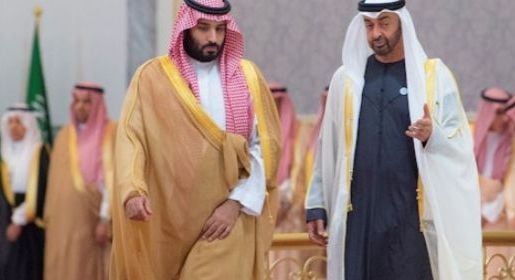
ISLAMABAD: Saudi Arabia’s Crown Prince Mohammed bin Salman has sent a lengthy letter to UAE National Security Advisor Tahnoon bin Zayed, outlining detailed complaints about Abu Dhabi’s activities in Sudan and Yemen, according to multiple US and Western officials.
The correspondence, dispatched several weeks ago and shared with American authorities, highlights growing tensions between the two Gulf allies despite their historical cooperation.
In the letter, the Saudi leader expressed that Riyadh could no longer tolerate Sudan’s protracted civil war, particularly while accusing the UAE of supporting the paramilitary Rapid Support Forces (RSF).
Sudan’s conflict, now in its third year since erupting in April 2023 between the Sudanese Armed Forces and the RSF, has displaced millions and caused widespread humanitarian crises.
International reports and UN experts have repeatedly alleged Emirati backing for the RSF through arms supplies, logistics, and other means, though Abu Dhabi has consistently denied these claims.
Saudi Arabia, in contrast, has positioned itself as a supporter of the Sudanese Armed Forces and a key mediator, hosting talks in Jeddah alongside the United States.
The letter’s tone underscores Riyadh’s strategic concerns over regional stability, especially given Sudan’s proximity across the Red Sea and its implications for maritime security routes.
Crown Prince Mohammed bin Salman also defended Saudi military involvement in Yemen as essential for the kingdom’s national security.
He reaffirmed that Riyadh views Yemen as its legitimate sphere of influence and plans to assume greater responsibility for the war-torn nation’s stability along its southern border.
This stance follows recent Saudi actions in Yemen, including airstrikes in December against UAE-backed secessionist allies in the south, notably the Southern Transitional Council (STC).
Saudi forces have since pursued efforts to reduce Emirati presence and influence in the country entirely.
The letter proposed mediation through the crown prince’s brother, Saudi Defence Minister Khalid bin Salman, suggesting a pathway for dialogue amid the escalating rift.
Tahnoon bin Zayed, often referred to in regional circles as the “spy sheikh” due to his intelligence role, received the detailed grievances directly.
The document listed specific complaints, including UAE military aid to the STC without Saudi coordination, which Riyadh described as crossing a red line.
Broader context reveals deepening Saudi-Emirati rivalry across the Red Sea region, fueled by divergent interests in proxy conflicts and economic ambitions.
In Yemen, initial joint intervention against the Houthis in 2015 gave way to divergences, with the UAE focusing on southern ports and proxies while Saudi Arabia prioritized border security and Houthi containment.
The 2022 truce in Yemen has largely held, but recent STC advances and Saudi counter-moves have reignited friction.
Analysts note that Saudi Arabia perceives Emirati actions in both Sudan and Yemen as destabilizing, potentially prolonging chaos and threatening Gulf security.
The letter’s sharing with US officials indicates Riyadh’s intent to internationalize the concerns, especially amid ongoing American diplomacy in the region.
Despite the complaints, the offer of mediation through Khalid bin Salman signals a preference for resolution over open confrontation.
Observers point to the Red Sea’s strategic importance, where instability in Sudan and Yemen could disrupt global shipping lanes and energy flows.
Saudi efforts have included diplomatic outreach, such as engagements with Egypt to curb alleged RSF supply routes.
The UAE’s reported use of regional airspace and corridors for support has drawn particular Saudi ire.
Humanitarian fallout from these rivalries remains severe, with Sudan’s war causing famine risks and mass displacement, while Yemen grapples with reconstruction delays.
The correspondence reflects a shift in Gulf dynamics, where former close partners now compete assertively for influence.
Regional experts suggest that unresolved tensions could embolden other actors, including Iran, in exploiting divisions.
The letter arrives at a time when Saudi Arabia seeks to consolidate its leadership in Gulf affairs under Vision 2030 priorities.
For the UAE, the complaints challenge its independent foreign policy approach.
No official responses from Riyadh or Abu Dhabi have been issued publicly regarding the letter’s contents.
The development underscores the complex interplay of security, influence, and proxy support shaping the Middle East’s future.