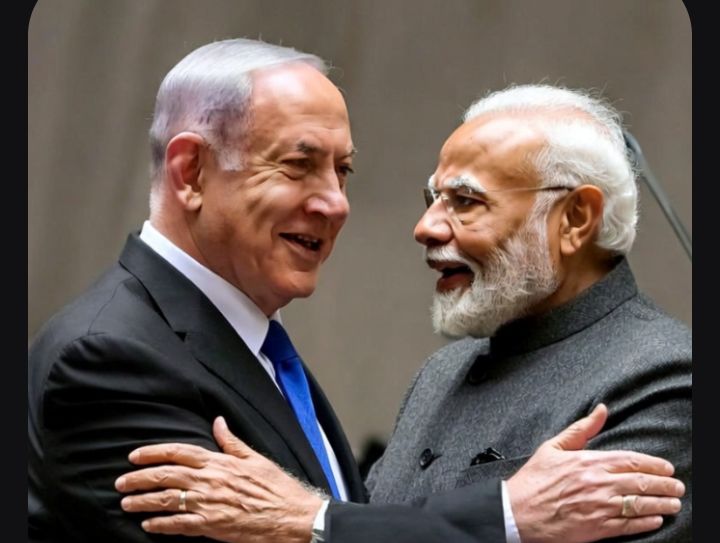
Israeli Prime Minister Benjamin Netanyahu has unveiled a strategic vision for a new Mediterranean-Middle East alliance to counter radical Shiite and Sunni axes, proposing a broad network linking India, Arab states, Greece, Cyprus, African partners, and additional Asian countries.
Netanyahu: The vision is to build a strategic alliance across the Mediterranean and the Middle East, linking India, Arab states, African partners, Greece, Cyprus and additional Asian countries.
The goal is a unified bloc that sees the region clearly and stands in direct opposition to both the radical Shiite axis and the radical Sunni axis. Earlier Israel has raised concerns over rising Pakistan Turkey and Saudi Arabia alliance. The proposed hexagon alliance of Israel and India would be against this new alliance.
ISLAMABAD: Israeli Prime Minister Benjamin Netanyahu has outlined an ambitious diplomatic vision to forge a strategic alliance spanning the Mediterranean and Middle East regions, aimed at countering what he describes as radical Shiite and emerging Sunni axes.
Speaking at the start of a recent government meeting, Netanyahu emphasized the need for a unified bloc of nations sharing a clear view of regional realities, challenges, and objectives.
He described the proposed framework as a “hexagon of alliances” encompassing India, moderate Arab states, African partners, Mediterranean countries such as Greece and Cyprus, and select Asian nations.
This initiative comes amid shifting geopolitical dynamics following significant weakening of Iran’s Shiite-led axis through Israeli military actions since October 2023.
Netanyahu highlighted deepened bilateral ties with India as a cornerstone, noting upcoming high-level engagements including a visit by Indian Prime Minister Narendra Modi.
He stressed that economic, diplomatic, and security cooperation would form the backbone of these partnerships.
The vision seeks to build on existing trilateral frameworks, particularly between Israel, Greece, and Cyprus, which have advanced maritime security, energy interconnectors, and defense coordination in the Eastern Mediterranean.
These efforts include progress on the India-Middle East-Europe Economic Corridor (IMEC), linking Asia to Europe via regional infrastructure.
Netanyahu positioned the alliance as a direct response to persistent threats from radical forces.
He noted the severe blows inflicted on the radical Shiite axis, led by Iran and its proxies such as Hezbollah and others.
Simultaneously, he warned of an emerging radical Sunni axis, influenced by Muslim Brotherhood ideologies and involving actors seeking regional dominance.
Israeli analysts have increasingly pointed to a potential reconfiguration where Sunni powers, previously aligned against Iran, may form new coalitions.
Concerns in Jerusalem focus on rapprochement among Turkey, Saudi Arabia, Egypt, Qatar, and Pakistan.
Such alignments could alter the balance of power, with Pakistan’s nuclear capabilities adding a layer of complexity.
Former Israeli officials have described Turkey’s ambitions under President Recep Tayyip Erdogan as potentially encircling Israel through Sunni networks.
Reports indicate quiet coordination among these states on issues ranging from Red Sea security to broader diplomatic initiatives.
Netanyahu’s proposal aims to consolidate moderate forces against both extremes.
By integrating India—a rising global power with strong defense and technology ties to Israel—the alliance gains strategic depth extending beyond the Middle East.
India’s involvement aligns with shared interests in countering terrorism and ensuring maritime stability.
Arab states that have normalized relations with Israel through the Abraham Accords provide a foundation for broader inclusion.
Greece and Cyprus contribute Mediterranean leverage, countering Turkish influence in disputed waters and energy resources.
African partners could enhance economic corridors and security cooperation against common threats.
Netanyahu underscored that the bloc would promote stability, prosperity, and shared values rather than confrontation.
He framed it as an axis of nations seeing “eye-to-eye” on regional goals.
This approach reflects Israel’s post-October 2023 strategy of translating military gains into diplomatic anchors.
Strengthened Eastern Mediterranean alliances serve as a bulwark against instability.
Parliamentary discussions in Israel, Greece, Cyprus, and the United States have urged deeper cooperation in infrastructure, natural resources, and security.
Such initiatives aim to curb expansionist ambitions in the region.
The vision also addresses concerns over a potential Sunni bloc replacing the diminished Shiite threat.
Israeli security assessments highlight risks if nuclear-capable Pakistan aligns closely with Turkey and Saudi Arabia.
This could compel doctrinal reassessments in Jerusalem.
Netanyahu’s announcement coincides with efforts to advance IMEC and related projects like the Great Sea Interconnector for energy cooperation.
These practical steps could embed Israel in long-term regional networks connecting to Europe and Asia.
While details remain to be organized and presented formally, the proposal signals Israel’s intent to shape a new Middle East order.
It prioritizes alliances based on mutual interests in stability over ideological divisions.
Regional observers note that success depends on navigating complex relations among potential partners.
Moderate Arab states balance ties with Israel against broader Sunni dynamics.
India’s strategic autonomy influences its engagement.
Greece and Cyprus focus on immediate Mediterranean priorities.
The plan underscores a multipolar approach amid ongoing conflicts and realignments.
Netanyahu’s vision seeks to position Israel at the center of a resilient network.
This could redefine alliances in a region long defined by rival axes.