*WASHINGTON – The United States expanded its sanctions war against Russiato China on Thursday, announcing punitive measures against a Chinesemilitary organization for buying Russian fighter jets and missiles.*
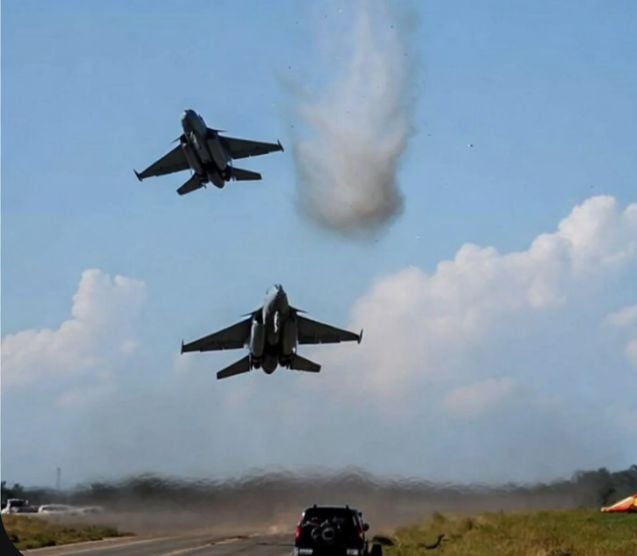
Stepping up pressure on Moscow over its “malign activities,” the US StateDepartment said it was placing financial sanctions on the EquipmentDevelopment Department of the Chinese Ministry of Defense, and its topadministrator, for its recent purchase of Russian Sukhoi Su-35 fighter jetsand S-400 surface-to-air missiles.
Officials said it was the first time a third country has been punishedunder the CAATSA sanctions legislation for dealing with Russia, andsignaled the Trump administration´s will to risk relations with othercountries in its campaign against Moscow.
They also said that the US could consider similar action against othercountries taking delivery of Russian fighter jets and missiles. US allyTurkey is currently talking with Moscow about an S400 deal.
“The ultimate target of these sanctions is Russia,” a senior administrationofficial told journalists, insisting on anonymity.
“CAATSA sanctions in this context are not intended to undermine the defensecapabilities of any particular country. They are aimed at imposing costs onRussia in response to its malign activities.”
CAATSA, or the Countering America´s Adversaries Through Sanctions Act, waspassed in 2017 as a tool that gives the Trump administration more ways totarget Russia, Iran and North Korea with economic and political sanctions.
With regard to Russia, CAATSA arises from the country´s “aggression inUkraine, annexation of Crimea, cyber intrusions and attacks, interferencein the 2016 elections, and other malign activities,” the State Departmentsaid.
The legislation allows the government to take action against thosecompanies and individuals who have been placed on the CAATSA blacklist.
EDD and its director Li Shangfu became targets after taking delivery overthe past year of the jets and missiles from Rosoboronexport, Russia´s mainarms export entity already on the CAATSA blacklist for its support of theAssad regime in Syria.
– Targeting Russian ´big ticket´ arms deals –
At the same time, the State Department also announced it was placing 33Russian intelligence and military-linked actors on its sanctions blacklistunder the CAATSA rules.
Read Top Stories
All of them — defense related firms, officers of the GRU militaryintelligence agency, and people associated with the St. Petersburg-basedInternet Research Agency disinformation group — have been on previous USsanctions lists and 28 of them have already been indicted by Russiaelection meddling investigator Robert Mueller.
“We will continue to vigorously implement CAATSA and urge all countries tocurtail relationships with Russia´s defense and intelligence sectors, bothof which are linked to malign activities worldwide,” the State Departmentsaid.
The sanctions freeze any of EDD´s and Li´s assets in US jurisdictions.
They also restrict EDD´s access to global financial markets by blockingforeign exchange transactions under US jurisdiction or any transactions inthe US financial system.
The senior official stressed that CAATSA is not going to be implementedacross the board, but that the US was choosing Russia´s sale of “biggerticket items” of “new, fancy, qualitatively significant stuff” that couldhave a “security impact” on the United States.
“The CAATSA was not intended to take down the economy of third partycountries. It´s intended to impose appropriate pressures on Russia inresponse to Russian malign acts,” the official said.
The official declined to answer if the US would take similar action ifRussia delivers S400 missiles to other countries such as Turkey, which isin talks to buy them.
However, he said, “You can be confident that we have spent an enormousamount of time talking about prospective purchases of things such as S-400sand Sukhois with people all around the world who may have been interestedin such things and some who may still be.”
“We have made it very clear to them that these — that systems like theS-400 are a system of key concern with potential CAATSA implications.” -APP/AFP