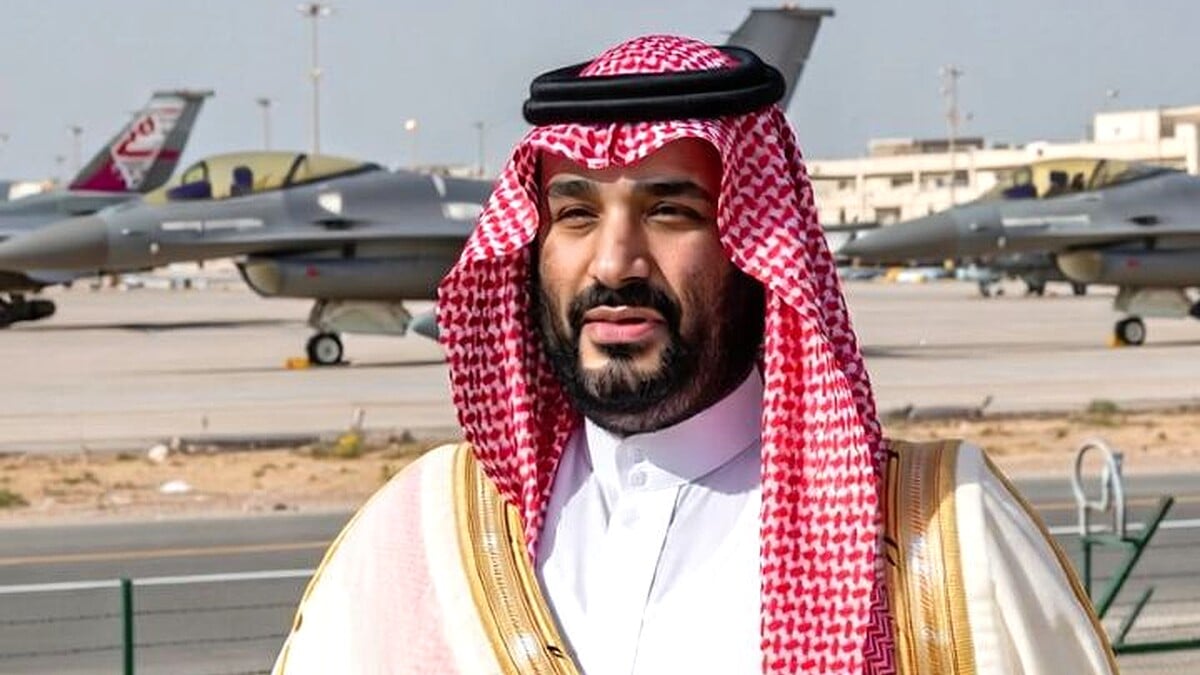
ISLAMABAD: Saudi Arabia has agreed to open the King Fahd Air Base in Taif to American forces for operations against Iran, multiple US and Western officials familiar with the matter have confirmed to Middle East Eye.
The decision comes as the US-Israeli war on Iran enters its fourth week, marking a clear shift in Riyadh’s stance from initial caution to active logistical support.
The agreement followed a telephone call earlier this month between Elbridge Colby, a senior US Department of War official, and Saudi Defence Minister Khalid bin Salman, brother and key adviser to Crown Prince Mohammed bin Salman.
Iranian attacks on US bases in the Gulf had intensified, prompting Washington to seek expanded access and overflight rights across the region.
King Fahd Air Base in Taif was selected for its strategic distance from Iranian Shahed drone ranges, unlike Prince Sultan Air Base near Riyadh, which has faced repeated strikes including damage to five US Air Force KC-135 refuelling aircraft.
Taif lies approximately 150 kilometres southeast of Jeddah in Mecca Province at an elevation of 1,477 metres, placing it in the Hejaz mountain foothills for better defensive positioning.
The base’s proximity to Jeddah, now a vital Red Sea logistics hub after Iran’s effective control of the Strait of Hormuz, enhances supply lines for sustained operations.
Thousands of US ground troops are already en route to the region from East Asia, underscoring the need for secure forward facilities.
Saudi Arabia’s move reflects a broader evolution in Gulf responses to the conflict that began on 28 February 2026 with US and Israeli airstrikes on Iranian targets.
Initially, Saudi Arabia, the UAE and Qatar had lobbied President Donald Trump against using their territories as launchpads for offensive action.
Yet the kingdom has since absorbed direct Iranian retaliation, including strikes on Riyadh and the port of Yanbu.
Saudi Foreign Minister Prince Faisal bin Farhan stated that Iran’s “heinous attacks” shattered trust built over years of outreach, reserving Riyadh’s right to military response.
A Western official in the Gulf told Middle East Eye that the attitude in Riyadh has shifted toward supporting the US war as a way to punish Iran for its strikes.
Trump and Crown Prince Mohammed bin Salman have maintained regular phone calls over the past three weeks to coordinate positions.
The UAE has conveyed similar readiness, with Foreign Minister Sheikh Abdullah bin Zayed informing US Secretary of State Marco Rubio that Abu Dhabi is prepared for the conflict to last up to nine months.
Since the war’s start, the UAE alone has intercepted 338 ballistic missiles and 1,740 drones, bearing the heaviest burden among Gulf states despite hosting US facilities.
Qatar suffered severe damage to its Ras Laffan refinery from Iranian missiles, cutting 17 percent of its gas production with repairs estimated at three to five years.
King Fahd Air Base itself carries deep historical ties to US-Saudi defence cooperation dating back to the 1953 establishment of the US Military Training Mission.
During the 1990-1991 Gulf War, the facility served as a forward operating base for coalition aircraft, including U-2 reconnaissance planes and EF-111A Ravens in operations against Iraq.
Today it features dual runways and supports joint exercises with US forces under programmes such as Peace Sun and Peace Shield.
Around 200 Western personnel, including American advisers, are already stationed there, providing medical and recreational infrastructure for extended deployments.
Current and former US officials note that granting access to this western base avoids over-reliance on eastern facilities vulnerable to Iranian one-way attack drones and ballistic missiles.
The development also aligns with Jeddah’s growing role as a critical supply node amid disrupted Gulf shipping routes.
Experts caution that deeper Saudi involvement in offensive operations risks opening a “can of worms” for the kingdom, potentially drawing it into direct confrontation.
Yet Riyadh appears to calculate that punishing Iran outweighs the risks, especially after repeated attacks on its own soil.
The war’s objectives, as outlined by US and Israeli statements, include dismantling Iran’s nuclear and missile programmes while neutralising proxy threats across the region.
Iran has responded with strikes on Gulf infrastructure and US assets, escalating the cycle of retaliation.
Oman has publicly distanced itself, with its Foreign Minister describing the conflict as not America’s war and urging allies to clarify limits.
In contrast, Saudi Arabia’s actions signal alignment with Washington for a potentially prolonged campaign.
This base access expands US operational reach at a time when thousands more troops and assets are flowing into the theatre.
Regional stability hangs in balance as oil exports have halted and energy prices surge globally.
Pakistan, a close partner of both Saudi Arabia and the United States, watches developments closely given its strategic ties and energy dependencies.
The agreement underscores how Gulf monarchies are recalibrating security calculations four weeks into a conflict with no immediate end in sight.