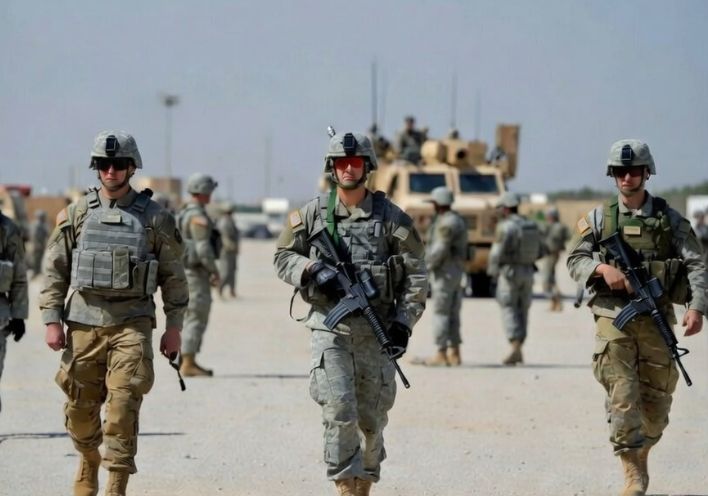
ISLAMABAD: Hundreds of United States troops have been withdrawn from the Al Udeid Air Base in Qatar and from bases in Bahrain hosting the US Navy’s Fifth Fleet, according to a report by The New York Times citing anonymous Pentagon sources.
The pullout, reported on Friday, involves hundreds of personnel and is viewed widely as a precautionary step to reduce vulnerability at major forward-deployed sites.
Al Udeid Air Base stands as the largest American military installation in the Middle East, normally accommodating around 10,000 troops and serving as a critical hub for air operations under US Central Command.
Bahrain hosts the headquarters of the Fifth Fleet, responsible for naval operations across the Persian Gulf, Red Sea, Arabian Sea and parts of the Indian Ocean.
Forces continue to operate at bases in Iraq, Syria, Kuwait, Saudi Arabia, Jordan and the United Arab Emirates, with no reported withdrawals from those locations.
The timing aligns with sharply escalated tensions between Washington and Tehran, driven by discussions of a potential US military strike on Iran.
President Donald Trump has publicly weighed options for action against Iran, including limited strikes aimed at pressuring Tehran into negotiations on its nuclear programme and ballistic missile capabilities.
Reports indicate the Pentagon is conducting one of the largest military buildups in the Middle East in two decades, involving additional aircraft carriers, fighter jets, air defence systems and support assets.
The USS Abraham Lincoln Carrier Strike Group has been positioned in the region for weeks, while another group led by the USS Gerald R. Ford is en route or nearby.
Such deployments signal readiness for sustained operations if diplomatic efforts in Geneva and elsewhere fail to produce results.
Trump has stated that prospects for a deal with Iran could become clear within days, while warning of severe consequences if Tehran does not comply with US demands.
Iran has responded defiantly, with officials declaring that any attack would make all US bases and assets in the region legitimate targets.
In a recent letter to the United Nations secretary-general, Iran’s mission warned that Washington would bear full responsibility for any uncontrolled escalation.
Tehran has fortified nuclear sites, rebuilt missile production facilities and conducted military drills, including live-fire exercises in the Strait of Hormuz.
The June 2025 exchange, when US strikes targeted Iranian nuclear facilities followed by an Iranian missile response against Al Udeid, remains fresh in regional memory, though that episode ended in a swift cease-fire.
Analysts suggest a new campaign could prove longer and more intense, potentially involving strikes on nuclear infrastructure, missile arsenals or even leadership targets.
Options under consideration reportedly include regime change scenarios, though no final decision has been announced.
The withdrawal from high-profile bases like Al Udeid and those in Bahrain aims to mitigate risks to personnel should Iran retaliate with ballistic missiles or drones.
Iran possesses one of the largest missile inventories in the region, capable of reaching most US facilities in Gulf states.
Air defence reinforcements, including Patriot systems, have been moved to protect remaining positions.
Some reports indicate troops may have been repositioned for other missions rather than fully evacuated, though the scale of the movement underscores heightened alert status.
US Central Command has not issued an immediate public response to queries about the reported withdrawals.
Certain outlets, including Fox News, have cited officials denying large-scale evacuations, suggesting the movements involve routine rotations or tactical repositioning.
The discrepancy highlights the fog surrounding sensitive military adjustments during periods of brinkmanship.
Gulf Arab states hosting US forces express private concern over the potential for blowback, fearing disruption to oil infrastructure and regional stability.
The Strait of Hormuz, through which a significant portion of global oil passes, has seen Iranian demonstrations of force in recent weeks.
Any closure or interference could spike energy prices worldwide.
The broader context includes ongoing Iranian domestic unrest, with protests prompting US statements of support and warnings against repression.
Trump has referenced intelligence indicating shifts in Tehran’s behaviour, though specifics remain classified.
As diplomatic channels remain open but strained, the troop movements reflect a dual strategy of deterrence and force protection.
The coming days may determine whether negotiations yield progress or if military options advance further.
Regional observers watch closely, aware that miscalculation could draw multiple states into a wider confrontation.
The presence of tens of thousands of US troops across the Middle East, combined with naval assets, positions Washington strongly but also exposes forces to retaliatory risks.
Iran’s repeated assertions of readiness for war add to the volatility.
Whether the withdrawals prove temporary or part of a larger redeployment will likely become clearer as events unfold.