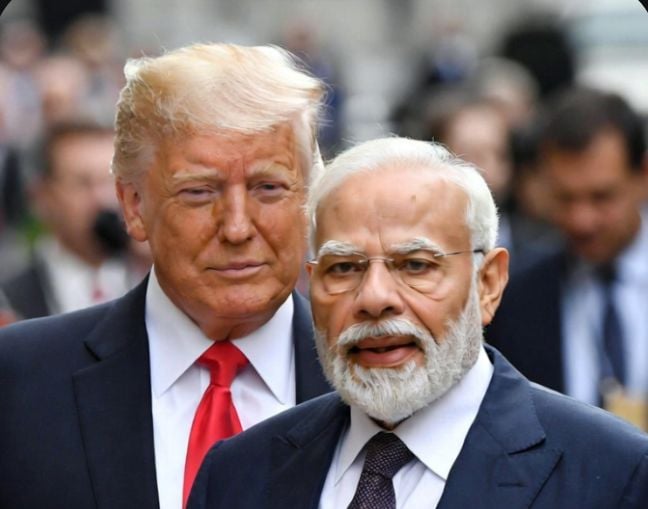
ISLAMABAD: US President Donald Trump has declared that nothing has changed in the recently announced interim trade framework with India, emphasizing that the arrangement primarily benefits the United States by ensuring Indian exports face tariffs while American goods enter India with reduced or eliminated duties.
Trump made the remarks during a White House press conference on February 20, 2026, hours after the US Supreme Court ruled 6-3 that his administration’s broad reciprocal tariffs imposed under the International Emergency Economic Powers Act were unlawful.
The court’s decision invalidated the legal basis for the sweeping tariffs Trump had used since April 2025 to address trade imbalances, including punitive measures on India over its energy purchases from Russia.
Despite the setback, Trump insisted the India deal remains intact. He stated that India will continue paying tariffs on its exports to the US, while the US pays none in return.
This framing directly challenges earlier Indian narratives portraying the agreement as mutually beneficial or advantageous for New Delhi.
The interim trade framework was announced in early February 2026 following discussions between Trump and Prime Minister Narendra Modi.
Under the terms outlined in a joint US-India statement, India committed to eliminating or significantly reducing tariffs on a range of US industrial goods, agricultural products including dried distillers grains, sorghum, tree nuts, fruits, soybean oil, wine and spirits.
In exchange, the US agreed to apply a reciprocal tariff of 18 percent on many Indian originating goods such as textiles, apparel, leather, footwear, plastics, rubber, organic chemicals and certain machinery.
The deal also provided for the removal of additional tariffs on select Indian products like generic pharmaceuticals, gems, diamonds and aircraft parts upon finalization.
This reduced the effective tariff burden on Indian exports from a peak of 50 percent — which included a 25 percent penalty linked to Russian oil imports — to levels more competitive with those faced by regional rivals like Vietnam, Bangladesh and Indonesia.
Indian officials, including Commerce Minister Piyush Goyal, highlighted the deal’s potential to grant exporters access to the vast US market valued at trillions of dollars, benefiting micro, small and medium enterprises, farmers and fishermen.
Trump, however, presented the pact as a reversal of previous imbalances. He described past trade dynamics as unfair, claiming India had been “ripping off” the United States due to smarter negotiation by Modi.
Trump praised Modi as a “great gentleman” and “much smarter” than previous US counterparts but stressed the current arrangement flips the script: “We are not paying tariffs to them, and they are paying tariffs to us. We did a little flip.”
His comments underscore a one-sided interpretation, focusing on tariff flows rather than broader market access gains for Indian sectors.
The Supreme Court ruling prompted Trump to announce a new 10 percent global tariff on imports under alternative trade authorities, aiming to maintain revenue streams and pressure trading partners.
Analysts note this could introduce uncertainty, though the India-specific framework appears shielded for now.
In India, opposition voices, including from Congress leaders, have questioned the government’s acceptance of Trump’s characterization and urged a re-examination or renegotiation to better protect domestic interests, particularly farmers facing potential import competition.
Trade experts point out that while the tariff reduction from punitive levels offers relief, the asymmetric concessions — with India opening markets more widely — may favor US exporters in key sectors.
The deal forms part of ongoing bilateral trade agreement negotiations launched in 2025, aiming for deeper commitments on supply chains and market access.
Trump’s blunt assessment has sparked debate in diplomatic circles, potentially complicating public perceptions in India where the agreement was initially welcomed as a diplomatic success amid tariff pressures.
Observers suggest the episode highlights the challenges of negotiating with an administration prioritizing visible wins for domestic audiences.
As both sides move toward formalizing the interim pact, the focus remains on whether the framework delivers balanced outcomes or tilts decisively toward US advantages as Trump claims.
The development underscores persistent asymmetries in global trade leverage, even between strategic partners like the United States and India.