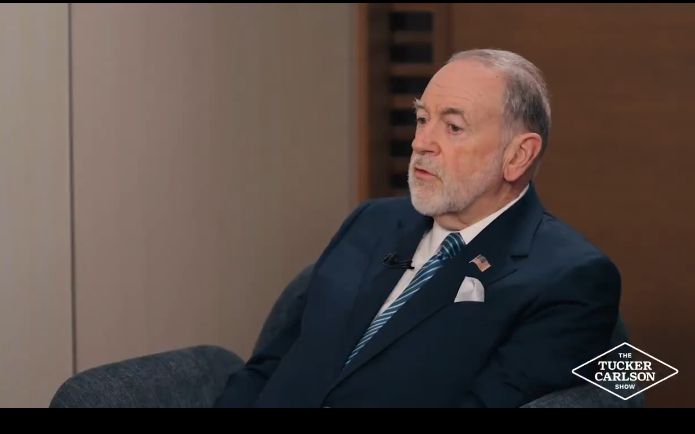
ISLAMABAD: In a provocative statement that has triggered widespread international concern, US Ambassador to Israel Mike Huckabee declared it would be acceptable for Israel to take control of the entire Middle East, asserting that the land was promised to the Jewish people by God according to biblical texts. Speaking in an interview with American commentator Tucker Carlson, the ambassador suggested such an outcome would be permissible, even if it included large parts of Saudi Arabia, the whole of Jordan, Syria, and other neighboring countries.
The remarks emerged during a discussion on the biblical boundaries described in Genesis 15:18, where God promises Abraham land extending from the river of Egypt to the great river Euphrates. Huckabee affirmed the interpretation, stating that Israel occupies only a small fraction of the territory originally granted through divine covenant. He described the promise as unconditional and eternal, rooted in scripture rather than modern political agreements.
This perspective draws directly from Christian Zionist theology, which interprets certain Old Testament passages as mandating support for a maximalist Jewish state. Huckabee, a former Baptist pastor and long-time advocate of this viewpoint, has repeatedly framed Israel’s territorial rights in religious terms. His appointment as ambassador in early 2025 reflected the influence of evangelical constituencies within American politics, where millions view biblical prophecy as relevant to contemporary Middle East policy.
The notion of a “Greater Israel” encompassing the Nile-to-Euphrates region has historical roots in early Zionist literature and certain strands of revisionist thought from the early twentieth century. After the 1967 war, when Israel captured the West Bank, Gaza Strip, Sinai Peninsula, and Golan Heights, the concept gained renewed attention among some political and religious factions. Although mainstream Israeli policy has focused on security and negotiated borders, references to historic or spiritual claims persist in certain circles.
Geographically, the biblical expanse described would cover roughly 1.5 million square kilometers, compared with Israel’s current area of about 22,000 square kilometers. Such a territory would incorporate densely populated regions, including Jordan’s population of over ten million, large parts of Syria, northern Saudi Arabia, and portions of Iraq. The area includes critical water resources, agricultural land, and strategic energy infrastructure.
Saudi Arabia, in particular, would face direct implications, as the proposed boundaries reach into its northern provinces near the Jordanian border. Jordan, with a significant Palestinian-origin population, would cease to exist as a sovereign entity under the maximalist interpretation. Syria, already fragmented by years of conflict, would lose substantial territory in its southern and eastern regions.
International law provides a stark contrast to these biblical claims. The United Nations Charter prohibits the acquisition of territory by force, while multiple Security Council resolutions have declared Israeli settlements in occupied territories illegal. The Fourth Geneva Convention explicitly forbids annexation of land seized during conflict. The International Court of Justice has reaffirmed these principles in advisory opinions concerning the West Bank and East Jerusalem.
Reactions across the Arab world have been uniformly critical. Official statements from Amman described the ambassador’s words as irresponsible and destabilizing. Damascus rejected any suggestion of territorial concessions, citing longstanding UN recognition of Syrian sovereignty over the Golan Heights. In Riyadh, commentators warned that such rhetoric undermines years of diplomatic normalization efforts between Israel and several Gulf states.
From Pakistan’s perspective, the statement carries particular weight given Islamabad’s consistent support for Palestinian self-determination and its advocacy for the protection of Muslim holy sites in Jerusalem. Successive Pakistani governments have condemned territorial expansionism in the region, viewing it as a threat to broader Muslim-world interests and regional stability.
Huckabee later attempted to temper his remarks, clarifying that he did not advocate immediate military action to realize the full biblical boundaries. He emphasized Israel’s right to secure, defensible borders and suggested the comment was partly illustrative rather than prescriptive. Nevertheless, the initial phrasing—describing full regional control as “fine”—has fueled accusations of promoting irredentist ideology from a senior American diplomatic post.
Evangelical support for Israel remains a significant factor in United States foreign policy debates. Surveys indicate that a majority of white evangelicals believe the modern state of Israel fulfills biblical promises. This theological alignment has translated into substantial political and financial backing for pro-Israel positions across administrations.
The Gaza conflict, ongoing Lebanese border tensions, and Israeli military presence in parts of Syria already strain regional relations. Ambassador Huckabee’s comments risk further complicating ceasefire efforts and diplomatic initiatives aimed at a negotiated two-state framework, which enjoys backing from the majority of United Nations member states.
As the Middle East navigates multiple overlapping crises, statements invoking divine entitlement over sovereign territories introduce new layers of uncertainty. The international community continues to stress adherence to established borders, international law, and mutual recognition as the foundation for any lasting peace.