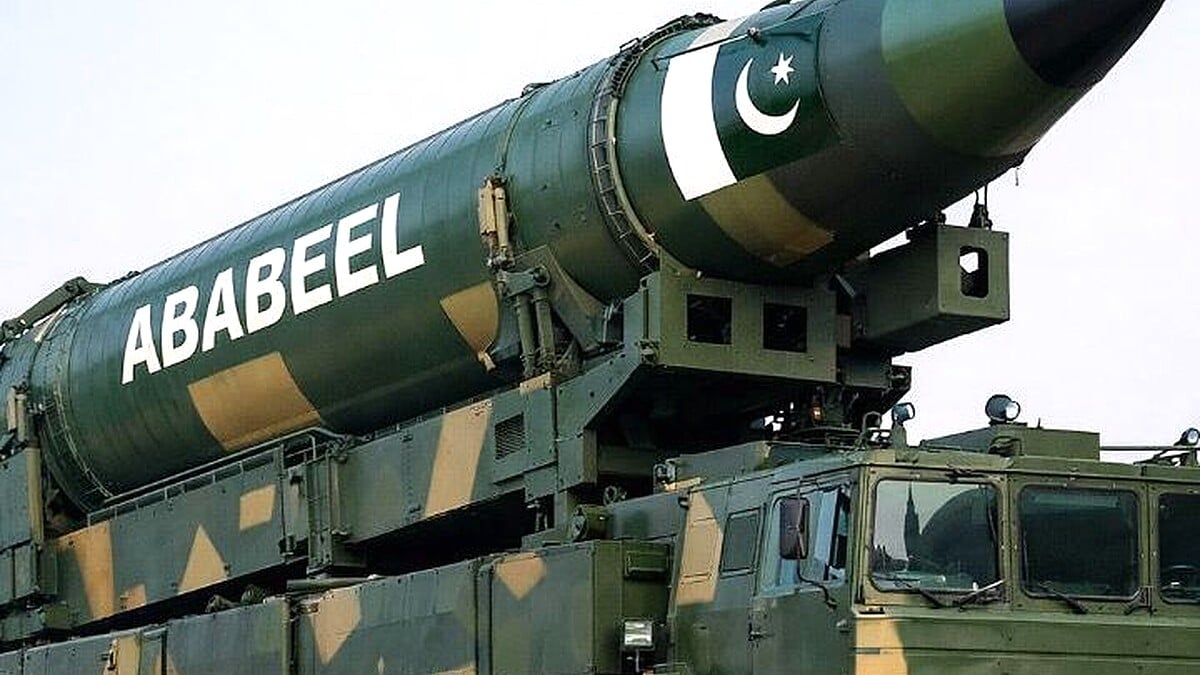
ISLAMABAD: Pakistan’s development of the Ababeel medium-range ballistic missile has redefined the strategic balance in South Asia, with defence analysts increasingly describing it as one of the most advanced deterrence platforms in the region. Designed with Multiple Independently Targetable Reentry Vehicle capability, the system represents a significant leap in missile technology, enabling a single missile to carry and deploy multiple nuclear warheads against separate targets.
The Ababeel missile, first tested in 2017, was developed to address the growing sophistication of missile defence systems worldwide. Its MIRV capability allows it to release several warheads during the terminal phase of flight, each capable of independently adjusting trajectory toward different targets. This technological advancement is widely viewed as a countermeasure to ballistic missile defence systems, which are typically designed to intercept single warhead threats.
Security experts note that the key advantage of MIRV technology lies in its ability to overwhelm defence systems through saturation. By deploying multiple warheads along with potential decoys, the missile complicates interception efforts, reducing the probability of successful neutralisation. In practical terms, even highly advanced air defence systems face severe challenges in tracking and intercepting multiple incoming objects simultaneously, particularly when combined with countermeasures.
Pakistan’s strategic planners have repeatedly stated that the Ababeel system is intended to ensure the credibility of its minimum deterrence posture. The concept of credible minimum deterrence, central to Pakistan’s nuclear doctrine, focuses on maintaining sufficient capability to deter aggression without engaging in an arms race. In this context, Ababeel’s development is seen as a response to evolving regional threats rather than an escalation initiative.
The missile is believed to have a range of approximately 2,200 kilometres, placing key strategic targets within reach. Its range, combined with MIRV capability, enhances both survivability and effectiveness. By diversifying payload delivery and complicating interception, the system strengthens second-strike capability, which is a critical component of nuclear deterrence stability.
Global missile defence systems, including those developed by technologically advanced states, are primarily optimised to intercept limited ballistic threats. Systems such as ground-based interceptors, terminal high-altitude defence platforms, and naval missile shields rely on precise tracking and interception of incoming warheads. However, the introduction of MIRV-equipped missiles like Ababeel introduces new complexities that can strain these defensive architectures.
Analysts caution, however, that no weapon system is entirely unstoppable. While MIRV technology significantly reduces interception probabilities, modern defence systems continue to evolve, incorporating advanced radar tracking, artificial intelligence-based targeting, and layered defence mechanisms. The effectiveness of interception depends on multiple variables, including detection timing, system readiness, and the scale of incoming threats.
Despite these caveats, Ababeel’s development has positioned Pakistan among a select group of countries possessing operational MIRV technology. This capability is traditionally associated with major nuclear powers, reflecting a high level of engineering sophistication in guidance systems, miniaturisation of warheads, and reentry vehicle design. The successful testing of such systems demonstrates advancements in both missile accuracy and payload management.
Regional security dynamics have also played a crucial role in shaping Pakistan’s missile programme. The introduction of missile defence initiatives in neighbouring countries has been a key factor influencing strategic calculations. In response, Pakistan has focused on ensuring that its deterrent remains credible under changing technological conditions, particularly in the face of potential interception capabilities.
Defence observers argue that the presence of MIRV systems contributes to deterrence stability by reinforcing the principle of assured retaliation. When both sides in a strategic environment possess the ability to penetrate defences, the incentive for pre-emptive strikes diminishes. This, in theory, reduces the likelihood of conflict escalation, although it also underscores the importance of responsible command and control structures.
At the same time, the deployment of advanced missile systems raises broader questions about arms control and regional stability. International non-proliferation frameworks have historically struggled to address emerging technologies such as MIRVs, which complicate verification and limitation efforts. As more states invest in advanced delivery systems, the need for updated regulatory mechanisms becomes increasingly apparent.
Pakistan has consistently maintained that its strategic capabilities are defensive in nature and aimed at preserving peace through deterrence. Officials emphasise that the country remains committed to avoiding conflict while ensuring national security against evolving threats. In this context, systems like Ababeel are presented as essential components of a balanced and credible deterrent posture.
As military technologies continue to advance, the interplay between offensive capabilities and defensive systems is expected to intensify. The development of MIRV-equipped missiles such as Ababeel highlights the ongoing evolution of strategic warfare, where innovation in one domain drives countermeasures in another. For policymakers and defence analysts alike, this dynamic underscores the complexity of maintaining stability in an increasingly technology-driven security environment.