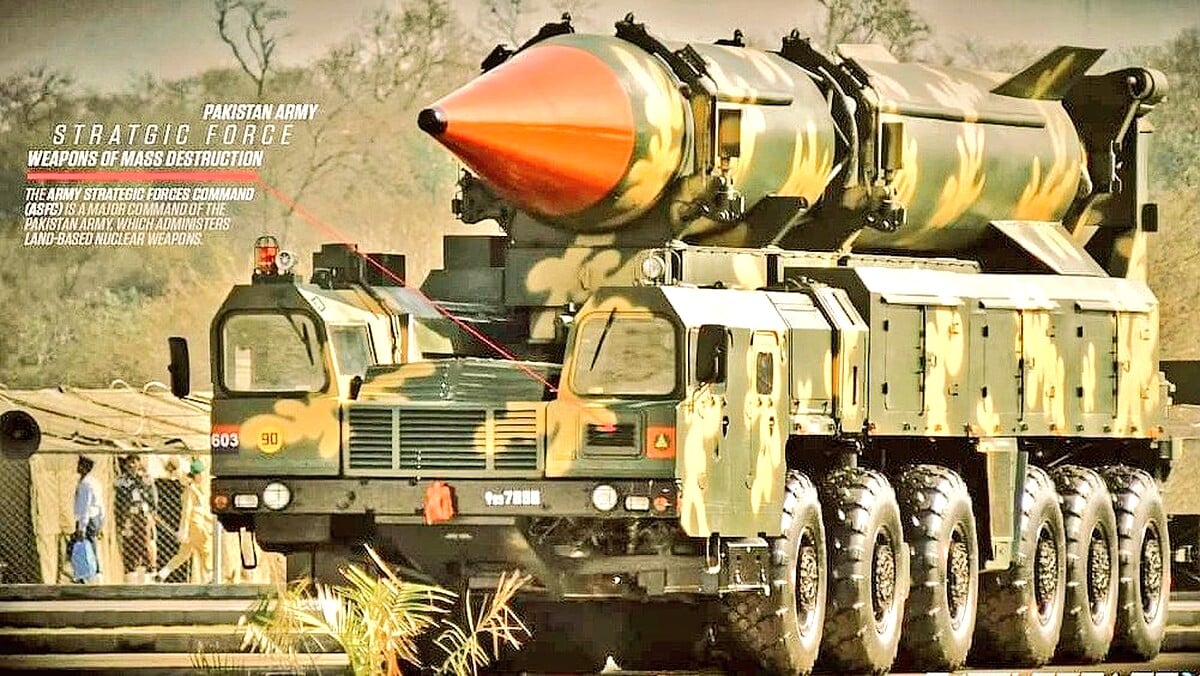
ISLAMABAD: A recent statement by US intelligence chief alleging that Pakistan could be developing missiles capable of reaching the United States has triggered renewed scrutiny of Islamabad’s strategic weapons programme, raising questions about the actual extent of its missile capabilities and future ambitions.
The claim, while not accompanied by publicly disclosed evidence, has gained traction amid rising global tensions and a broader focus on missile proliferation. Analysts, however, caution that such assertions require careful examination against known technological benchmarks, Pakistan’s doctrinal posture, and its historical trajectory in missile development.
Pakistan’s missile programme has traditionally been shaped by its regional security environment, particularly its strategic competition with India. Over the past three decades, Islamabad has developed a range of ballistic and cruise missiles primarily designed for deterrence within South Asia. These systems are widely understood to be calibrated for regional ranges rather than intercontinental reach.
Among its most advanced ballistic systems is the , which reportedly has a range of approximately 2,750 kilometres. This capability allows Pakistan to cover the entirety of India, including distant island territories such as the Andaman and Nicobar Islands. Military analysts describe this as the upper threshold of Pakistan’s publicly known ballistic missile range.
In addition to the Shaheen series, Pakistan operates the and the . The Ababeel, in particular, has drawn international attention due to its claimed capability of Multiple Independently Targetable Reentry Vehicles, a technology that allows a single missile to carry multiple warheads aimed at different targets. While significant, this advancement still falls within medium-range ballistic missile classification.
For a missile to be classified as an intercontinental ballistic missile, or ICBM, it must typically have a range exceeding 5,500 kilometres. The distance between Pakistan and the continental United States far exceeds this threshold, generally requiring ranges of over 10,000 kilometres depending on the launch and target points. At present, there is no publicly verified evidence that Pakistan possesses or has tested a missile within this category.
Experts argue that developing an operational ICBM involves complex technological challenges, including advanced propulsion systems, miniaturised nuclear warheads, precision guidance, and reliable reentry vehicle design capable of surviving extreme atmospheric conditions. Such programmes also require extensive testing, which is difficult to conceal given the global network of satellite surveillance and missile tracking systems.
Pakistan’s strategic doctrine further complicates the plausibility of such development. The country adheres to a policy of “credible minimum deterrence,” which focuses on maintaining sufficient capability to deter aggression from regional adversaries rather than projecting power globally. This doctrine has consistently guided its investments in missile systems tailored to South Asian security dynamics.
Moreover, Pakistan is a signatory to various international non-proliferation norms, although it is not a member of the Nuclear Non-Proliferation Treaty. Its missile programme is monitored closely by global powers, and any significant shift toward intercontinental capabilities would likely attract immediate international attention and diplomatic consequences.
Some analysts suggest that the recent US claims may be influenced by broader geopolitical considerations, including heightened sensitivities around missile development in Asia and the Middle East. Others view the statement as part of a pattern of precautionary intelligence assessments, which sometimes highlight potential future risks rather than confirmed capabilities.
It is also worth noting that technological progress in missile development can be incremental and dual-use in nature. Improvements in range, accuracy, or payload capacity in existing systems could theoretically serve as building blocks for longer-range platforms over time. However, such a transition from medium-range to intercontinental capability is neither quick nor easily achievable.
Regional security experts point out that Pakistan’s current focus appears to remain on refining survivability and deterrence effectiveness rather than extending range beyond its immediate strategic needs. This includes advancements in solid-fuel technology, mobile launch platforms, and sea-based deterrence concepts, all of which enhance second-strike capability without necessarily increasing maximum range.
In contrast, countries that possess operational ICBMs, such as the United States, Russia, and China, have invested decades and vast resources into their development, supported by extensive testing regimes and sophisticated industrial infrastructure. Replicating such capabilities would represent a significant departure from Pakistan’s established trajectory.
While the statement by has sparked debate, the available evidence suggests that Pakistan does not currently possess missiles capable of reaching the United States. Its existing arsenal remains firmly within the medium-range category, aligned with its regional deterrence strategy.
Nonetheless, the episode underscores the importance of transparency and dialogue in addressing global concerns over missile proliferation. As technological advancements continue and geopolitical tensions evolve, such claims are likely to remain a subject of scrutiny among policymakers and analysts alike.