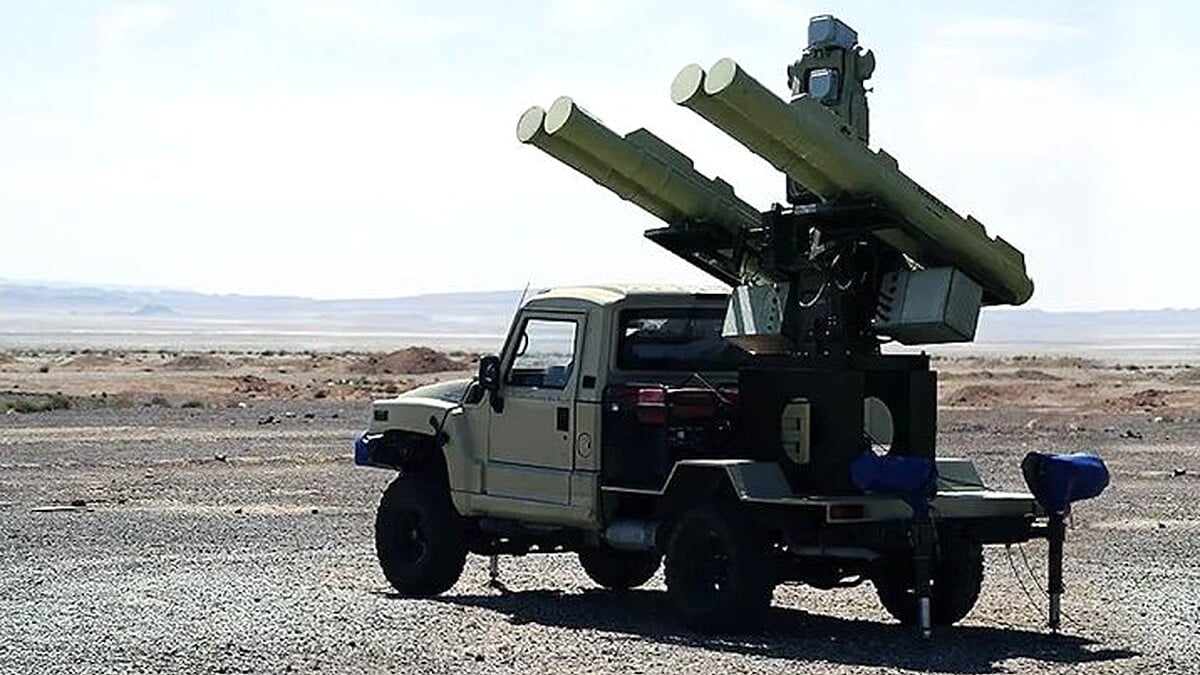
ISLAMABAD: Iranian forces have confirmed the shooting of a United States F-35 fifth-generation fighter jet over central Iran using the indigenous Majid short-range air defence system.
The Islamic Revolutionary Guard Corps conducted the successful strike, marking the first verified surface-to-air hit on an F-35 in combat.
Multiple independent sources identify the AD-08 Majid as the weapon responsible.
This development carries immediate implications for ongoing air operations and could reshape strategies for stealth aircraft penetration deep into defended airspace.
The Majid system, also designated AD-08, entered service after its public debut at a military parade in April 2021.
Produced by Iran’s Defence Industries Organization, it serves primarily for point defence of critical assets rather than wide-area coverage.
Its maximum engagement range stands at eight kilometres with an altitude ceiling of six kilometres, making it ideal for low-altitude threats.
The system mounts on a highly mobile Aras-2 tactical vehicle, allowing rapid repositioning in contested environments.
Each launcher carries four to eight missiles, each weighing 75 kilograms with a 156-millimetre diameter and 2.67-metre length.
Crucially, the Majid operates without emitting radar signals, relying instead on passive sensors that enhance its survivability against electronic warfare.
The missile itself uses a passive imaging infrared homing guidance system, often described as heat-seeking technology.
This guidance detects infrared radiation naturally emitted by targets without transmitting any signal that could alert the aircraft.
Modern imaging infrared seekers employ cooled focal-plane arrays to create detailed thermal images of the target.
They lock onto the hottest parts of an aircraft, typically the engine exhaust plume or nozzle area.
Unlike older infrared missiles, the Majid’s seeker discriminates against decoy flares and background clutter by comparing the target’s shape and heat signature against pre-loaded profiles.
The F-35 Lightning II, despite its advanced radar-absorbent materials and faceted design optimised for radio-frequency stealth, still generates significant infrared output from its Pratt & Whitney F135 engine.
Although the aircraft incorporates exhaust cooling and nozzle shaping to reduce its thermal signature, these measures prove less effective at close ranges or specific engagement aspects.
The Majid’s passive nature means the F-35’s radar warning receivers provided no advance alert during the intercept.
Iranian footage released after the incident shows a single missile launch followed by impact, suggesting high precision and possible conservation of limited munitions.
The shootdown occurred during a US combat mission over Iranian territory, forcing the aircraft into an emergency landing at a regional base.
The pilot remained stable, but the jet sustained damage that underscores vulnerabilities previously considered minimal.
Analysts note that the F-35 programme remains the largest fighter acquisition effort outside China, with more than 20 allied nations operating or ordering the platform.
This first confirmed loss to a surface-to-air missile will likely prompt reviews of operational tactics across multiple theatres.
Both US and Israeli planners have relied heavily on F-35s for initial penetration strikes to suppress enemy air defences.
The Majid’s demonstrated capability against such aircraft could force greater reliance on standoff weapons or electronic attack support.
Iran’s air defence network integrates the Majid with optional Kashef-99 three-dimensional phased-array radars for extended detection up to 12 kilometres or more.
The system can track multiple threats simultaneously while maintaining its own low signature.
Development of the Majid reflects Iran’s broader push toward self-reliant defence technologies amid decades of international sanctions.
Engineers focused on low-cost, mobile systems that counter high-value stealth platforms without requiring expensive radar networks.
Heat-seeking technology itself traces its roots to early post-World War II experiments but has evolved dramatically with digital imaging.
Contemporary seekers operate in the mid-wave or long-wave infrared spectrum where aircraft engines emit strongest signals.
The detector cools to cryogenic temperatures to reduce internal noise and improve sensitivity.
Once locked, proportional navigation algorithms guide the missile along an intercept course, with proximity fuzes ensuring detonation even on glancing impacts.
In the current conflict, this technology has proven decisive against platforms engineered primarily against radar threats.
The incident highlights a growing asymmetry where passive infrared systems bypass traditional stealth advantages.
US officials have acknowledged the event while emphasising ongoing investigations and continued operations.
Regional observers suggest the strike may reduce the tempo of deep strikes until countermeasures or revised tactics emerge.
Iranian commanders have described the Majid as part of a layered defence architecture that includes longer-range systems and electronic warfare assets.
The successful engagement validates years of investment in short-range air defence modernisation.
For global F-35 operators, the event raises questions about infrared signature management in contested environments.
Engineers may accelerate development of advanced exhaust suppression or infrared countermeasures.
The shootdown also affects planning for coalition air campaigns where stealth aircraft serve as force multipliers.
With production rates increasing and export demand high, any perceived reduction in survivability could influence future procurement decisions.
Iran continues to integrate the Majid into both regular armed forces and Revolutionary Guard units for comprehensive coverage.
Its dual capability against drones, cruise missiles and manned aircraft broadens its utility beyond the current conflict.
The passive guidance further complicates enemy suppression efforts since launch sites remain difficult to detect electronically.
Overall, the strike represents a milestone in asymmetric warfare where indigenous innovation challenges advanced Western platforms.
As the air campaign evolves, both sides will adapt to this new reality of infrared-guided threats.
The Majid’s performance may inspire similar systems elsewhere while prompting stealth aircraft operators to reassess risk profiles in high-threat zones.