ISLAMABAD: Pakistan has capitalised on last year’s brief but intense military confrontation with India to dramatically boost its defence industry and arms exports.
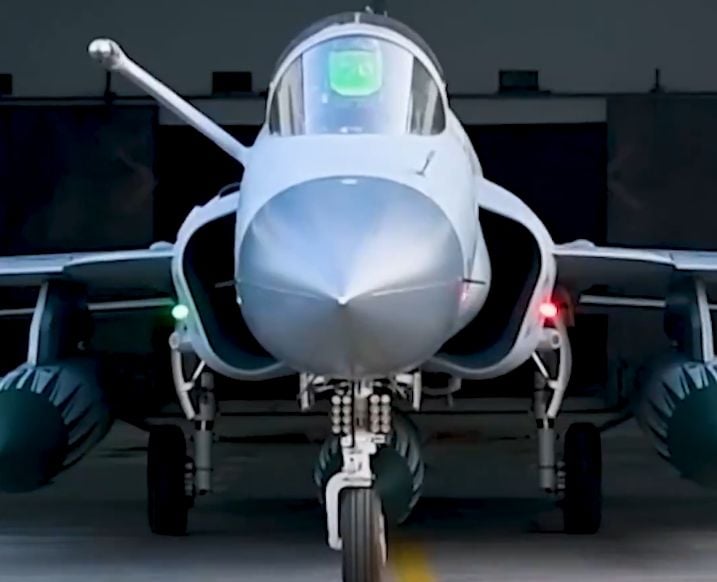
The four-day air conflict in May 2025 provided a real-world testing ground for Pakistani weaponry, particularly the domestically produced JF-17 Thunder fighter jet.
Officials and analysts describe the JF-17’s performance as battle-tested, crediting it with key successes against advanced Indian systems, including the reported destruction of an S-400 surface-to-air missile battery.
This combat demonstration shifted perceptions of Pakistani equipment from budget alternatives to proven reliable platforms in modern warfare.
Defence exports, previously modest, surged in the aftermath, with reports indicating contracts worth nearly $10 billion signed in 2025 alone.
Some estimates place the total value of deals and potential pipeline at up to $13 billion, encompassing fighter jets, trainer aircraft, drones, armoured vehicles, naval platforms and ammunition.
The JF-17 Thunder remains the flagship product, co-developed with China and manufactured at the Pakistan Aeronautical Complex in Kamra.
Interest in the jet intensified post-conflict, leading to deals and negotiations with countries across Africa, the Middle East, Asia and beyond.
Azerbaijan finalised a significant contract for JF-17s valued at around $1.6 billion in late 2025.
Libya reportedly entered a $4.6 billion agreement for 16 JF-17s along with Super Mushshak trainer aircraft.
Sudan emerged as a potential buyer for K-8 trainers, MFI-395 Super Mushshaks and possibly JF-17s in a deal estimated at $1.5 billion.
Bangladesh held high-level talks on acquiring JF-17s, signalling expanding interest in South Asia.
Negotiations continue with nations including Saudi Arabia, Iraq, Nigeria, Myanmar and others for various systems.
Pakistan’s Defence Export Promotion Organization has actively marketed these platforms, emphasising their cost-effectiveness, integration with Chinese technology and proven performance.
The Al-Khalid main battle tank and Fatah-series guided multiple launch rocket systems also featured prominently in demonstrations.
Exports of arms and ammunition jumped from low figures in previous years to hundreds of millions, with 2025 marking an all-time high.
Prior to the conflict, annual defence exports hovered in the tens of millions of dollars according to international trade data.
The post-conflict boom could contribute substantially to foreign exchange reserves, potentially boosting them by a significant percentage if major deals materialise.
Pakistan’s defence industry, supported by the Ministry of Defence Production since 1951, has long focused on indigenisation to reduce import dependence.
Collaboration with China, accounting for a large share of imports and co-production, has accelerated capabilities.
The JF-17, in particular, benefits from joint production, allowing technology transfer and local assembly.
Analysts note that while the surge represents progress, structural constraints remain, including limited industrial base and long production lead times.
Full realisation of the $13 billion pipeline may unfold gradually over years.
The conflict also highlighted multi-domain operations, integrating air, space and cyber elements, further enhancing the appeal of Pakistani systems.
Defence Minister statements suggest this success could transform the broader economic outlook by fostering high-value manufacturing.
Pakistan positions itself as an emerging mid-tier defence supplier, challenging traditional Western dominance in certain markets.
Buyers seek affordable yet capable alternatives amid global supply chain shifts and geopolitical realignments.
The May 2025 skirmish, though limited, offered credentials that decades of marketing could not achieve.
International media, including Al Jazeera’s Project Force segment by Alex Gatopoulos, examined how Islamabad converted the confrontation into a bonanza for its arms sector.
This narrative frames combat experience as a unique selling point in competitive global markets.
Pakistan’s strategy includes bundling sales with training, maintenance and operational support, distinguishing it from some competitors.
As deals progress, the industry aims for sustained growth, targeting even higher annual revenues in coming years.
The developments underscore a shift from primarily defensive posture to proactive export-oriented defence diplomacy.