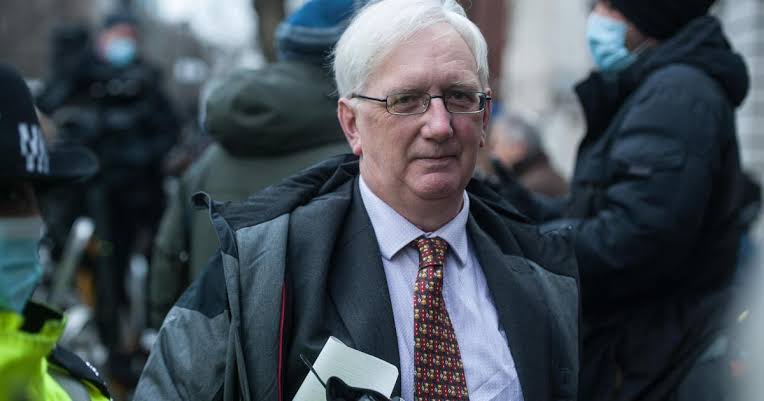
ISLAMABAD: A former British diplomat has sparked international debate by asserting that the imprisonment of Pakistan’s ex-Prime Minister Imran Khan has significantly contributed to Zionism’s unchecked influence worldwide, leaving no prominent Muslim leader to boldly confront it.
Craig Murray, once the UK Ambassador to Uzbekistan, posted this view on X in February 2026, stating that Khan’s removal silenced a key voice against Western imperialism and its alliances.
Murray’s statement echoes his long-standing criticism of global power dynamics, where he accuses Western forces of manipulating Muslim nations to maintain strategic dominance.
Data from intercepted diplomatic cables, revealed by The Intercept in 2023, show US officials pressuring Pakistan to oust Khan over his neutral stance on the Russia-Ukraine conflict.
In a March 2022 meeting, US Assistant Secretary Donald Lu reportedly warned Pakistani diplomats that relations would improve if Khan were removed, citing his refusal to align against Russia.
Khan, ousted via a no-confidence vote in April 2022, had publicly rejected demands to condemn Russia, questioning at a rally whether Pakistan was a “slave” to Western powers.
Murray has repeatedly linked this to CIA orchestration, tweeting in January 2025 that Khan’s 14-year sentence coincided with Pakistan receiving a $20 billion World Bank loan as a reward for compliance.
In a December 2024 post, Murray warned that attempts to eliminate Khan would lead to anarchy, emphasizing his role as Pakistan’s only viable leader amid military and CIA interference.
UN reports bolster these claims; in July 2024, the UN Working Group on Arbitrary Detention declared Khan’s imprisonment violated international law, urging his release.
Khan’s party, PTI, secured over 90 seats in the February 2024 elections despite rigging allegations, with independent observers noting voter suppression in PTI strongholds.
Murray’s June 2025 tweet praised Pakistan’s Defense Minister for warning against Israeli actions but urged Khan’s release to strengthen anti-imperialist voices.
Geopolitically, Khan’s removal shifted Pakistan’s foreign policy; post-ouster, Islamabad supplied arms to Ukraine, with European officials confirming Pakistani shells on battlefields by mid-2023.
This alignment contrasts with Khan’s tenure, where he maintained neutrality and criticized US drone strikes, refusing bases for operations.
On Palestine, Khan consistently supported self-determination, comparing his ouster to the 1953 CIA coup against Iran’s Mohammad Mossadegh for similar independence.
In a 2022 interview, Khan vowed never to recognize Israel without justice for Palestinians, linking it to Kashmir’s unresolved status.
Murray’s February 2024 post highlighted rigged elections and minimal Western coverage, attributing Khan’s 70% public support to his anti-CIA stance.
By 2026, Khan remains in Adiala Jail, facing over 100 charges deemed politically motivated by his allies.
Recent court filings reveal severe health deterioration; Khan has lost 85% vision in his right eye due to untreated blood clots, as reported by lawyer Salman Safdar in February 2026.
A Supreme Court-ordered medical exam confirmed solitary confinement for over two years, prompting international cricket legends to demand better care.
UN experts in 2024 noted his detention aimed to bar him from politics, disqualifying him via convictions in corruption cases like Toshakhana and cipher leaks.
Geopolitically, Khan’s absence has muted bold challenges to Zionism; a February 2026 joint statement by eight Muslim nations condemned Israel’s West Bank measures but stopped short of drastic actions like embargoes.
Saudi Arabia and UAE, post-Abraham Accords, have deepened ties with Israel, with trade reaching $2.5 billion by 2025, per Israeli reports.
Turkey and Indonesia criticized Israel’s Gaza policies, but without unified pressure, as seen in OIC summits yielding resolutions but no boycotts.
Murray’s November 2023 tweet lamented the CIA’s role in depriving the Muslim world of Khan’s authoritative voice during Palestine’s existential crisis.
Data from INSS in 2025 shows anti-Zionist rhetoric among US Muslim leaders intensified, but global Muslim states remain divided, with some like Pakistan tilting Westward.
Khan’s 2022 ouster, per Middle East Monitor, followed US dissatisfaction with his Palestine solidarity and refusal to normalize with Israel.
In 2024, PTI protests drew millions, with polls showing 65% of Pakistanis believing foreign interference caused his fall, per Gallup Pakistan.
Murray’s April 2024 response to critics defended his Khan advocacy, urging searches of his timeline for consistent support.
By February 2026, Khan’s petition seeks sentence suspension on medical grounds, citing 17-year terms for graft as unjust amid vision loss.
International implications persist; Consortium News in 2023 detailed how Khan’s removal aligned Pakistan with US bids, weakening Muslim unity on issues like Palestine.
Al Jazeera reports from 2026 note Khan’s eye condition stems from delayed treatment, with family alleging negligence in solitary confinement.
Murray’s July 2024 post accused Pakistan’s military of CIA collusion, explaining Western silence on the arbitrary detention.
Geopolitically, Pakistan’s post-Khan arms to Ukraine totaled $500 million by 2025, per Globely News, shifting from Khan’s balanced diplomacy.
Muslim leaders’ 2025 calls for Gaza action, signed by over 90 US imams, urged embargoes but saw limited state response.
Khan’s influence endures; his son’s 2026 statement blamed 922 days of isolation for health woes, fueling global concern.
Ultimately, Murray’s linkage underscores a perceived vacuum: without figures like Khan, Zionism faces diminished opposition from Muslim leadership, per his 2026 analysis.