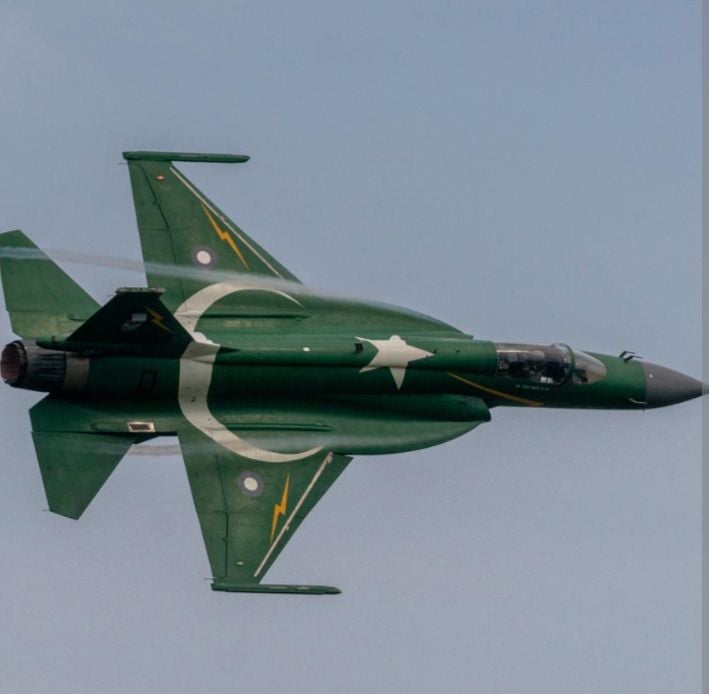
ISLAMABAD: Social media reports originating from Indian and Afghan accounts have circulated claims that Saudi Arabia has cancelled a purported contract to purchase JF-17 Thunder fighter jets from Pakistan, sparking speculation about strained defence ties between Islamabad and Riyadh. Fact-checking and analysis of credible sources reveal that no formal contract existed for Saudi Arabia to cancel, and no official statement from Riyadh has confirmed any rejection of the JF-17 or Turkey’s KAAN fighter. Instead, recent developments point to United States pressure on Saudi Arabia to prioritise American F-35 jets over alternatives from Pakistan and Turkey, highlighting geopolitical manoeuvring in the region’s arms market.
The controversy stems from earlier reports in January 2026 indicating discussions between Pakistan and Saudi Arabia to convert approximately $2 billion in Saudi loans to Pakistan into a potential acquisition of JF-17 Thunder jets, a lightweight multirole fighter jointly developed by Pakistan Aeronautical Complex and China’s Chengdu Aircraft Corporation. These talks were framed as deepening military cooperation following a mutual defence pact signed in September 2025. Sources familiar with the matter described the arrangement as one option among others, with the JF-17 positioned as a cost-effective solution for Riyadh’s air force modernisation.
Pakistan’s Foreign Office swiftly denied knowledge of any such deal when initial reports surfaced, stating it was unaware of negotiations to swap loans for jets. This cautious response underscored the exploratory nature of the discussions rather than a binding agreement. No official confirmation emerged from either side about a finalised contract, which explains the absence of any verifiable cancellation announcement.
Recent reporting from defence outlets indicates that Washington has actively intervened, securing assurances from Saudi Arabia that it would not proceed with acquiring the JF-17. This development aligns with broader US efforts to maintain dominance in Gulf arms sales, particularly after President Donald Trump’s administration confirmed readiness to supply F-35 Lightning II stealth fighters to Riyadh as part of a large-scale defence agreement in late 2025. The F-35, a fifth-generation platform, represents a significant leap in capability over the fourth-generation JF-17, offering advanced stealth, sensor fusion, and network-centric warfare features that appeal to Saudi strategic needs amid regional threats.
The US pressure extends beyond the JF-17 to include scrutiny of Saudi Arabia’s interest in Turkey’s fifth-generation KAAN fighter programme, developed by Turkish Aerospace Industries. While Riyadh has provided guarantees against purchasing Pakistani jets, no similar commitments have been made regarding KAAN participation. American officials have questioned the rationale for pursuing non-US options when F-35 availability is on the table, viewing such diversification as a potential dilution of Washington’s leverage in the kingdom’s defence procurement.
Social media amplification of the supposed cancellation appears concentrated in accounts from India and Afghanistan, regions with historical rivalries or tensions involving Pakistan. These narratives often frame the story as a diplomatic setback for Islamabad, emphasising unverified claims without referencing official sources. Analysts note that such reports fit patterns of information operations aimed at undermining Pakistan’s defence export ambitions, especially as the JF-17 gains visibility through exhibitions and combat-proven credentials from regional operations.
Pakistan continues to promote the JF-17 aggressively on the international stage. At the World Defense Show 2026 in Riyadh earlier this month, the Pakistan Air Force showcased the JF-17 Block III variant, highlighting its advanced avionics, active electronically scanned array radar, and integration of precision-guided munitions. The platform has drawn strong interest from multiple countries across Africa, the Middle East, and Asia, with Pakistan engaged in talks with up to 13 potential buyers. Its affordability, estimated at $25-50 million per unit depending on configuration, contrasts sharply with the F-35’s higher price tag and associated logistical demands.
Saudi Arabia’s defence strategy reflects a deliberate hedging approach. As the region’s largest arms importer, with annual budgets exceeding $60 billion, Riyadh seeks to diversify suppliers to reduce dependency on any single partner. Interest in the JF-17 was linked to financial mechanisms like loan conversions, offering mutual benefits amid Pakistan’s economic challenges. However, the allure of American technology, including potential F-35 transfers, appears to have outweighed these considerations under current geopolitical realities.
No evidence supports claims of a formal JF-17 contract rejection by Saudi Arabia. The absence of statements from Riyadh or Islamabad confirming cancellation reinforces that the matter involved preliminary discussions rather than a terminated deal. Pakistan’s ongoing export push for the JF-17 remains intact, bolstered by its operational track record and competitive pricing in a crowded global market.
The episode illustrates the complex interplay of alliances in Middle Eastern defence procurement. US influence continues to shape outcomes, prioritising American systems while countering inroads by non-Western or alternative suppliers. For Pakistan, the focus shifts to other prospective markets where the JF-17’s attributes align with buyer requirements for reliable, maintainable multirole fighters without stringent political conditions.
Defence experts caution against overinterpreting social media rumours, urging reliance on verified official channels. As regional dynamics evolve, including US-Saudi F-35 negotiations and Turkey’s KAAN advancements, the arms landscape in the Gulf promises further strategic adjustments.