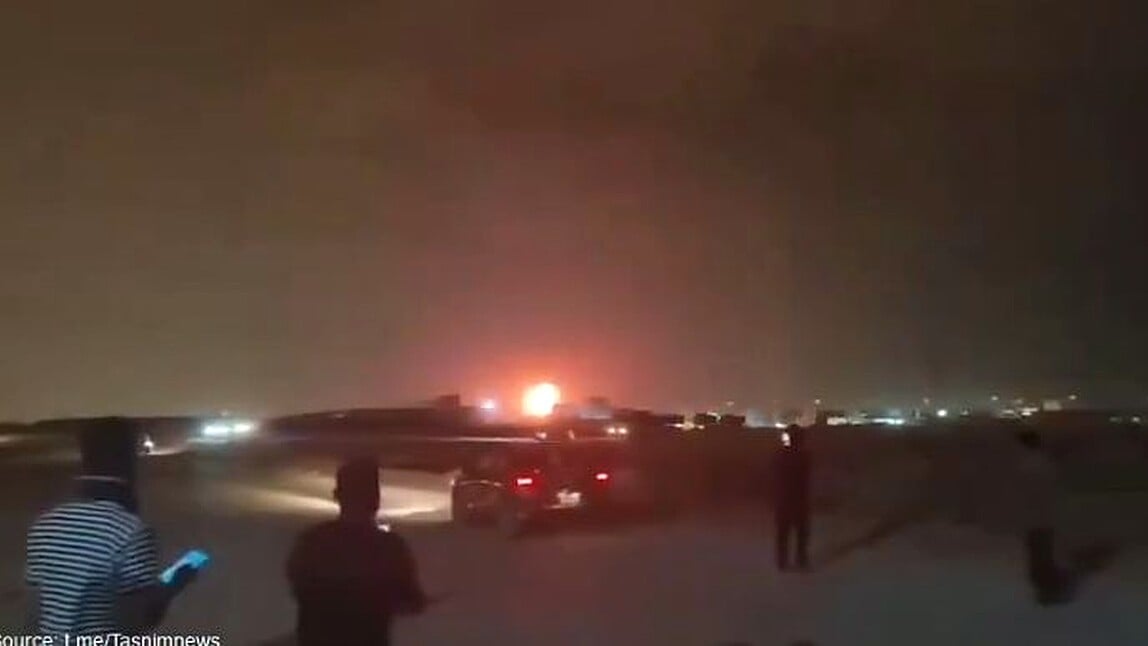
RIYADH: Dramatic video footage circulating online has captured the moment an Iranian missile strike destroyed a fuel depot at a major air base near Riyadh, used to support United States fighter jets and aerial operations in the region.
The footage, described by observers as showing intense explosions and secondary fires, aligns with recent reports of Iranian missile attacks targeting military infrastructure in Saudi Arabia. Sources indicate the targeted facility supplied aviation fuel critical for refueling US aircraft, including fighter jets deployed amid the ongoing Middle East tensions.
The incident occurred at Prince Sultan Air Base, located in Al-Kharj province south of Riyadh, a strategic hub hosting significant US military presence. This base has served as a key forward operating location for American forces, supporting extended air missions across the Gulf and beyond.
According to accounts from US officials cited in international media, the strike damaged infrastructure linked to fuel storage and distribution. While initial claims suggested complete destruction of a dedicated fuel depot for US fighter jets, assessments indicate the primary impact affected refueling capabilities essential for sustained operations.
The attack forms part of a broader pattern of Iranian retaliatory actions following US and Israeli strikes on Iranian targets. Iranian forces have employed ballistic missiles in coordinated salvos, aiming to disrupt allied military logistics and project power across the region.
Prince Sultan Air Base gained renewed importance in recent years as tensions escalated. It hosts various US aircraft, including advanced fighter models and support assets. Fuel depots at such installations are vital, enabling rapid turnaround for combat sorties and long-range patrols.
No immediate casualties were reported from this specific strike on the fuel-related facilities, though the base has faced multiple threats. Saudi air defenses intercepted several projectiles in related incidents around Riyadh and eastern provinces, limiting wider damage.
The circulating video, purportedly from security cameras or eyewitness sources, shows a bright flash followed by massive fireballs, consistent with aviation fuel ignition. Such imagery has amplified global attention on the vulnerability of forward-deployed assets in allied territories.
Military analysts note that disrupting fuel supply chains represents a high-impact asymmetric strategy. For US fighter jets reliant on aerial refueling and ground-based support, any degradation in depot capacity could constrain operational tempo and force reliance on alternative bases farther afield.
Saudi Arabia’s Defense Ministry has not issued detailed confirmations on this particular fuel depot incident but has acknowledged ongoing interceptions of drones and missiles targeting the kingdom. In parallel events, defenses downed multiple threats over Riyadh, demonstrating active layered protection systems.
The escalation underscores the interconnected nature of the current conflict. Iran’s Islamic Revolutionary Guard Corps has claimed responsibility for strikes on sites supporting US and Israeli operations, framing them as responses to perceived aggressions.
US military posture in Saudi Arabia includes thousands of personnel and dozens of aircraft. The presence at Prince Sultan facilitates rapid response capabilities but also exposes assets to long-range Iranian missile threats, which have ranges exceeding 1,000 kilometers.
Regional observers point to the strategic calculus behind targeting fuel infrastructure. Aviation fuel depots represent high-value, relatively soft targets compared to hardened aircraft shelters. Damage here can achieve disproportionate effects on air campaign sustainability.
Repair efforts are reportedly underway at the affected sites, with damaged assets being assessed for quick restoration. US officials have emphasized resilience, noting that while some capabilities were impaired, core operations continue without major interruption.
The footage’s emergence has fueled debates on escalation risks. Visual evidence of such strikes heightens public and diplomatic scrutiny, potentially pressuring involved parties toward de-escalation or further entrenchment.
Broader implications include potential disruptions to global energy markets and shipping security, as Gulf tensions persist. Saudi Arabia remains a pivotal player, balancing defense alliances with efforts to contain spillover from neighboring conflicts.
As investigations continue, the captured moment serves as a stark reminder of the volatile security environment enveloping Riyadh and its military installations.
Iran-Saudi Arabia relations, strained for years, face additional pressure from these developments. Diplomatic channels remain limited, with proxy dynamics amplifying direct confrontations.
The international community watches closely, as further strikes could widen the theater of operations beyond current boundaries.