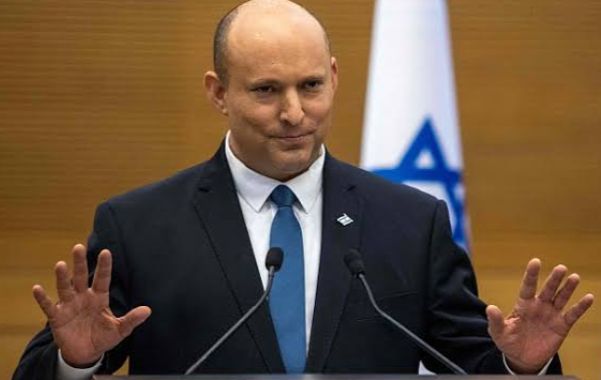
ISLAMABAD: Pakistan’s Foreign Office has categorically dismissed recent remarks by former Israeli Prime Minister Naftali Bennett describing an emerging regional axis comprising Turkey, Qatar, the Muslim Brotherhood and nuclear-armed Pakistan as mere speculation.
The spokesperson made the position clear during the weekly press briefing on Thursday when questioned about Bennett’s statements delivered at a conference of American Jewish organization presidents in Jerusalem.
The Foreign Office termed the assertions as purely conjectural and stated that Pakistan does not comment on remarks made by officials of a country it does not recognize.
The spokesperson emphasized that the nature of the former Israeli leader’s comments was inherently speculative and lacked any factual grounding.
Bennett’s remarks surfaced a few days earlier during his address to the conference where he warned of a new alignment allegedly hostile to Israel.
He specifically identified Turkey, Qatar, the Muslim Brotherhood and Pakistan as forming what he called a new axis in the region.
According to Bennett, this grouping is fueling enmity against Israel while simultaneously attempting to exert influence over Saudi Arabia.
The former prime minister singled out Turkish President Recep Tayyip Erdogan as a particularly dangerous adversary actively working to encircle Israel.
He cautioned that Israel must not repeat past mistakes of underestimating threats emerging along its borders.
Bennett accused the current Israeli government of being asleep to the growing dangers posed by radical ideologies in the neighborhood.
He described the Muslim Brotherhood as the ideological core of this supposed axis and claimed that it enjoys the backing of Pakistan’s nuclear arsenal.
Bennett asserted that Turkey is leading this coalition and that the combination represents a serious strategic challenge.
Pakistan’s response aligns with its long-standing policy of not engaging diplomatically with Israel due to the absence of formal relations.
The country has consistently maintained that any dialogue with Israel would remain conditional on a just and comprehensive resolution of the Palestinian issue.
Analysts note that Bennett’s comments reflect a broader pattern of Israeli political figures highlighting perceived threats from Muslim-majority states to domestic and diaspora audiences.
Such statements often serve to underscore security concerns and justify defense policies amid shifting regional dynamics.
Turkey and Qatar have faced frequent criticism from Israeli officials in recent years over their support for Palestinian causes and their positions on Gaza.
Pakistan, while maintaining strong ties with both Ankara and Doha, has repeatedly affirmed its independent foreign policy and commitment to the two-state solution.
The inclusion of Pakistan in Bennett’s narrative appears linked primarily to its status as the only Muslim nation possessing nuclear weapons.
No public evidence has surfaced indicating any formal security pact or coordinated anti-Israel strategy involving the mentioned countries.
Diplomatic observers in Islamabad point out that Pakistan’s relations with Turkey and Qatar remain focused on economic cooperation, defense collaboration and humanitarian coordination rather than any anti-Israel front.
Pakistan’s nuclear program continues to be described officially as a minimum credible deterrent developed solely for national security against conventional threats.
The Foreign Office’s brief but firm rejection underscores Islamabad’s reluctance to dignify what it views as unfounded speculation from a non-recognized entity.
Bennett, who served as prime minister from 2021 to 2022, has remained active in public discourse since leaving office and frequently comments on regional security matters.
His latest intervention comes at a time of heightened tensions in the Middle East following prolonged conflict in Gaza and evolving normalization efforts involving several Arab states.
Pakistan has historically avoided direct involvement in Middle Eastern rivalries while advocating for Palestinian rights at international forums including the United Nations and the Organization of Islamic Cooperation.
The spokesperson’s remarks reaffirm that Pakistan will not respond substantively to statements originating from unrecognized quarters.
This approach is consistent with previous instances where similar allegations were brushed aside without elaboration.
Regional security experts suggest that framing Pakistan within such an axis may aim to draw attention to broader geopolitical realignments rather than reflect concrete alliances.
Pakistan continues to prioritize strategic autonomy in its foreign relations while deepening partnerships with friendly nations across the Muslim world.
The episode highlights the persistent sensitivities surrounding Israel’s security perceptions and Pakistan’s firm non-engagement stance.