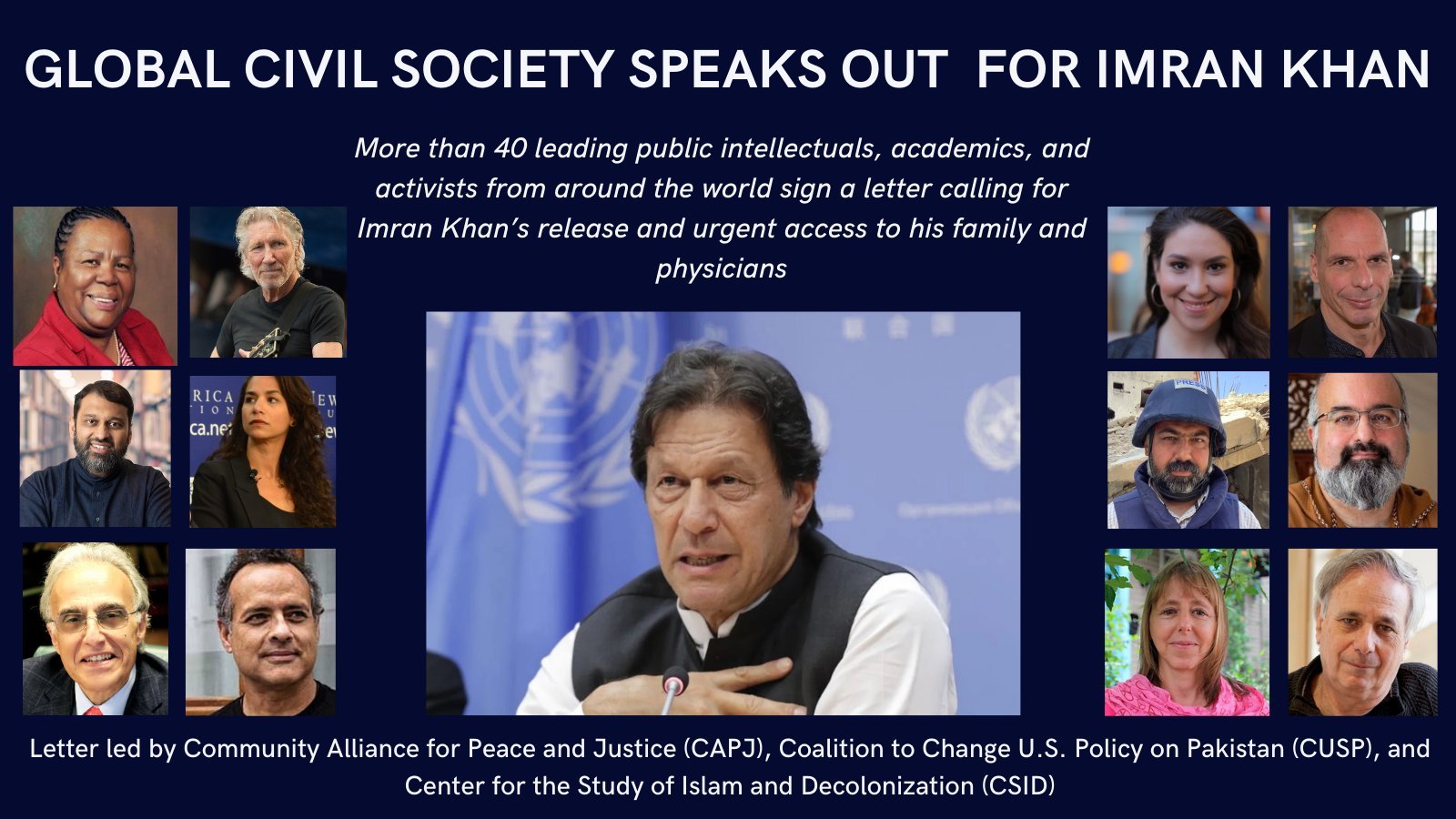
ISLAMABAD: More than 40 leading global scholars, public intellectuals, and human rights advocates have issued an urgent international letter calling for immediate medical access for former Prime Minister Imran Khan and an end to his arbitrary detention.
The letter highlights concerns over severe ocular damage allegedly resulting from prolonged medical neglect while in custody at Adiala Jail in Rawalpindi.
Signatories include prominent figures such as Dr. Naledi Pandor, former South African Minister of International Relations; Dr. John L. Esposito, Georgetown University professor; economist Yanis Varoufakis; legal scholar Noura Erakat; Dr. Omid Safi; Dr. Yasir Qadhi; musician Roger Waters; historian Dr. Vijay Prashad; Dr. Nader Hashemi; former UN official Craig Mokhiber; journalist Motasem Dalloul; podcaster Katie Halper; Dr. Nidal Jboor; activist Medea Benjamin; Dr. Ashok Swain; Dr. Richard Falk; historian Dr. Ilan Pappe; journalist Sana Saeed; Dr. Assal Rad; Dr. Tamara Sonn; Dr. Chandra Muzaffar; Dr. Junaid Ahmad; Connecticut State Senator Saud Anwar; and others from international civil society.
The appeal is led by the Community Alliance for Peace and Justice, the Coalition to Change U.S. Policy on Pakistan (CUSP), and the Center for the Study of Islam and Decolonization.
This development comes amid escalating concerns about Khan’s health, particularly his vision in the right eye.
Reports indicate that Khan has suffered significant vision loss, with his lawyer informing the Supreme Court that he retains only about 15 percent sight in the affected eye.
The condition has been diagnosed as central retinal vein occlusion, stemming from a blood clot that allegedly went untreated for months despite complaints starting around October 2025.
Khan’s lawyer, Barrister Salman Safdar, submitted a fact-finding report after a court-ordered visit, stating that jail authorities provided only eye drops initially and delayed proper intervention.
A procedure to address the issue occurred in late January 2026 at a hospital, but family and party representatives claim inadequate follow-up and exclusion of preferred specialists.
The Pakistan Tehreek-e-Insaf (PTI) has rejected government medical reports asserting improvement, demanding independent examination by Khan’s personal physician and transfer to a private facility like Shifa International Hospital.
Khan’s sister, Aleema Khan, has described the situation as unacceptable, emphasizing no trust in official assessments without family oversight.
A government-appointed medical team examined Khan at the jail recently, with some reports claiming partial vision improvement, though these remain contested.
The Supreme Court has intervened multiple times, ordering assessments and access to physicians, reflecting the gravity of the health dispute.
Khan has been detained since 2023 on various charges, including corruption, which he denies as politically motivated.
His incarceration exceeds 900 days, with supporters arguing it constitutes arbitrary detention.
International attention has grown, including a separate appeal from 14 former cricket captains urging dignified treatment and specialist care.
The scholars’ letter warns that continued neglect risks irreversible harm and calls for transparent implementation of court orders.
It stresses unrestricted access to qualified specialists chosen by Khan.
The signatories represent diverse fields, from academia and activism to former officials, underscoring broad global concern.
Human rights groups have long highlighted conditions in Pakistani detention facilities.
This letter adds to pressure on authorities amid ongoing legal battles in the Supreme Court.
PTI leaders continue protests and sit-ins demanding Khan’s medical transfer and broader political reforms.
The appeal urges an end to what it terms arbitrary detention, linking health issues to wider questions of justice.
As the situation unfolds, international observers watch closely for compliance with judicial directives and humanitarian standards.
The letter’s release amplifies calls for accountability and prompt action to safeguard Khan’s well-being.