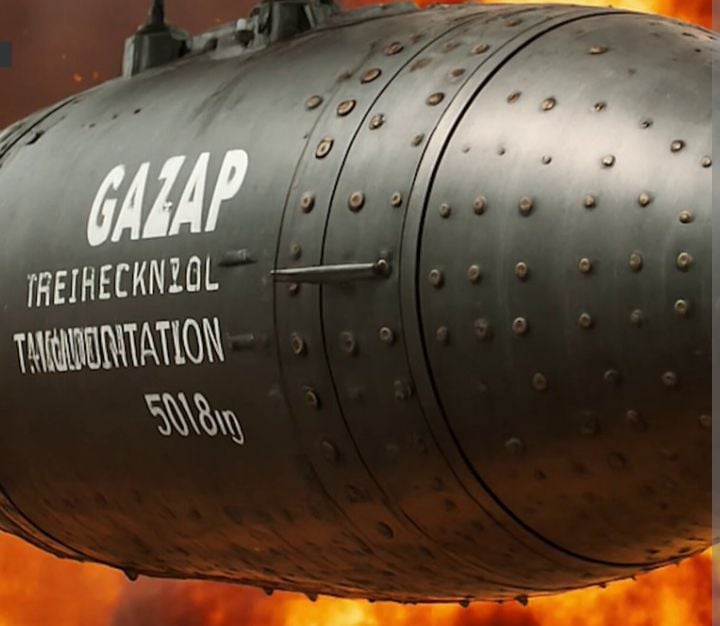
ISLAMABAD: Defence analysts indicate that Pakistan is exploring the integration of Turkey’s GAZAP high-explosive warhead into its missile arsenal, potentially transforming its conventional deep-strike options against Indian airbases.
The GAZAP, unveiled by Turkey at the International Defence Industry Fair (IDEF) 2025 in Istanbul, stands as the country’s most powerful non-nuclear aerial bomb. Developed by the Turkish National Defence Ministry’s research and development centre, the munition weighs 970 kilograms and features a sophisticated thermobaric and fragmentation design.
Experts describe the GAZAP as a modified Mk-84 class bomb with enhanced destructive power. It disperses approximately 10,000 controlled fragments at a density of 10.16 fragments per square metre, far surpassing traditional designs that achieve lower fragmentation rates over wider areas.
The warhead’s blast effects prove devastating within 150 to 200 metres, while structural damage extends up to 300 metres. This capability stems from optimised explosive filler and delayed detonation timing, extending the explosion duration for greater impact.
Turkey’s defence industry, led by entities such as Roketsan, has completed qualification and certification processes for the GAZAP. It remains compatible with F-16 fighter jets, with potential future adaptations for drones or other platforms.
Reports highlight growing military cooperation between Pakistan and Turkey. Ankara has supplied Bayraktar TB2 drones, assisted in naval projects like the MILGEM corvettes, and modernised Pakistani F-16 aircraft. This partnership extends to technology sharing in missiles and air defence systems.
Should integration proceed, Pakistan could equip surface-to-surface or cruise missiles with the GAZAP warhead. Such modifications would enable precision strikes on hardened targets, leveraging the warhead’s fragmentation and blast radius to disable infrastructure effectively.
Strategic assessments point to Indian Air Force bases in the northeast as primary potential targets. Facilities such as Tezpur Air Force Station and Bagdogra Air Force Station fall within range of several Pakistani missile systems, including variants of the Babur cruise missile and Ra’ad air-launched systems.
Extended-range missiles in Pakistan’s inventory could reach deeper locations, including assets in the Andaman and Nicobar Islands. These strikes would aim to neutralise critical elements like runways, aircraft shelters, fuel depots, and command centres in a single salvo.
The GAZAP’s design emphasises area denial and saturation effects. Its thermobaric component consumes oxygen in the blast zone, creating vacuum-like pressure that collapses structures and inflicts severe casualties on exposed personnel.
Defence observers note that this development aligns with Pakistan’s push for indigenous and co-developed conventional capabilities. It seeks to counter perceived asymmetries in air power and maintain credible deterrence without escalating to nuclear thresholds.
Regional military balances could shift if such integration materialises. India’s airbases represent key nodes in its operational doctrine, and their disruption would complicate rapid response scenarios in potential conflicts.
Turkey’s export-oriented defence policy supports technology transfers to allies like Pakistan. Previous collaborations demonstrate willingness to share know-how in guidance systems and warhead technologies.
Analysts caution that no official confirmation exists regarding specific GAZAP transfers or adaptations. Discussions remain speculative, based on deepening bilateral ties and shared strategic interests.
Pakistan’s missile program already incorporates precision guidance for standoff attacks. Adding a high-yield warhead like the GAZAP would enhance lethality against dispersed or fortified targets.
The warhead’s fragmentation pattern targets soft and semi-hardened assets effectively. Runways could suffer extensive cratering and debris, while aircraft in open shelters face high destruction probabilities from penetrating fragments.
Fuel storage and ammunition depots remain vulnerable to secondary explosions triggered by the initial blast wave. Command facilities might experience structural failure under sustained overpressure.
This potential capability would provide Pakistan with a potent conventional deep-strike option. It complements existing ballistic and cruise missile forces, offering flexibility in escalation control.
Broader implications involve South Asian stability. Heightened conventional precision could deter aggression but also raise risks of miscalculation during crises.
Defence planners in the region monitor these developments closely. Technological leaps in allied arsenals demand corresponding adjustments in force posture and defensive measures.
The GAZAP’s introduction underscores Turkey’s rapid advancement in munitions design. Its focus on controlled fragmentation and extended blast effects sets a new benchmark for non-nuclear aerial weapons.
For Pakistan, pursuing such integration reflects a strategy of leveraging partnerships to modernise its arsenal. It aims to achieve qualitative improvements amid evolving regional security dynamics.