Rise of a New TTP-Aligned Militant Faction
Reports indicate that a newly announced militant group led by Maulvi Muhammad Baloch of Kalat, Balochistan, has pledged allegiance to TTP Chief Mufti Noor Wali Mehsud, underscoring the ongoing fragmentation within militant ranks and their revival under a unified Taliban-aligned banner. While the group remains unnamed in media coverage, its leadership and location in Balochistan mark its significance in current terror dynamics.
TTP’s Strategic Expansion and Mergers
Under Noor Wali’s leadership, the TTP has effectively absorbed over 60 splinter factions, including elements of Baloch separatists and AQIS affiliates—a process driven both by ideological alignment and tactical convenience. Notably, in 2022, the BLA’s Majeed Brigade formally joined TTP’s Khawaraj wing, pledging loyalty to its leader. These alliances reflect a growing religio-ethnic “terror troika” among TTP, BLA, and IS-Khorasan, aimed at destabilising Pakistan’s security architecture and disrupting projects like CPEC (The Express Tribune).
Alleged Indian Backing: Financial, Logistical, Strategic
Pakistani intelligence and independent reports consistently cite India’s external interference, particularly by RAW, in bridging TTP and BLA networks:
Indo-Afghan RAW-NDS coordination allegedly aimed to regroup TTP splinter groups, combining resources and recruiting networks across Afgahnistan into Pakistan.
Confession of Maulvi Mansoor—a former TTP administrator—described RAW funding, Afghan shelter, and orchestrated operations in Balochistan to sabotage CPEC by targeting Chinese nationals and creating a narrative of forced disappearances .
Pakistan’s defence officials accuse India of actively training and enabling TTP operatives based in Afghan territories to attack Pakistani check posts and civilian installations.
A UN Security Council Monitoring Team report confirmed that Afghan Taliban continues to provide financial and operational support to TTP, with Noor Wali’s family reportedly receiving $43,000 per month—facilitating growth and lethal campaigns in Pakistan .
Implications of Maulvi Muhammad Baloch’s Allegiance
Read Top Stories
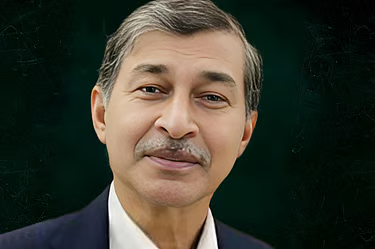
The recent allegiance of Maulvi Muhammad Baloch’s group:
Highlights TTP’s deepening footprint in Balochistan, challenging Pakistani state authority in the southwest.
Signals continued fusion of Baloch separatist and Taliban-aligned jihadist ideologies, consolidating a broader insurgency network.
Reinforces suspicions of external interference, particularly Indian intelligence leveraging Afghan sanctuaries to destabilize Pakistan from within.
Pakistan’s Counterterrorism Response & Regional Fallout
Pakistan has conducted multiple “sanitization operations” in North Waziristan and Khyber Pakhtunkhwa, targeting emerging militants and network facilitators (AP News). Yet, as TTP’s violence surged—a 90% spike in terror-related deaths in 2024—the threat landscape has only intensified .
Amid this, Pakistan maintains India’s strategic footprint is central to hijacking insurgent movements for geopolitical gain—destabilizing border regions and undermining infrastructure initiatives like CPEC.
Conclusion
The pledge of allegiance by Maulvi Muhammad Baloch’s Kalat faction to Mufti Noor Wali is emblematic of a broader militant regrouping: splintered jihadist, separatist, and extremist elements are converging under the TTP banner. This consolidation, allegedly abetted by India through Afghan channels, not only undermines Pakistan’s national stability but also underscores the complexity of proxy warfare in the region. The unfolding trend demands rigorous counterterrorism vigilance and calibrated diplomacy to curtail external influence over insurgent realignments.