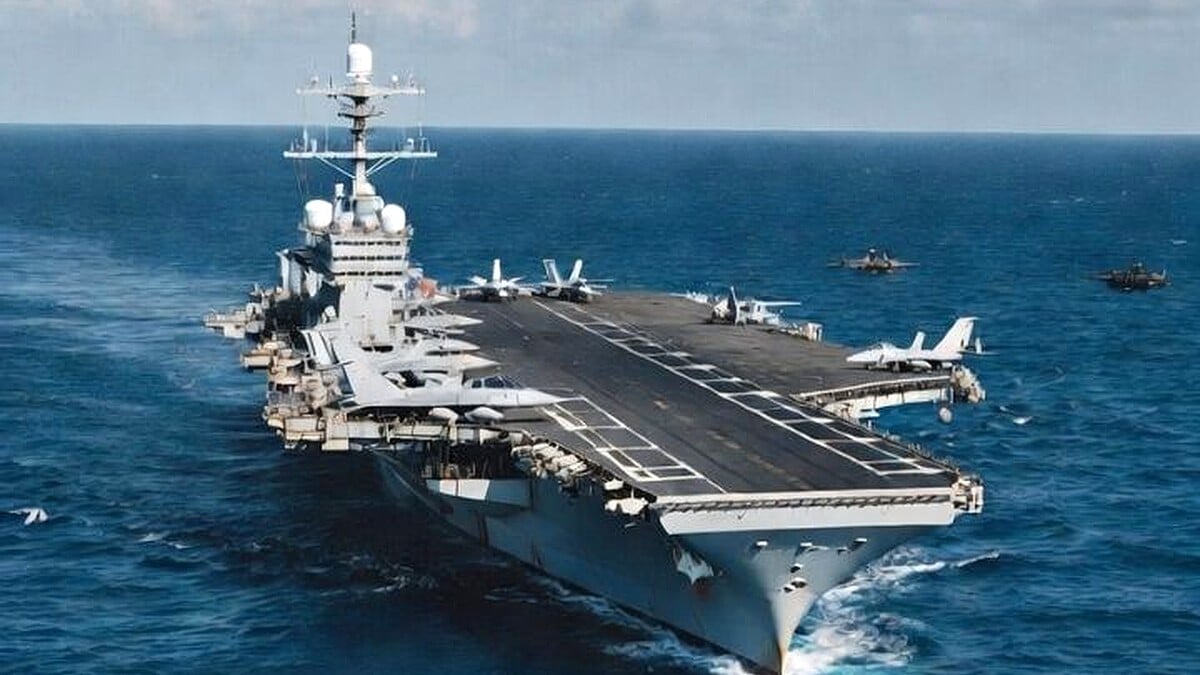
ISLAMABAD: The USS Gerald R. Ford (CVN-78), the lead ship of the United States Navy’s most technologically advanced carrier class, is scheduled to return to Souda Naval Base in Crete next week after departing its current station in the Northern Red Sea.
The movement follows a major onboard fire that broke out on March 12 in the ship’s main laundry facility, prompting an extensive damage control effort that lasted more than thirty hours.
US Central Command confirmed the incident was non-combat related, with no impact to the nuclear propulsion systems and the carrier remaining mission-capable throughout.
Two sailors suffered minor injuries that were treated onboard, while a third crew member required medical evacuation for additional evaluation and care.
The fire spread through ventilation ducts, severely damaging several berthing compartments and rendering proper sleeping accommodations unavailable for more than 600 sailors.
Many crew members have since resorted to sleeping on deck plates, tables and other temporary surfaces, highlighting significant habitability challenges in the aftermath.
The Gerald R. Ford is expected to arrive at Souda Bay primarily for nuclear refueling operations, routine resupply and detailed assessment of the fire damage.
The Crete base, a strategic NATO facility used by US naval forces, previously hosted the carrier in late February during its initial transit toward the Middle East.
Beyond refueling and logistics, the stop will allow naval investigators to conduct a thorough examination of the blaze, including analysis of its origin and contributing factors.
Greek media outlet Kathimerini reported that officials are exploring multiple causes, including the possibility that the fire may have been intentionally set by disaffected crew members seeking to curtail the mission.
No official US Navy statement has corroborated or denied that specific line of inquiry, with spokespersons maintaining focus on the accidental nature of the event and successful containment.
The return to Souda Bay signals a likely pause in the carrier’s active operations within the Red Sea theater.
Current indications suggest the ship will not immediately resume station-keeping duties following repairs and inspections, with a probable westward transit toward its homeport in Norfolk, Virginia.
The Gerald R. Ford entered the region in early March after passing through the Suez Canal, having previously operated in the eastern Mediterranean.
Its deployment, part of the broader US naval response to regional tensions including support for Operation Epic Fury, has now exceeded 250 consecutive days at sea.
Projections place the total mission duration between ten and eleven months, approaching some of the longest carrier deployments recorded in recent decades.
Such extended periods away from home impose considerable strain on personnel, equipment maintenance cycles and overall force readiness.
The fire incident has amplified existing concerns about crew fatigue, morale and the human cost of sustained high-tempo operations in contested maritime environments.
Despite the challenges, the carrier strike group continues to provide essential presence and capability in coordination with allied forces.
The decision to reposition the Gerald R. Ford to Crete reflects standard protocol for addressing significant material casualties while preserving operational flexibility.
Naval analysts anticipate that findings from the ongoing investigation will inform future policies on deployment length, crew support programs and damage prevention measures aboard next-generation platforms.
The ship’s advanced systems, including the electromagnetic aircraft launch system and increased sortie generation capacity, underscore its strategic value even as the service manages the consequences of prolonged forward deployment.
As the carrier prepares for its return to Souda Bay, attention remains on balancing mission demands with the welfare of the more than 4,500 sailors serving aboard.
The forthcoming weeks are expected to bring greater clarity on repair timelines, investigation outcomes and the next phase of the strike group’s activities in the region.