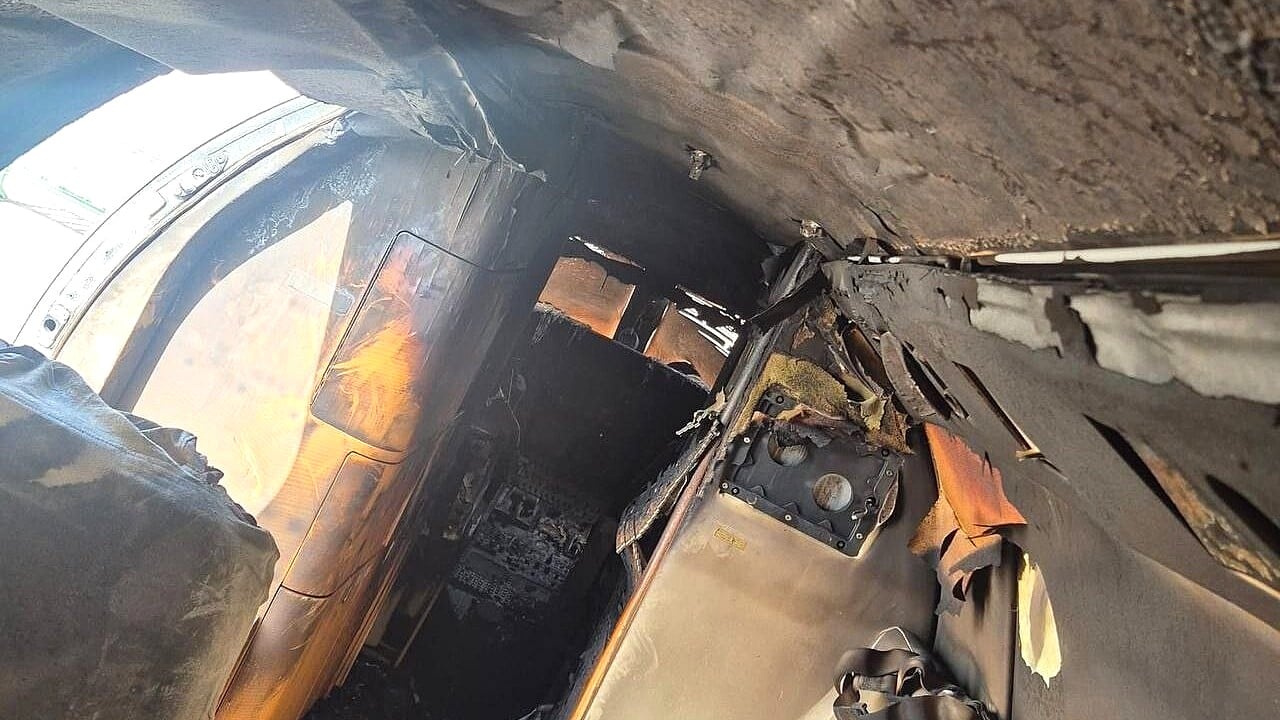
ISLAMABAD: Israel has officially acknowledged that three aircraft sustained severe damage at Ben Gurion International Airport following recent Iranian missile attacks.
The Israel Airports Authority confirmed on Wednesday that the aircraft, parked at the facility near Tel Aviv, were hit by debris from intercepted Iranian ballistic missiles.
Authorities described the damage as “severe,” with reports indicating one plane caught fire and was completely destroyed while the other two suffered significant structural harm.
No injuries were reported among personnel or passengers, as the incident involved non-commercial private planes rather than operational civilian or military aircraft.
The strikes form part of a prolonged exchange of missile barrages between Iran and Israel, intensified by broader regional hostilities involving US and allied forces.
Iran’s Islamic Revolutionary Guard Corps has repeatedly claimed targeting Ben Gurion Airport and associated Israeli Air Force installations in recent waves of attacks.
These include the use of heavy Khorramshahr-4 ballistic missiles equipped with one-tonne warheads, aimed at disrupting key infrastructure in central Israel.
Israeli air defence systems, including the multi-layered Arrow and David’s Sling networks, intercepted most incoming projectiles, preventing direct hits on critical runways or terminals.
However, falling debris from successful interceptions has emerged as a persistent hazard, scattering shrapnel across airport grounds and necessitating immediate runway sweeps.
Specialized teams routinely deploy vehicles to clear fragments after each alert, allowing operations to resume under strict safety protocols.
Ben Gurion Airport, Israel’s primary international gateway, has continued functioning amid the threats, though with frequent disruptions including temporary flight halts and mid-air holds.
The facility has adapted to wartime conditions, evacuating numerous parked aircraft earlier in the conflict and enforcing rigorous checks for shrapnel.
Witness accounts describe sirens blaring repeatedly, with passengers experiencing delays and heightened security measures.
The airport’s resilience stands out, as no other major civilian hub has operated under such sustained missile fire from a state adversary.
Military analysts note that Iran’s strategy appears focused on saturation attacks to overwhelm defences, even if direct impacts remain limited.
Debris-related damage highlights vulnerabilities in interception outcomes, where high-altitude explosions can rain fragments over wide areas.
In previous Iranian salvos, such as those in late 2024 and early 2026, impacts near airbases like Nevatim caused hangar and taxiway damage, though operational capacity endured.
The latest admission regarding Ben Gurion underscores the cumulative toll on civilian-adjacent infrastructure.
Private aircraft owners have yet to be publicly identified, but losses could run into millions given the value of executive and business jets.
Airport operations remain constrained, with duty-free areas sparsely populated and travelers opting for temporary exits from the country.
Some Israelis have cited ongoing cluster munition concerns and daily alerts as reasons for brief relocations abroad.
The conflict’s escalation traces back to retaliatory cycles, including Israeli and US strikes on Iranian nuclear and military sites.
Iran has framed its actions as defensive responses to perceived aggression against its sovereignty.
Israeli officials have vowed consequences for each attack, maintaining that air superiority persists despite occasional close calls.
Reports of a fighter jet nearly struck over Iran during operations further illustrate the risks in contested airspace.
Broader regional fallout includes damage to US assets, such as refueling aircraft at bases in Saudi Arabia from related Iranian strikes.
These incidents compound strains on allied logistics and interceptor stockpiles.
Ben Gurion’s ability to weather the storm reflects meticulous planning by the Israel Airports Authority and Home Front Command.
Runway clearance protocols ensure minimal downtime, though cumulative effects on passenger confidence and economic activity loom large.
Aviation experts warn that prolonged disruptions could deter international carriers and impact tourism and business travel.
The airport’s role in repatriation flights has also faced challenges, with some diverted or delayed due to active threats.
As exchanges continue, attention focuses on whether diplomatic channels can halt the missile tit-for-tat.
No immediate de-escalation appears likely, with both sides signaling readiness for further responses.
The damage to three private planes serves as a tangible reminder of the conflict’s reach into civilian spheres.
Israeli authorities emphasize that core military competence remains unaffected, with air force operations continuing unabated.
Yet the incident at Ben Gurion Airport reveals the indirect costs of advanced missile warfare in densely populated regions.
Iranian claims of precise strikes contrast with Israeli reports of limited direct impacts, highlighting information warfare dimensions.
Independent verification remains difficult amid censorship and restricted access to affected zones.
Satellite imagery from earlier episodes showed craters and structural harm at military sites, though Ben Gurion specifics await similar analysis.
The episode adds to the narrative of a grinding, attritional conflict with no swift resolution in sight.
Regional stability hangs in the balance as missile debris continues to pose risks long after launches.