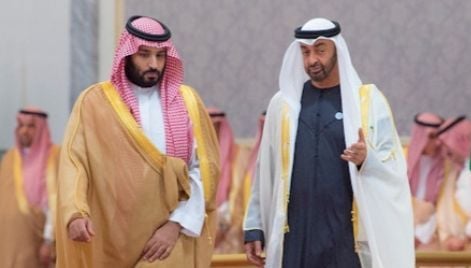
ISLAMABAD: US President Donald Trump has confidently stated that he could resolve the existing rift between Saudi Arabia and the United Arab Emirates with relative ease, while confirming he is not currently involved in mediation efforts.
The remarks were made during an interaction with reporters aboard Air Force One on February 17, 2026, as Trump returned to Washington from his Mar-a-Lago estate in Florida. He acknowledged the presence of genuine differences between the two Gulf nations, yet described the matter as straightforward to address.
Trump emphasized his experience in settling international disputes, noting that he has successfully mediated numerous conflicts between countries. He characterized the Saudi-UAE issue as comparatively simple, stating it could be settled very easily if pursued.
Reports from Anadolu Agency, Bernama, and other international outlets covered the president’s comments, highlighting his reluctance to engage actively at present. Trump indicated no immediate plans for direct intervention, suggesting the parties manage their differences independently for now.
The tensions stem primarily from divergent strategies in Yemen’s ongoing conflict. Saudi Arabia has prioritized combating Houthi rebels while preserving Yemen’s territorial unity under the internationally recognized government. The UAE, following a partial military withdrawal, has supported the Southern Transitional Council, a separatist group advocating greater southern autonomy.
In late 2025, the Southern Transitional Council advanced into eastern governorates such as Hadhramaut and Mahra, areas bordering Saudi Arabia. This move prompted Riyadh to launch airstrikes against perceived UAE-linked positions, including a weapons shipment at Mukalla port on December 30, 2025.
Saudi forces, aligned with the Presidential Leadership Council, subsequently rolled back these gains. The Southern Transitional Council announced its dissolution on January 9, 2026, amid Riyadh’s diplomatic and military pressure.
The UAE completed its withdrawal from Yemen, with Saudi Arabia pledging significant financial support—reportedly up to $3 billion—for Yemen’s security and development in southern regions previously influenced by Abu Dhabi.
Analysts view these events as symptomatic of deeper strategic divergences. Saudi Arabia seeks a stable southern border and Red Sea security corridor, viewing Emirati-backed separatism as a potential threat to national integrity. The UAE pursues maritime and logistical interests through control of key ports and influence in the Horn of Africa.
The rivalry extends beyond Yemen to Sudan, Somalia, and broader economic competition within the Gulf Cooperation Council. In Sudan, accusations link the UAE to support for the Rapid Support Forces, contrasting with Saudi backing for the Sudanese Armed Forces.
Such frictions risk fragmenting regional alliances against shared threats, including Iranian influence and Houthi activities disrupting Red Sea shipping. A prolonged discord could affect global energy markets, given Saudi Arabia’s leading oil export role and the UAE’s trade hub status.
Trump’s approach reflects his transactional foreign policy style, relying on personal relationships with Saudi Crown Prince Mohammed bin Salman and UAE President Mohammed bin Zayed. These ties facilitated initiatives like the Abraham Accords during his earlier tenure.
The president’s offer, though not actively pursued, signals US interest in Gulf cohesion. Washington maintains deep military and economic partnerships with both nations, viewing their unity as essential for countering regional challenges.
Historical precedents, such as the 2017-2021 Qatar blockade involving Saudi Arabia, the UAE, Bahrain, and Egypt, required extended diplomacy before resolution at the Al-Ula summit in 2021. That episode illustrated how GCC divisions impact energy stability and counterterrorism cooperation.
Current developments have prompted cautious US responses, with the administration likely urging restraint through back-channel communications to prevent escalation resembling past crises.
Observers note that while direct military confrontation between Saudi Arabia and the UAE remains improbable, proxy competitions continue to reshape Middle East dynamics. Saudi efforts now focus on consolidating influence in southern Yemen through dialogue with local leaders and financial commitments.
The UAE’s reduced direct involvement may shift its regional strategy toward subtler influence mechanisms. Both countries retain strong incentives for eventual reconciliation, given mutual economic interdependence and shared security concerns.
Trump’s public confidence underscores the potential of leader-level diplomacy in bridging gaps. Success, however, hinges on Riyadh and Abu Dhabi’s willingness to prioritize collective stability over individual ambitions.
As the situation evolves, international attention remains fixed on whether high-level engagement can prevent further fragmentation in an already volatile region.