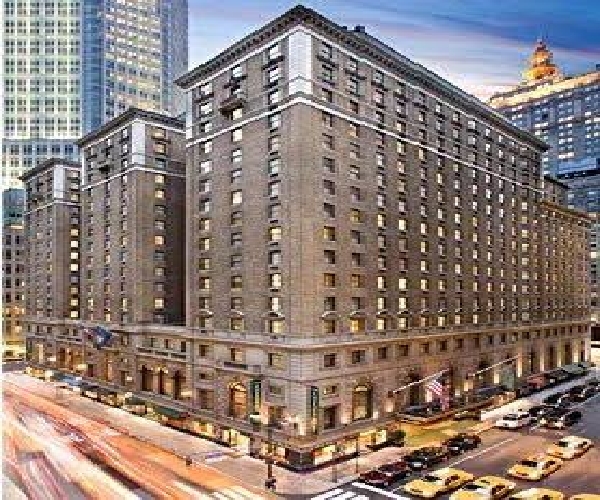
The government of Pakistan has returned to the initial stages of its efforts to monetize the historic Roosevelt Hotel in New York, seeking a new financial adviser to facilitate a joint venture redevelopment valued potentially at several billion dollars, amid persistent challenges and skepticism surrounding the multi-year process.
ISLAMABAD: Pakistan’s Privatization Commission has reinitiated the search for a qualified financial adviser to advance the long-delayed monetization of the Roosevelt Hotel, a prime Midtown Manhattan property owned by the state through Pakistan International Airlines (PIA) entities.
The commission recently issued a request for proposals to engage a broker with proven expertise in major United States metropolitan transactions, particularly in Manhattan, following the rejection of most prior bids for non-compliance.
This development marks a return to square one after earlier engagements faltered, including the resignation of Jones Lang LaSalle (JLL) in 2025 due to a potential conflict of interest arising from heightened client interest in the vacant site.
The Roosevelt Hotel, located at 45 East 45th Street opposite Grand Central Terminal, spans approximately 600,000 square feet across 19 stories and features 1,025 rooms, though it has remained closed to guests since 2020 after financial struggles.
Originally opened in 1924 and acquired by PIA in 2000 for about $36.5 million following a lease arrangement from 1979, the property represents one of Pakistan’s most valuable overseas assets in a high-demand commercial district near Times Square.
Government officials, including Prime Minister Shehbaz Sharif’s adviser on privatization Muhammad Ali, who chairs the Privatization Commission, have emphasized a joint venture model over an outright sale to maximize long-term value.
Under the proposed structure, Pakistan would contribute the land while a private partner injects approximately $1 billion in equity, supplemented by $2 billion to $3 billion in debt financing, resulting in a total project scale of $3 billion to $5 billion.
The redevelopment envisions transforming the site into a high-rise mixed-use tower, potentially 50 to 60 stories with 1.8 million square feet of office, residential, or commercial space, significantly enhancing the asset’s worth.
Officials project that this approach could increase the value of Pakistan’s retained stake by more than 200 percent, even as ownership dilutes to around 40 to 50 percent post-transaction.
The plan aligns with broader IMF-backed privatization efforts, including the recent successful divestment of a majority stake in PIA to a consortium led by Arif Habib Corporation, while retaining strategic assets like the Roosevelt Hotel under government control.
Earlier attempts included marketing the property for sale or partnership in 2024 via JLL, with expectations of an initial $100 million payment by mid-2026 under a joint venture.
However, the process encountered setbacks, such as JLL’s withdrawal and the disqualification of non-compliant proposals from seven bidding groups, including consortia led by Citigroup, CBRE with Morgan Stanley, and others.
Market observers in New York have expressed skepticism about the timeline and execution, citing Pakistan’s bureaucratic history of indecision on the asset since its acquisition over two decades ago.
Despite strong global interest from banks, technology firms, and developers seeking prime Manhattan space, the repeated resets raise questions about achieving a swift and transparent conclusion.
The commission aims to appoint a new adviser within weeks to build on prior due diligence and transaction structuring completed in 2024.
This initiative forms part of Pakistan’s strategy to generate revenue from non-core state assets amid economic pressures, including debt management and foreign reserve stabilization.
The Roosevelt Hotel’s prime location and redevelopment potential continue to attract attention, yet the path forward depends on securing a credible partner and navigating regulatory complexities in both Pakistan and the United States.
As the process restarts, stakeholders await clarity on whether this latest effort will finally unlock the site’s substantial economic promise or prolong the uncertainty that has characterized the endeavor.