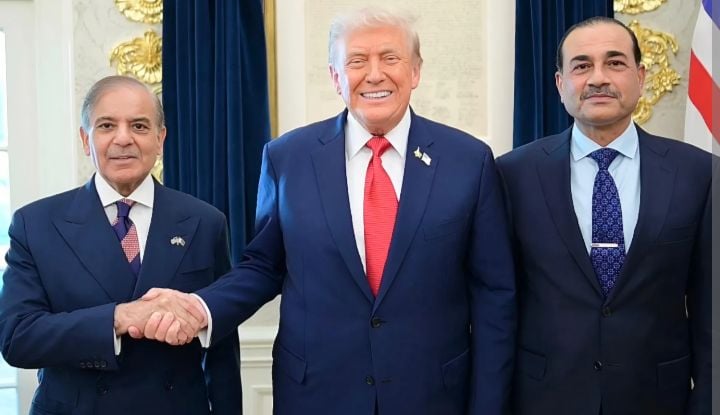
ISLAMABAD: Prime Minister Shehbaz Sharif arrived in Washington to attend the high-profile summit of the Board of Peace (BoP), a US-led initiative spearheaded by President Donald Trump that seeks to reshape post-war stabilisation efforts in Gaza and beyond. While the summit’s stated objective is to consolidate a fragile ceasefire and mobilise billions of dollars for reconstruction, Pakistani policymakers are weighing a far more delicate question: could joining a proposed International Stabilisation Force entangle Islamabad in a conflict with grave domestic and diplomatic consequences?
The BoP summit, hosted under the patronage of the United States administration, aims to formalise three pillars — sustaining the Gaza ceasefire, launching a $5 billion reconstruction pool announced by Washington, and structuring a lean, leader-driven global forum positioned as an alternative to the slower consensus-based mechanisms of the United Nations. At the centre of discussions is the proposed International Stabilisation Force (ISF), envisaged to secure reconstruction corridors and oversee transitional governance arrangements.
However, statements attributed to President Trump and Israeli Prime Minister Benjamin Netanyahu — suggesting that any stabilisation mechanism must ensure Hamas is disarmed — have complicated the calculus for Muslim-majority states, including Pakistan. Diplomatic sources indicate that while several countries are open to contributing logistical or peacekeeping support, they are wary of any mandate that could place their troops in direct confrontation with Hamas or align them with coercive disarmament operations.
For Pakistan, the stakes are unusually high.
The Pakistan Army has long participated in UN peacekeeping missions, earning international credibility for professionalism in Africa and the Middle East. Yet the ISF would not be a UN-mandated force but rather a coalition-based deployment structured outside traditional multilateral frameworks. Legal scholars caution that operating without explicit UN Security Council authorisation could expose participating states to accusations of breaching international norms or siding in an unresolved armed conflict.
Domestically, the political ramifications could be profound.
Public sentiment in Pakistan remains overwhelmingly sympathetic to the Palestinian cause. Major religious parties and segments of civil society have consistently framed the Gaza conflict as a struggle against occupation. Should Islamabad commit troops to a force perceived as tasked with disarming Hamas — an entity widely viewed domestically as part of Palestinian resistance — the government could face street protests, parliamentary backlash, and heightened political polarisation.
Security analysts also warn of the risk of militant blowback. Pakistan’s experience during the post-9/11 era demonstrates how alignment with US-led security frameworks can trigger internal instability. Militant groups could exploit any deployment narrative to justify retaliatory violence, potentially reviving dormant extremist networks.
Economic considerations further complicate the decision.
Pakistan’s fragile economy relies heavily on multilateral financial institutions and bilateral partnerships. While Washington has not publicly linked ISF participation to economic incentives, diplomatic observers note that strategic alignment often influences broader bilateral relations. Refusal to contribute troops might irritate the Trump administration, particularly if the BoP becomes a flagship foreign policy initiative.
Yet acquiescence carries its own risks.
Analysts argue that joining a force perceived as targeting Hamas could strain Pakistan’s relations with key regional partners, including Iran and certain Gulf constituencies sensitive to Palestinian politics. It may also complicate Islamabad’s long-standing diplomatic position advocating a two-state solution based on pre-1967 borders and the status of Jerusalem.
The institutional design of the BoP reflects Washington’s preference for agile coalitions capable of rapid deployment. Proponents argue that such flexibility allows for quicker stabilisation compared to the bureaucratic inertia of the United Nations. Critics, however, question both legitimacy and sustainability, warning that peacekeeping without a clear political settlement risks entrenching conflict rather than resolving it.
Military experts emphasise the importance of mandate clarity.
If the ISF were confined strictly to securing humanitarian corridors and protecting reconstruction infrastructure under internationally recognised parameters, participation might resemble traditional peacekeeping. But if operational directives extend to forcibly disarming factions or enforcing political arrangements, the mission would shift from stabilisation to coercion.
Such a shift could transform Pakistani troops from neutral peacekeepers into perceived combatants.
There is also the constitutional dimension. Any overseas deployment requires careful coordination between the civilian leadership and military command. Previous peacekeeping commitments were framed within established UN protocols, offering political cover and legal justification. The absence of that framework could intensify scrutiny from opposition parties and constitutional experts.
Strategically, Islamabad must weigh its long-term diplomatic positioning.
Maintaining balanced relations with Washington remains important, particularly in trade, security cooperation and multilateral advocacy. At the same time, Pakistan has sought to reinforce its image as a principled advocate for Palestinian statehood and broader Muslim solidarity. A miscalculated deployment could undermine that narrative.
Observers suggest a middle path may be under consideration — offering financial contributions, humanitarian expertise, or limited non-combat logistical support while refraining from direct troop involvement. Such an approach would signal goodwill toward Washington without exposing Pakistan to the full spectrum of risks associated with a combat-capable stabilisation mandate.
Ultimately, the decision will hinge on the final contours of the ISF mandate emerging from the summit. Clear legal authorisation, explicit humanitarian parameters and credible guarantees regarding Palestinian political rights could mitigate some concerns. Conversely, an open-ended security mission framed around disarmament could place Islamabad in a precarious position domestically and internationally.
As the Board of Peace seeks to chart a new course in post-conflict governance, Pakistan’s leadership faces a familiar but formidable dilemma: balancing alliance expectations with national sentiment, safeguarding economic stability while preserving diplomatic credibility, and supporting global peace without compromising domestic cohesion.
In a volatile regional environment, the cost of miscalculation could be far greater than the promise of participation.