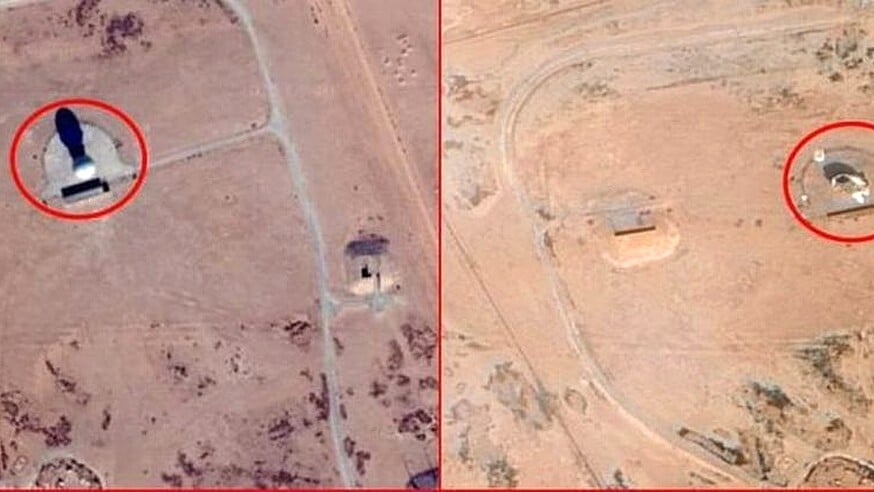
ISLAMABAD: An Iranian drone strike has destroyed a US-made AN/FPS-117 early warning radar installed at Al-Qaisumah Airport in northeastern Saudi Arabia, marking a significant escalation in regional aerial confrontations and exposing vulnerabilities in Gulf air defence networks.
The attack, reported on March 17, targeted the long-range surveillance system located at the civilian-military facility in Hafar Al-Batin area of Saudi Arabia’s Eastern Province. Satellite imagery and open-source intelligence have geolocated the site at coordinates 28°20’49″N 46°07’43″E, confirming damage to the radar installation following the precision drone strike.
The AN/FPS-117, manufactured by Lockheed Martin, serves as a critical component of integrated air defence. Operating in the L-band frequency, it provides three-dimensional detection and tracking capabilities for airborne threats. The system can identify aircraft, cruise missiles, ballistic missiles and unmanned aerial vehicles at ranges exceeding several hundred kilometres, often up to 400 km under optimal conditions.
Saudi Arabia operates multiple units of this radar as part of its layered defence architecture, which includes upgrades requested through foreign military sales programmes. The destroyed unit at Al-Qaisumah contributed to monitoring vast airspace over the kingdom’s northeastern border, an area proximate to potential threat vectors from Iraq and beyond.
Reports indicate the strike was carried out using Iranian-designed one-way attack drones, highlighting Tehran’s evolving capability to conduct standoff operations with low-cost munitions against high-value targets. Such drones, costing tens of thousands of dollars each, contrast sharply with the multimillion-dollar radar systems they neutralise, underscoring asymmetric warfare dynamics in the ongoing conflict.
This incident forms part of a broader pattern of Iranian retaliatory actions across the Middle East. Recent strikes have targeted similar high-priority assets, including AN/TPY-2 radars associated with THAAD batteries in Jordan and other Gulf locations. Cumulative losses to US and allied radar infrastructure have reached substantial figures, with estimates suggesting billions of dollars in damaged or destroyed equipment.
The destruction at Al-Qaisumah Airport raises immediate concerns for Saudi air defence integrity. Without this radar, coverage gaps may emerge in early warning for incoming threats, potentially forcing reliance on adjacent systems or alternative surveillance methods. Military analysts note that replacing such specialised radars involves lengthy procurement, installation and calibration processes, often spanning years.
Regional tensions have intensified amid reciprocal strikes between Iran and US-Israeli coalitions. Iranian forces have prioritised degrading enemy sensor networks to complicate missile defence coordination. This approach aims to reduce the effectiveness of integrated systems that feed data to interceptors across the Arabian Peninsula.
Saudi authorities have not issued an official confirmation of the strike or the extent of damage, consistent with protocols for sensitive military infrastructure. However, open-source reports, including satellite observations and geolocated imagery shared on specialised platforms, provide corroborating evidence of the radar’s destruction.
The event occurs against a backdrop of heightened drone activity in the Gulf. Saudi air defences have intercepted numerous hostile unmanned systems in recent months, though penetrations persist in targeting strategic sites. Civilian aviation at Al-Qaisumah, primarily serving domestic routes, remains unaffected in terms of operations, though security protocols may have been tightened.
Experts emphasise that the loss of even a single AN/FPS-117 unit weakens the overall early warning posture. The radar’s mobility and long-range detection make it valuable for border surveillance, particularly in vast desert regions where ground-based alternatives prove limited.
Iran’s demonstrated precision in such operations signals advancements in drone guidance and targeting. By focusing on radar installations, attackers seek to blind adversaries before larger barrages, a tactic observed in multiple theatres.
The strike’s implications extend beyond immediate military effects. It reinforces perceptions of vulnerability in static, high-value assets amid proliferating low-cost aerial threats. Defence planners in the region and beyond may accelerate investments in distributed sensor networks, electronic warfare countermeasures and hardened facilities.
As confrontations continue, the destruction of the AN/FPS-117 at Al-Qaisumah serves as a stark reminder of evolving warfare realities, where technological superiority faces challenges from affordable, asymmetric tools.