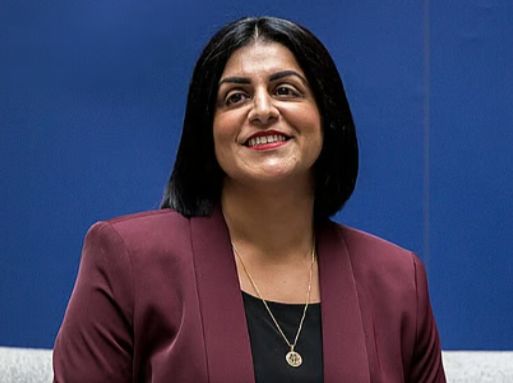
ISLAMABAD: British Prime Minister Sir Keir Starmer is confronting intense political pressure that has raised speculation about a possible no-confidence motion or forced resignation, with Home Secretary Shabana Mahmood positioned as a leading contender to replace him and potentially become the United Kingdom’s first Muslim and Pakistani-origin prime minister.
The crisis intensified in early February 2026 following revelations from Jeffrey Epstein-related files that highlighted the depth of ties between Lord Peter Mandelson, whom Starmer appointed as UK ambassador to the United States, and the late sex offender Jeffrey Epstein.
This appointment triggered widespread backlash, with critics questioning Starmer’s political judgment and accusing him of undermining public trust in government.
Key resignations compounded the turmoil, as Starmer’s chief of staff, Morgan McSweeney, stepped down after accepting responsibility for advising on the Mandelson nomination.
Shortly afterward, the prime minister’s communications director, Tim Allan, also resigned, citing the need for a refreshed team at Downing Street.
These departures exposed internal fractures within the Labour Party and fueled perceptions of instability at the highest levels.
Scottish Labour leader Anas Sarwar, a prominent figure in the party, became the most senior voice to publicly call for Starmer’s resignation, describing the situation as marked by “too many mistakes” in Downing Street.
Sarwar’s intervention marked a significant escalation, as it represented dissent from within Labour’s ranks rather than solely from opposition parties.
Opposition Conservative leader Kemi Badenoch seized on the moment, declaring that Labour had “lost confidence” in Starmer and describing his position as “in office, but not in power.”
She indicated that her party remained prepared to table a vote of no confidence in the House of Commons, though she noted it was not yet the appropriate stage for such action.
Liberal Democrats echoed calls for a confidence vote to test Starmer’s support among his own lawmakers.
Despite the mounting challenges, Starmer has maintained a defiant stance, repeatedly affirming his commitment to remain in office.
In public statements, he declared he would “never walk away from the mandate” given to him by voters or from “the country that I love.”
Cabinet ministers rallied around him in a show of unity, with senior figures issuing statements of support to quell immediate speculation about a leadership challenge.
Analysts note that Labour’s substantial parliamentary majority, secured in the 2024 general election, makes an opposition-led no-confidence motion highly unlikely to succeed without substantial defections from Labour MPs.
A formal leadership contest within Labour would require a challenger to secure nominations from at least 20 percent of the party’s MPs, equivalent to roughly 81 lawmakers under current rules.
No such threshold has been met publicly, and the party has no formal mechanism for a parliamentary vote of no confidence against its own leader akin to those in some other systems.
Starmer’s approval ratings have remained low, with recent polls showing net favourability in negative territory, though a slight recovery was observed in mid-February 2026 following the initial crisis peak.
The controversy has intersected with broader governance issues, including policy U-turns on local elections, immigration reforms, and economic measures, which have further eroded public and internal party confidence.
Amid this uncertainty, attention has turned to potential successors, with Home Secretary Shabana Mahmood emerging prominently in media reports and betting markets.
Mahmood, born in Birmingham to parents from Mirpur in Azad Kashmir, has Pakistani heritage and serves as one of the most senior figures in the current cabinet.
Appointed Home Secretary in the September 2025 cabinet reshuffle, she replaced Yvette Cooper and has overseen critical portfolios including immigration, law and order, and national security.
Her tenure has featured hardline approaches to border controls and unauthorized migration, earning support from the centre-right of the Labour Party.
As a former barrister and MP for Birmingham Ladywood, Mahmood has built a reputation for persuasive oratory and pragmatic policymaking.
Reports indicate she is viewed as a credible contender in any leadership contest, with bookmakers placing her odds in the range of 7/1 to 12/1 and prediction platforms assigning her a notable probability.
If elevated to prime minister while Labour retains its majority, Mahmood would achieve historic milestones as the UK’s first Muslim prime minister, first female Muslim leader, and first of Pakistani origin.
Other figures, including Deputy Prime Minister Angela Rayner and Health Secretary Wes Streeting, have also been mentioned, but Mahmood’s profile has risen sharply amid the current turmoil.
Political observers caution that the situation remains fluid, with Starmer’s allies working to stabilize his position through demonstrations of cabinet solidarity and policy delivery.
The Epstein fallout has damaged perceptions of judgment, yet no immediate trigger for resignation or a successful no-confidence motion has materialized.
The coming weeks, including local elections and ongoing scrutiny, will likely determine whether the pressure subsides or intensifies further.
For now, Starmer clings to power, while names like Shabana Mahmood highlight the potential for transformative change at the top of British government.