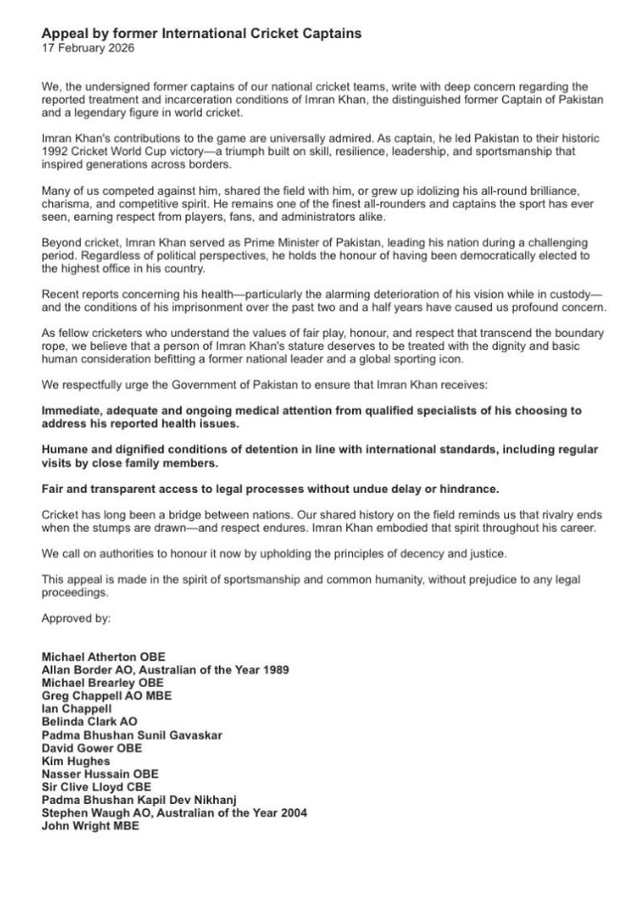
ISLAMABAD: A group of fourteen former international cricket captains has issued a rare cross-border humanitarian appeal calling for improved prison conditions and immediate medical attention for Pakistan’s jailed former prime minister Imran Khan.
The petition, drafted by former Australian captain Greg Chappell, highlights deep concern over Khan’s reported health deterioration, particularly the alarming loss of vision in his right eye during more than two and a half years of incarceration.
Signatories include Indian cricket icons Sunil Gavaskar and Kapil Dev, alongside Australia’s Ian Chappell, Allan Border, Steve Waugh, Belinda Clark and Kim Hughes, England’s Mike Atherton, Nasser Hussain, Mike Brearley and David Gower, West Indies’ Clive Lloyd, and New Zealand’s John Wright.
Many of these former captains competed against Khan on the field or admired his all-round brilliance, charisma and competitive spirit throughout his storied cricket career.
Khan, now 73, captained Pakistan to the 1992 World Cup victory and later transitioned into politics, founding the Pakistan Tehreek-e-Insaf party and serving as prime minister from 2018 until his ouster via a no-confidence vote in April 2022.
Since August 2023, he has remained in Adiala Jail in Rawalpindi, facing convictions in multiple cases that his supporters and he describe as politically motivated revenge by the subsequent government.
His lawyer, Salman Safdar, informed the Supreme Court last week that Khan had suffered significant vision impairment in his right eye while in custody, initially reported as leaving him with only 15 percent sight due to central retinal vein occlusion and delayed treatment.
A medical board examination conducted in jail on Sunday, following Supreme Court orders, reported some improvement after treatment, with unaided vision in the right eye at 6/24 partial and improved to 6/9 partial with glasses.
The board noted that a second dose of anti-VEGF injection may be required as per schedule, describing the current vision as substantially good at this stage compared to earlier concerns.
However, Khan’s personal physician, Dr Aasim Yusuf, stated he could not independently verify the improvement since prison authorities have not permitted him access to examine the former premier directly.
Khan’s family and party representatives have rejected aspects of the official medical updates, insisting on independent verification and expressing ongoing worries about his overall health and isolation.
The petition emphasizes values of fair play, honour and respect that transcend cricket boundaries, asserting that a figure of Khan’s stature as a former national leader and global sporting icon deserves dignified and humane treatment in line with international standards.
It respectfully urges the Government of Pakistan to provide immediate, adequate and ongoing medical attention from qualified specialists of Khan’s choosing, humane detention conditions including regular family visits, and fair, transparent access to legal processes without undue delays.
The appeal arrives against a backdrop of heightened scrutiny over Khan’s incarceration, including prior accusations from his side of substandard conditions, solitary confinement periods and restricted medical access.
Pakistan Tehreek-e-Insaf leaders have repeatedly highlighted these issues in court petitions and public statements, linking them to broader claims of political victimization.
The office of Prime Minister Shehbaz Sharif has indicated it has not yet formally received the captains’ statement, though the petition was directed to his government.
This intervention from the global cricket community underscores the enduring respect for Khan’s legacy as one of the game’s finest all-rounders, who took 362 Test wickets and scored over 3,800 runs in the longest format, besides leading memorable triumphs.
His contributions extended beyond the field, including establishing the Shaukat Khanum Memorial Cancer Hospital, reflecting his commitment to social causes.
The signatories’ action, despite geopolitical tensions between nations like India and Pakistan, including recent military frictions, demonstrates how shared sporting history can foster appeals for basic human consideration.
Observers note that such endorsements from revered figures may amplify international attention on Khan’s case, potentially influencing discussions around prison reforms and political detainees’ rights in Pakistan.
Khan’s legal team has filed petitions seeking his release on medical grounds, citing the eye condition as a pressing humanitarian issue requiring urgent resolution.
As the situation develops, the petition serves as a reminder of the intersection between sportsmanship and advocacy for justice, urging authorities to prioritize dignity and health in handling high-profile cases.