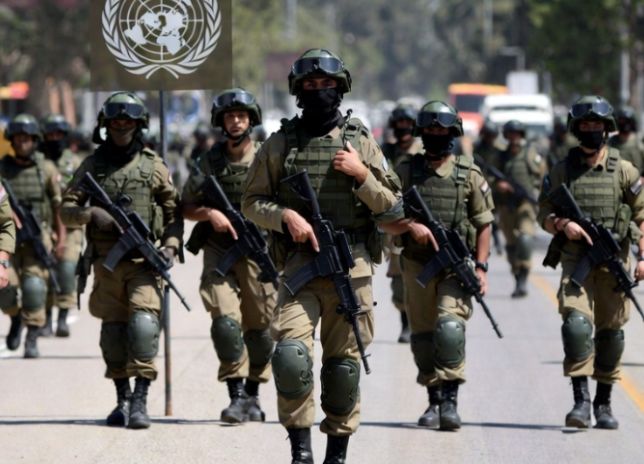
ISLAMABAD: Indonesia is gearing up to contribute up to 8,000 troops for a potential deployment to Gaza by June as part of a proposed multinational peacekeeping force under a UN-mandated International Stabilisation Force.
The announcement marks one of the most concrete commitments to date for stabilising the war-torn territory following a US-brokered ceasefire.
Army spokesperson Brigadier General Donny Pramono stated that an initial contingent of around 1,000 soldiers could be ready for early deployment by April.
The full force, structured as a composite brigade, would follow progressively, with readiness achieved by the end of June.
Pramono emphasised that the deployment timeline depends entirely on political decisions by the Indonesian government and relevant international mechanisms.
Final authorisation rests with President Prabowo Subianto, who is navigating domestic and diplomatic considerations.
Indonesia’s foreign ministry has clarified that participation does not imply normalisation of relations with Israel, a state Jakarta does not recognise diplomatically.
The ministry reiterated on Saturday that the mission remains strictly humanitarian and non-combatant in nature.
Indonesian troops would focus on engineering, medical support, and humanitarian assistance rather than engaging in combat operations.
The mandate explicitly requires consent from the Palestinian Authority and excludes any role in demilitarising parties to the conflict.
Indonesia has consistently opposed forced displacement or demographic changes affecting Palestinians.
This position aligns with Jakarta’s longstanding support for Palestinian self-determination and a two-state solution.
The peacekeeping preparations coincide with the inaugural Board of Peace meeting, chaired by US President Donald Trump.
The Board of Peace serves as a framework for postwar reconstruction and stabilisation in Gaza.
President Prabowo Subianto is scheduled to travel to Washington this week to attend the summit.
His participation underscores Indonesia’s role in amplifying voices of developing nations within the initiative.
Indonesia formally joined the Board of Peace after signing its charter in Davos in late January alongside other leaders.
Trump has highlighted pledges from member countries, including thousands of personnel and billions in reconstruction funding.
The proposed multinational force could involve around 20,000 troops in total from various contributors.
Indonesia’s offer represents the first firm public commitment of significant scale to the International Stabilisation Force.
Other nations, including Morocco, Albania, and Greece, have expressed interest in joining the effort.
The force aims to secure ceasefire lines, support local authorities, and facilitate humanitarian rebuilding.
Indonesian military leaders, including Army Chief of Staff General Maruli Simanjuntak, have indicated training has commenced.
Focus areas include medical units and engineering capabilities suited to postwar recovery.
Domestic debate has emerged over the deployment’s implications for Indonesia’s foreign policy independence.
Critics question the stretch on military resources and potential diplomatic strains.
Supporters argue it enhances Jakarta’s global standing as the world’s largest Muslim-majority nation.
President Prabowo has framed involvement as a contribution to regional stability and eventual peace.
The mission aligns with Indonesia’s history of UN peacekeeping contributions worldwide.
This includes deployments in Lebanon, Congo, and other conflict zones under UN auspices.
Indonesia maintains one of the largest peacekeeping contingents among developing countries.
The Gaza proposal tests Jakarta’s balancing act between principled support for Palestine and pragmatic international engagement.
Observers note the timing links to broader US-led diplomatic efforts in the Middle East.
Trump’s plan envisions phased implementation, with stabilisation preceding full reconstruction.
Indonesia’s readiness signals momentum toward operationalising the force.
Yet uncertainties persist regarding exact numbers, timelines, and international consensus.
The foreign ministry stressed no mandate exists for enforcing demilitarisation or confronting armed groups.
Troops would prioritise training Palestinian police and aiding civilian infrastructure recovery.
This humanitarian emphasis addresses concerns over mission creep.
As preparations advance, the decision ultimately hinges on President Subianto’s assessment.
His upcoming Washington visit may provide further clarity on Indonesia’s role.
The development reflects evolving dynamics in global responses to the Gaza crisis.
Indonesia’s stance combines firm principles with practical contributions to peace efforts.