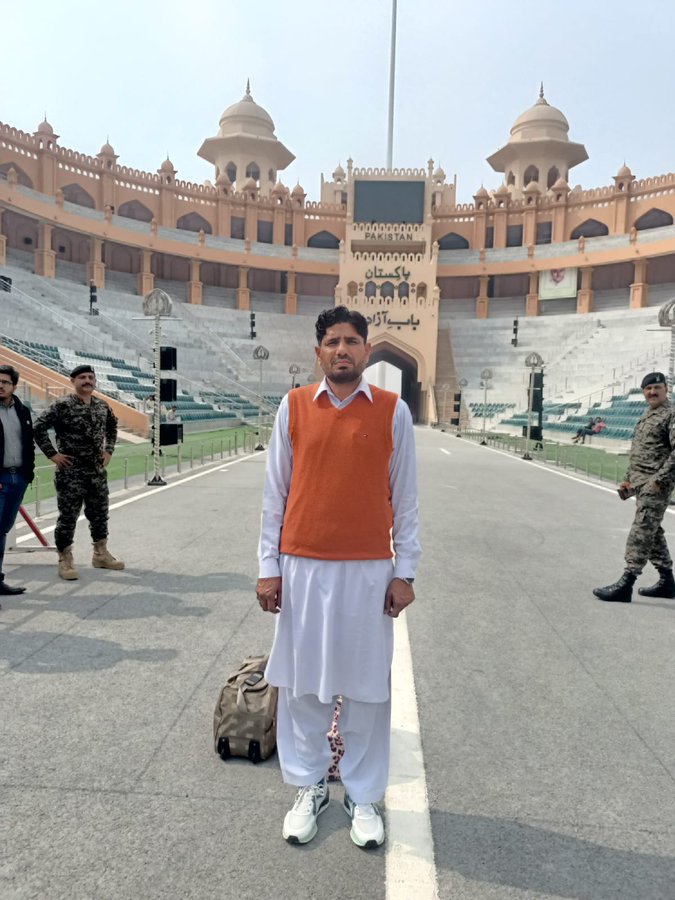
ISLAMABAD: A Pakistani national, Muhammad Shahid Iqbal Bhatti, was repatriated from India on Tuesday after serving nearly 17 years in prison on espionage charges, marking a significant humanitarian development in bilateral prisoner exchanges.
The repatriation occurred through the Wagah-Attari border, a customary crossing point for such transfers between the two neighbouring countries.
Pakistan’s High Commission in India announced the development on the social media platform X, stating that Bhatti, a Pakistani citizen imprisoned in India, had been handed over to Pakistani authorities.
The High Commission emphasized its ongoing commitment to securing the release and return of all Pakistani prisoners detained in Indian jails.
According to official sources, Bhatti hails from Kasur district in Punjab province and was sentenced by an Indian court following accusations of spying for Pakistan.
Court records and media reports indicate that Bhatti was arrested in August 2008 by police in Indian Punjab, specifically in the Patiala area, where he was found in possession of sensitive military-related maps and operating under an assumed identity.
Investigations revealed that Bhatti had entered India via Nepal in 2005 and had been residing in Saharanpur, Uttar Pradesh, under the alias Devraj Sehgal for approximately one year prior to his arrest.
He was initially apprehended based on secret information provided to authorities, leading to his identification as a Pakistani national from Pattoke, Hala Road, Kasur.
Following a trial, Bhatti received a 17-year prison sentence, which he served primarily in Gautam Buddh Nagar District Jail in Uttar Pradesh.
The sentence, encompassing periods of judicial custody and imprisonment, concluded around early 2025, after which formalities for repatriation were initiated.
Indian authorities coordinated with their Pakistani counterparts, including through diplomatic channels, to facilitate the handover.
The process involved correspondence between the two governments to complete legal and administrative requirements before Bhatti was escorted to the border under security arrangements.
Upon arrival at Wagah, he was received by Pakistani officials and subsequently transported to his hometown.
This case reflects the broader context of cross-border detentions, where individuals from both nations are occasionally arrested on espionage or illegal entry charges amid longstanding geopolitical tensions.
Such repatriations often occur after sentence completion, as part of reciprocal arrangements under consular access protocols.
Bhatti’s release follows similar actions in recent months, including the repatriation of three other Pakistani prisoners from India in late November 2025.
These exchanges underscore the role of diplomatic efforts in resolving humanitarian issues affecting citizens detained abroad.
Pakistan’s Ministry of Foreign Affairs and its missions abroad consistently advocate for the welfare and timely repatriation of nationals imprisoned overseas.
The Pakistan High Commission in New Delhi has highlighted its sustained endeavours in this regard, contributing to multiple successful repatriations over time.
Bhatti’s return after an extended period of incarceration is expected to provide relief to his family, who endured years of separation.
Residents of Kasur and surrounding areas have expressed hope that such incidents prompt greater caution regarding cross-border movements.
The incident also draws attention to the vulnerabilities faced by individuals in border regions, where economic pressures or personal circumstances sometimes lead to risky decisions.
Experts note that espionage allegations in South Asia frequently involve complex investigations and lengthy judicial processes.
In Bhatti’s case, the possession of military documents formed the core of the prosecution’s argument, resulting in the substantial sentence.
While details of the evidence remain limited in public domain, the conviction withstood appeals and led to full term completion.
The repatriation process, though delayed by several months post-sentence, demonstrates adherence to bilateral agreements on prisoner transfers.
Both countries maintain mechanisms for consular visits and notifications under the Vienna Convention on Consular Relations.
This latest development may encourage further dialogue on streamlining such procedures to minimize prolonged detentions.
Observers view these repatriations as modest confidence-building measures amid otherwise strained relations.
Bhatti’s homecoming concludes a chapter that began nearly two decades ago, highlighting the human cost of regional rivalries.
Authorities have assured that necessary support will be extended to him upon reintegration into society.
The episode serves as a reminder of the importance of diplomatic channels in addressing individual cases within the larger framework of bilateral ties.