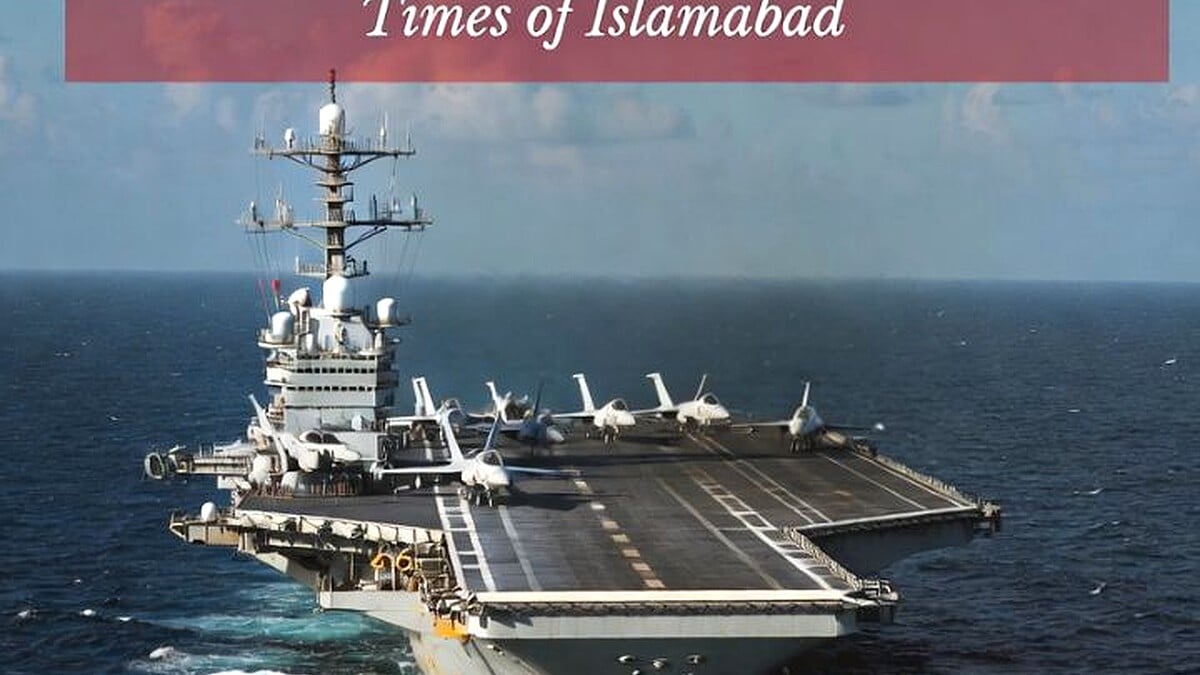
ISLAMABAD: Recent analysis of satellite imagery, including from Chinese sources, indicates that the USS Abraham Lincoln aircraft carrier has significantly distanced itself from Iran’s coastal waters in the Gulf of Oman region. The carrier, previously positioned approximately 350 kilometres from Iranian shores, is now reported to be about 1,100 kilometres away, operating behind Oman’s coastal mountain ranges in the broader Arabian Sea. This repositioning coincides with ongoing regional tensions and the deployment of another major US naval asset, the USS Gerald R. Ford, which has moved further south into the Red Sea.
The movement of the USS Abraham Lincoln marks a notable shift in US naval posture amid heightened confrontations in the Middle East. Open-source intelligence and commercial satellite data have long tracked the carrier’s presence in the Arabian Sea since its arrival in the US Central Command area in late January 2026. Earlier imagery from European Sentinel-2 satellites placed the vessel roughly 240 kilometres off Oman’s coast in February, equating to distances of around 420 to 678 kilometres from Iran’s nearest points along the Gulf of Oman.
Claims from Iranian sources in early March suggested that the carrier had come under attack, prompting a retreat. Reports indicated the USS Abraham Lincoln was operating about 340 kilometres from Iran’s territorial boundary before allegedly withdrawing over 1,000 kilometres. While US officials denied any successful strikes and affirmed the carrier remained operational with continued flight activities, the current satellite observations align with a pattern of pulling back to safer standoff distances.
Positioning behind Oman’s coastal mountains provides natural shielding from potential coastal missile threats. Iran’s arsenal includes anti-ship ballistic missiles designed to target large surface vessels, and maintaining greater separation reduces vulnerability while preserving the carrier’s ability to project air power through its embarked Carrier Air Wing 9, featuring F/A-18 Super Hornets and other aircraft.
This adjustment occurs as the US maintains a robust dual-carrier presence in the region. The USS Gerald R. Ford, the Navy’s newest and largest supercarrier, transited the Suez Canal in early March 2026 and entered the Red Sea shortly thereafter. Operating further south in the Red Sea positions the Ford strike group to support operations across multiple theatres, including potential contingencies in the broader Middle East.
The Ford’s deployment adds significant capability, with its advanced electromagnetic aircraft launch system and increased sortie generation rate compared to Nimitz-class carriers like the Abraham Lincoln. Its presence in the Red Sea complements the Lincoln’s operations in the Arabian Sea, creating layered naval coverage amid escalating activities tied to Operation Epic Fury and related efforts.
Satellite imagery from various providers, including commercial firms, has been instrumental in verifying these movements. Chinese geospatial intelligence entities have contributed to public tracking, releasing high-resolution images that monitor US naval assets in real time. Such transparency from diverse sources underscores the challenges of concealing large-scale naval deployments in contested waters.
The repositioning of the USS Abraham Lincoln may reflect tactical recalibration rather than de-escalation. Greater distance allows sustained operations while mitigating risks from Iran’s short-range coastal defences and drone swarms. The carrier’s escorts, including Arleigh Burke-class destroyers equipped with advanced air defence systems, continue to provide layered protection.
Regional dynamics remain fluid, with US forces supporting allied interests and deterring further aggression. The dual-carrier configuration enhances flexibility, enabling rapid response across the Arabian Sea, Gulf of Oman, Strait of Hormuz approaches, and Red Sea corridors.
Analysts note that such manoeuvres balance deterrence with force protection. The 1,100-kilometre separation cited in recent imagery places the Abraham Lincoln well outside immediate threat envelopes while keeping its strike range intact through aerial refuelling and extended mission profiles.
As tensions persist, satellite monitoring will likely continue to shape public understanding of naval movements. The USS Abraham Lincoln’s shift, combined with the USS Gerald R. Ford’s southern progression, illustrates the US Navy’s adaptive strategy in a high-stakes environment.