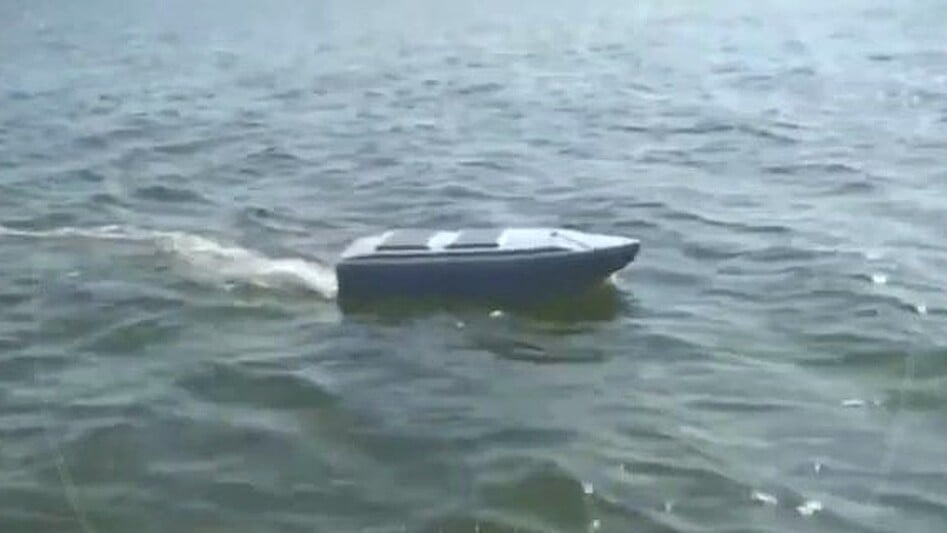
ISLAMABAD: Recent conflicts in the region, including the Iran war, have underscored the critical role of underwater threats in modern naval warfare, prompting Pakistan to intensify its pursuit of indigenous unmanned systems for protecting vital sea lanes and ports.
The Pakistan Navy has prioritized unmanned maritime platforms to counter asymmetric threats and enhance domain awareness in the Arabian Sea. Developments unveiled at events such as the Pakistan International Maritime Exhibition and Conference (PIMEC 2025) highlight a shift toward autonomous technologies.
Muhassir, an unmanned surface vessel (USV) developed locally, measures 10 meters in length and weighs 7.3 tons in its semi-submersible configuration. It achieves speeds of up to 40 knots and offers a range exceeding 400 nautical miles. The platform supports reconnaissance missions and can be equipped with a 12.7mm gun or explosive payloads for offensive operations.
Corsair, another USV originating from private-sector efforts, spans 4 meters and functions as a kamikaze drone. It carries a 50 kg payload, reaches 30 knots, and extends to 100 nautical miles. Designed to target warships and port infrastructure, it represents a cost-effective precision strike option.
Israr, an autonomous underwater vehicle (AUV), extends 3 meters and operates at depths of up to 300 meters for durations of four hours. It performs intelligence, surveillance, and reconnaissance (ISR) tasks, alongside seabed mapping and port monitoring. The system enables covert underwater presence without risking manned assets.
These platforms emerged prominently in 2025 exhibitions, with collaborations between defense entities like NESCOM and private firms such as Beyond Koncept and Stingray Technologies driving progress. The focus on indigenous design reduces reliance on foreign suppliers while tailoring capabilities to regional needs.
Complementing these efforts, the Mudmair loitering munition underwent successful testing in January 2026. The Pakistan Navy conducted live-fire exercises in the North Arabian Sea, where the long-range variant engaged surface targets effectively. This system adds persistent strike potential to naval operations.
The Shahpar III medium-altitude long-endurance (MALE) unmanned combat aerial vehicle (UCAV) has evolved with a dedicated naval variant. Equipped with lightweight torpedoes, sonobuoys, and maritime radar, it supports anti-submarine warfare (ASW) and extended patrol duties. The platform reaches altitudes of 41,000 feet, offers beyond-line-of-sight ranges up to 3,000 km, and provides endurance of 40 hours in ISR configurations.
First flight tests for Shahpar III are confirmed by the end of 2026, building on earlier unveilings. Integration of ASW tools like the ultra-lightweight Eghraaq torpedo enhances its multi-role utility against subsurface threats.
Pakistan’s broader naval modernization includes the impending induction of Hangor-class submarines from China, with the first expected in service by 2026. This complements unmanned systems by strengthening underwater deterrence.
The navy’s January 2026 exercise also featured open-sea trials of unidentified USVs alongside missile firings, demonstrating operational integration of unmanned and conventional assets. Such tests validate reliability in real maritime environments.
Experts note that these advancements address vulnerabilities exposed in recent regional conflicts, where stealthy underwater approaches posed significant risks. By investing in distributed, low-signature platforms, Pakistan aims to create force multipliers that deter aggression and secure economic lifelines.
The emphasis on private-sector involvement accelerates innovation. Companies like Sysverve Aerospace contribute loitering munitions, while others advance USV designs. This ecosystem fosters self-reliance in emerging technologies.
Overall, Pakistan’s underwater drone push aligns with global trends toward unmanned systems in naval strategy. It positions the navy to maintain credible presence amid evolving threats in the Indian Ocean region.
The developments reflect strategic foresight, combining ISR, strike, and denial capabilities. As testing and integration continue, these indigenous platforms promise to reshape Pakistan’s maritime posture.