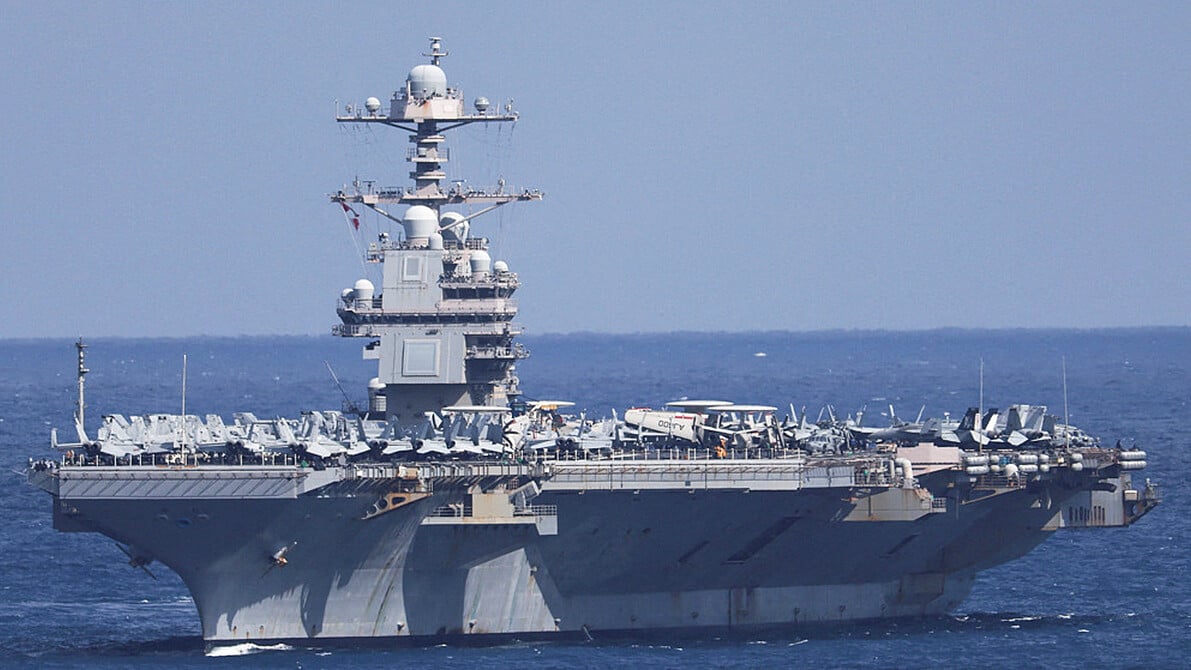
ISLAMABAD: Iran’s Islamic Revolutionary Guard Corps has dramatically raised the stakes in the Red Sea by formally designating all logistical and service facilities supporting the US Navy’s flagship aircraft carrier USS Gerald R. Ford as legitimate military targets, citing the warship’s presence as an existential threat to Iranian national security.
The bold declaration, delivered Sunday through the official spokesman of Khatam al-Anbiya Central Headquarters, marks one of the most explicit warnings yet issued against American naval assets in the region amid spiraling US-Iran confrontation.
Khatam al-Anbiya, the joint operational command overseeing Iran’s conventional and asymmetric forces, stated unequivocally that any infrastructure enabling the carrier strike group’s sustained operations—ranging from port services and fuel depots to maintenance yards—falls within the legitimate scope of Iranian defensive retaliation.
The USS Gerald R. Ford, the world’s most advanced nuclear-powered supercarrier at over 100,000 tons displacement, entered the Red Sea via the Suez Canal on March 6, 2026, following its transit from the Mediterranean.
Commercial satellite imagery analyzed by China’s MizarVision firm shows the vessel conducting operations approximately 100 kilometers offshore from Saudi Arabia, with recent positional changes indicating a shift closer to the strategic port city of Jeddah.
Accompanied by a full carrier strike group—including Arleigh Burke-class guided-missile destroyers—the Ford is conducting its inaugural Middle East deployment since commissioning in 2017.
The carrier has remained continuously at sea for more than 255 days, nearing the upper limits of extended carrier endurance records established during previous global conflicts.
A minor onboard fire reported March 12 injured two sailors but was rapidly extinguished, according to official US Navy accounts.
This latest IRGC statement builds directly upon earlier warnings issued by Aerospace Force Commander Brigadier General Majid Mousavi, who disclosed that Iranian surveillance assets were closely tracking the carrier and awaiting its entry into pre-designated engagement envelopes.
The targeting language deliberately expands beyond the ship itself to encompass the entire support ecosystem that sustains high-tempo carrier operations in a high-threat maritime theater.
Iranian military spokesmen have repeatedly referenced prior claimed successes against US naval units, including alleged drone and missile strikes on the USS Abraham Lincoln carrier group during earlier phases of regional tension.
The Ford’s current positioning coincides with intensified American military reinforcement across the Middle East following the February 28 joint US-Israeli strikes described by Tehran as unprovoked aggression against sovereign Iranian territory.
Carrier air wings from the Ford have already supported Operation Epic Fury missions launched from eastern Mediterranean waters before the Red Sea redeployment.
Tehran perceives the carrier’s proximity to Saudi territorial waters—particularly near Jeddah—as enabling potential rapid-reaction strikes, enhanced intelligence collection, or forward staging against Iranian interests.
Saudi authorities have issued no public statement confirming or denying provision of port services to the American vessel, though Jeddah’s deep-water facilities and strategic location make it a logical resupply node.
The Red Sea corridor remains one of the world’s most heavily militarized and contested waterways, having witnessed repeated Houthi maritime attacks, coalition naval responses, and periodic disruptions to global commerce.
Military analysts interpret the IRGC announcement as a layered deterrence message: signaling capability and intent to domestic audiences while warning Washington that broadening the target set could impose severe operational costs on sustained carrier presence.
US Central Command has described the Ford’s deployment as part of routine force posture adjustments aimed at preserving freedom of navigation and deterring regional aggression.
No immediate official American response to the specific IRGC targeting declaration has been released as of late March 16.
The exchange of increasingly pointed public threats occurs against a backdrop of active military maneuvering by both sides, raising the specter of miscalculation in an already volatile theater.
Iran continues to frame its posture as purely defensive, portraying the carrier strike group as an intrusive offensive platform operating in waters critical to Iranian security.
Given the carrier’s unmatched power projection capacity and Iran’s demonstrated asymmetric naval capabilities, any kinetic exchange would carry profound implications for regional stability and international maritime security.
The international community watches closely as both Tehran and Washington maintain elevated readiness postures with no visible de-escalation pathway currently evident.