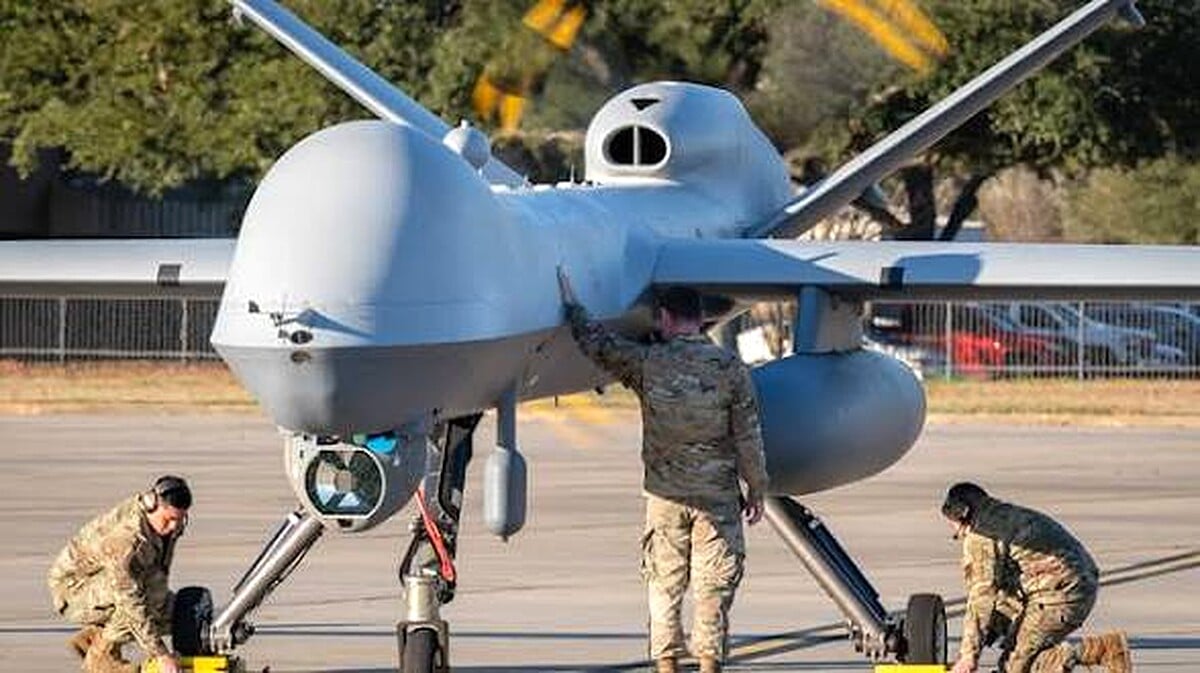
ISLAMABAD: Italy’s military has confirmed a drone attack on the Ali Al Salem Air Base in Kuwait early Sunday morning, resulting in the complete destruction of a remotely piloted aircraft belonging to the Italian Task Force Air. The incident occurred at a facility jointly hosting Italian and United States personnel and capabilities, highlighting the spillover effects of the ongoing regional conflict involving Iran and coalition forces.
Chief of the Defence General Staff General Luciano Portolano announced the development in an official statement shared via the Italian Armed Forces’ channels. He described how the drone directly struck a protected shelter, also known as a hardened aircraft shelter, where the unmanned aerial vehicle was housed. The aircraft, identified in multiple reports as an MQ-9A Predator, was rendered inoperable and fully destroyed in the strike.
All Italian personnel present at the base remained safe and uninjured during the attack. General Portolano emphasized that no human casualties occurred among Italian forces or others at the site. He immediately informed Defence Minister Guido Crosetto and maintained continuous coordination to monitor the status of Italian contingents deployed abroad.
The destroyed asset held significant operational value for Italy’s ongoing missions in the region. It served as an essential tool for intelligence, surveillance, and reconnaissance tasks supporting coalition efforts. Despite recent reductions in Italian troop numbers at the base, the drone had been retained there to preserve continuity in critical operations amid the deteriorating security environment.
Italy had proactively scaled back its presence at Ali Al Salem in the days leading up to the incident. This decision responded to the rapidly evolving threats across the Middle East, including repeated drone and missile strikes on coalition installations. Sources indicate that a substantial portion of Italian forces had already been relocated, with transport aircraft facilitating the repositioning to safer locations such as facilities in Saudi Arabia.
The Ali Al Salem Air Base functions as a key hub for multinational operations in the Gulf. It supports United States Air Force activities alongside contributions from partner nations, including Italy’s participation in missions like Operation Prima Parthica. This operation aligns with broader international coalition efforts to counter threats from militant groups and maintain stability in Iraq and surrounding areas.
The attack fits into a pattern of heightened drone activity targeting military sites in Kuwait and neighboring countries. Recent weeks have seen multiple incidents involving unmanned aerial vehicles aimed at bases hosting coalition troops. These actions reflect the broader escalation in the region, where proxy and direct strikes have expanded to include Gulf locations previously considered more secure.
No immediate claim of responsibility accompanied the strike on Ali Al Salem. However, the timing and method align with tactics employed in the current conflict dynamics. Analysts note that such targeted hits on unmanned assets aim to impose costs on coalition partners without necessarily causing personnel losses that could trigger stronger retaliatory responses.
Italy’s response has focused on factual reporting and personnel safety rather than escalation. General Portolano’s statement underscored the priority of protecting service members while acknowledging the challenges posed by the security situation. Defence officials continue to assess implications for future deployments and operational adjustments.
The incident underscores the vulnerabilities faced by forward-deployed forces in contested environments. Hardened shelters provide protection against certain threats, but the precision of modern drones challenges even these defenses. The loss of the MQ-9A highlights the high value placed on such platforms for persistent surveillance and strike capabilities in asymmetric warfare.
Broader regional tensions continue to influence military postures across the Middle East. Coalition partners, including Italy and the United States, maintain commitments to shared security objectives despite these setbacks. Adjustments in force posture, such as Italy’s preemptive reductions, demonstrate adaptive strategies to mitigate risks.
As investigations proceed, attention remains on preventing further incidents that could widen the scope of the conflict. The destruction of the Italian drone serves as a reminder of the persistent threats in the Gulf theater, where air bases remain focal points for adversary operations.
Italian authorities have reiterated their resolve to support coalition missions while prioritizing the welfare of deployed personnel. The event adds another layer to the complex security landscape, where drone warfare plays an increasingly prominent role in shaping battlefield outcomes.