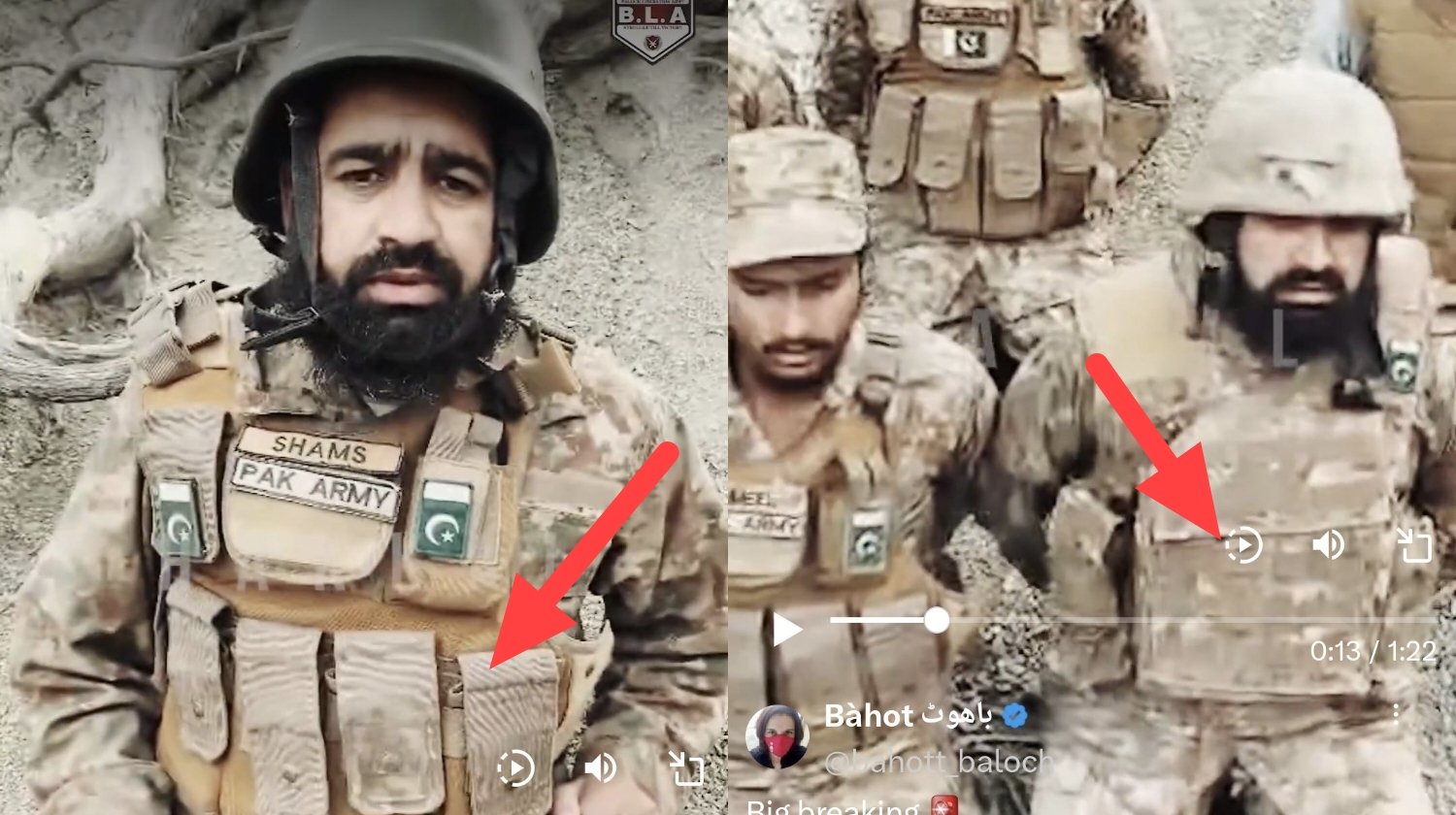
ISLAMABAD: Indian media outlets and pro‑Baloch Liberation Army (BLA) social accounts have been amplifying claims that 17 Pakistani soldiers were captured by BLA fighters, using fabricated or heavily manipulated video content that bears hallmarks of artificial intelligence and cinematic staging rather than verified battlefield footage.
The initial viral posts, purporting to show Pakistani military personnel in captivity, with social media accounts aligned with the Indian information ecosystem and BLA sympathizers sharing multiple clips and images. Close examination of these visuals reveals inconsistencies that strongly undermine the central claim of captured soldiers, raising serious questions about the credibility of both the sources and the narrative being pushed.
The most prominent video clip circulating online depicts men in military fatigues, alleged to be Pakistani soldiers, in what appears to be a makeshift holding area. However, forensic review by independent analysts shows signs of digital manipulation.
Several frames display visual artifacts, inconsistencies in lighting and shadows, and mismatches between audio and lip movements — all common indicators of deepfake or generative AI content. These technical anomalies provide a basis to question the authenticity of the purported footage.
One striking inconsistency lies in the reported number of captured personnel. While Indian outlets and BLA channels have repeatedly cited the figure of 17 captured soldiers, no official statement from the Pakistan Army, Inter‑Services Public Relations (ISPR), or government agencies has confirmed any such event.
Pakistan’s military spokesperson has categorically denied the claims, emphasizing that no soldiers are missing or in custody of any militant group. This official denial stands in direct contradiction to the narrative gaining traction online.
Further scrutiny of still images accompanying the video exposes additional discrepancies. In one image, a uniformed individual is seen wearing a bulletproof vest equipped with magazine pockets, typical of combat issue gear.
Yet in another purported frame from the same incident, the same individual appears to be wearing a different vest model, lacking the same configuration of magazine pouches. Analysts point out that such wardrobe inconsistencies are unlikely in genuine footage from the same scene, suggesting either staged reenactment or manipulated editing.
The similarity of faces across multiple images has also drawn attention. Two distinct frames allegedly show different soldiers, yet both appear to have nearly identical facial features.
This repetition raises the possibility that a limited set of source images or models was reused in creating the visuals, a common practice in synthetic media generation that prioritizes narrative impact over factual accuracy.
Independent verification efforts by global fact‑checking organizations have noted parallels between the current case and earlier instances where fabricated media was deployed to influence public perception during conflicts.
A notable comparison was drawn with staged Taliban footage that circulated in late 2025, which also featured AI‑assisted scenes that misled viewers about battlefield events and personnel status.
Experts in digital forensics caution that the increasing accessibility of generative AI tools means that high‑quality but deceptive content can be produced without sophisticated technical expertise.
“We are entering an era where visual content alone cannot be taken at face value,” said Dr. Murtaza Ahmed, a media integrity researcher. “What we’re seeing now underscores the need for rigorous verification protocols before unverified footage is presented as evidence of real world events.”
The strategic use of misleading media appears to be part of a broader informational campaign aimed at shaping public discourse and regional perceptions. Analysts suggest that narratives portraying Pakistani soldiers as captured could be intended to create political or psychological pressure, particularly within domestic audiences in India and among separatist‑aligned social communities.
Despite the viral spread of the videos, official military records and situational reports do not corroborate any incident of Pakistani soldiers falling into militant hands.
Cross‑referencing reported troop movements, operational logs, and military unit status reports shows no gaps or unexplained absences that would indicate such captures. This absence of supporting data further weakens the claims circulating online.
Security experts also warn of the potential consequences of such misinformation on diplomatic and intergovernmental relations.
“False narratives that involve alleged capture of uniformed personnel can escalate tensions and erode trust between states,” said Colonel (Retired) Saeed Khan, a defense analyst. “Responsible reporting and verification are essential to prevent misinformation from becoming a destabilizing factor.”
In response to the controversial content, several platforms have flagged some of the posts as potentially manipulated, and a few social media networks have taken steps to reduce the visibility of unverified claims. Nevertheless, the speed at which such content spreads highlights the ongoing challenges faced by digital platforms in curbing misinformation during high‑profile geopolitical events.
Observers note that this episode illustrates the heightened role of information warfare in contemporary conflicts, where narratives can be weaponized with as much impact as physical engagements.
The effective counter to such tactics, according to experts, lies in transparency, rapid verification, and public awareness about the limitations of unverified digital media.
Available data points toward a constructed narrative amplified through AI‑enabled visuals and cross‑border media channels, underscoring the critical need for cautious interpretation of sensational online content.