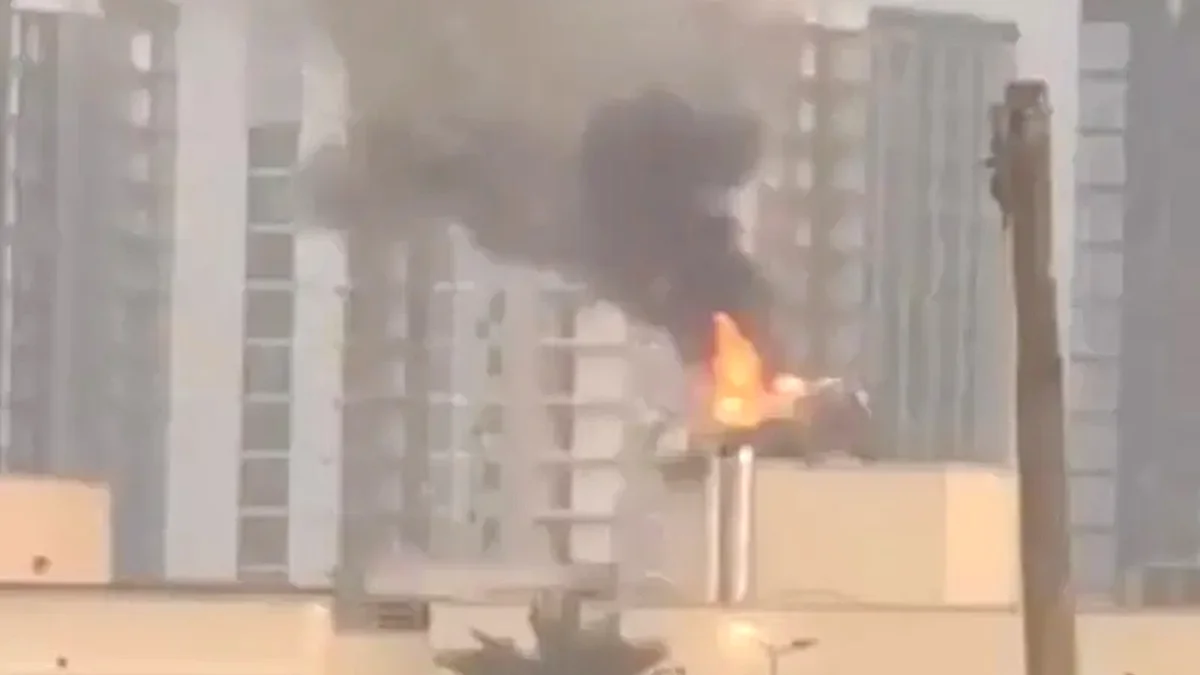
ISLAMABAD: Smoke rose from the United States Embassy compound in Baghdad on Saturday after a missile struck a helipad inside the heavily fortified diplomatic facility, Iraqi security officials confirmed.
The attack occurred in the Green Zone, the secure central district housing government buildings and foreign missions. Associated Press footage captured a column of smoke billowing over the sprawling complex, one of the largest American diplomatic outposts worldwide.
Iraqi security sources told Reuters that the US Embassy sustained a missile attack, with smoke visible from the building. Details on casualties or structural damage remained limited in initial reports.
The Associated Press reported that two Iraqi security officials confirmed a missile hit the helipad within the embassy boundaries. The projectile penetrated the fortified area despite security measures.
Al Jazeera cited sources indicating the strike caused damage to the mission area. No immediate claim of responsibility emerged from any group.
The incident unfolded shortly after separate strikes in Baghdad killed two members of Kataeb Hezbollah, a prominent Iran-backed armed faction. Security sources described one victim as a key figure in the group.
AFP reported that the embassy attack followed the killings of the two fighters affiliated with Iranian-supported militias. The timing suggested a possible retaliatory motive.
The US Embassy compound has faced repeated assaults from rockets and drones launched by Iran-aligned militias in recent years. Such groups operate under the broader umbrella of the Popular Mobilisation Forces in Iraq.
The attack coincides with heightened regional tensions stemming from the ongoing US-Israel war against Iran, now in its third week. US strikes have targeted Iranian military sites, including oil-critical infrastructure on Kharg Island.
President Trump described recent US operations as obliterating key Iranian targets. Iranian responses have included threats against American interests across the region.
In Iraq, Iran-backed militias have intensified operations against US facilities since the conflict escalated. Attacks on bases hosting coalition troops have become more frequent.
The US State Department maintains a Level 4 security alert for Iraq, warning of threats from Iran and aligned terrorist militia groups. Non-emergency personnel were ordered to leave earlier in the month.
The embassy suspended routine consular services amid the risks. Americans in Iraq face potential targeting of businesses, energy infrastructure, and hotels linked to US interests.
Iraqi Prime Minister Mohammed Shia al-Sudani condemned similar previous incidents as terrorist acts by rogue groups. He directed security forces to pursue perpetrators.
No immediate comment came from the US Embassy in Baghdad regarding Saturday’s strike. Officials have not detailed defensive intercepts or injuries.
The Green Zone’s defenses include advanced systems like C-RAM to counter incoming projectiles. Past incidents saw interceptions of drones and rockets aimed at the compound.
This latest event draws parallels to historical attacks on the embassy, including those linked to Kataeb Hezbollah following US airstrikes on militia positions.
Regional observers note Iraq’s precarious position, caught between alliances with the US and proximity to Iranian influence through Shiite armed factions.
The Popular Mobilisation Forces, integrated into Iraq’s security apparatus, include elements accused of coordinating with Tehran against American presence.
Escalation risks drawing Iraq deeper into the broader Middle East conflict. Militias have vowed support for Iran, targeting US-linked sites in retaliation for strikes on Iranian assets.
Oil facilities and energy infrastructure face threats, with some militias promising to hit such targets in response to US actions against Iran’s oil network.
The Baghdad incident underscores persistent vulnerabilities for diplomatic missions in conflict zones. Security protocols remain on high alert across US facilities in the region.
Analysts warn that continued tit-for-tat strikes could destabilise Iraq further, complicating efforts to maintain fragile political stability.
As investigations proceed, the attack highlights the interconnected nature of regional flashpoints, where actions in one theatre prompt responses in another.
Iraqi authorities continue monitoring the situation while urging restraint to prevent wider spillover.