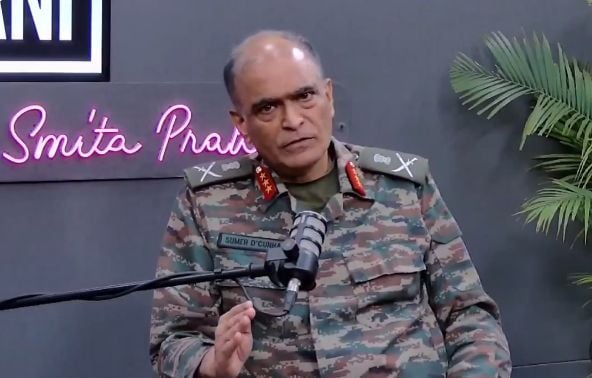
New Delhi, February 14, 2026 – In a candid discussion on the ANI Podcast hosted by Smita Prakash, Lieutenant General Sumer Ivan D’Cunha, the Director General of the Indian Army’s Air Defence (AAD), stated that Indian ground-based air defence systems did not shoot down any Pakistani aircraft during the May 2025 India-Pakistan conflict, known as Operation Sindoor.
Lt Gen D’Cunha, who led the Army Air Defence branch from 2023, oversaw the operation of key systems including the S-400, Akashteer command-and-control network, Akash missiles, and gun-based platforms such as the L-70, ZU-23-2, and Schilka. His tenure included managing responses to drone swarms, missile threats, and low-altitude incursions during the brief but intense clashes.
During the podcast episode, when asked directly by the host whether air defence units were able to hit any Pakistani aircraft, Lt Gen D’Cunha replied: “So you know… bigger size or smaller size. You know, it is like this that I am sure Pakistan as a nation is well aware of the capability our air defence has. It’s very aware of the capability of the Indian Air Force. It’s really aware of the capability of EW [Electronic Warfare] systems. And hence, flying—flying in depth—was not going to give them any major benefit. So, in my perception, they really didn’t fly too much.”
He elaborated that Pakistan’s awareness of India’s integrated air defence layered with fighter jets and electronic warfare deterred deep aerial penetrations. Lt Gen D’Cunha noted that Pakistani military jets were often masked behind civilian air traffic, reducing the likelihood of engagements, as India avoided targeting non-military flights. This cautious approach by Pakistan, he suggested, limited opportunities for shoot-downs by army-operated systems.
The remarks contrast with earlier assertions from Indian officials. In August 2025, Indian Air Force Chief Air Chief Marshal Amar Preet Singh claimed that the IAF, supported by systems like the S-400, downed several Pakistani military aircraft—up to six in some reports—during the conflict. These statements appeared in media briefings and were echoed in analyses highlighting India’s air superiority achievements by May 10, 2025. Official narratives emphasized successful interceptions and deep strikes into Pakistani territory.
However, Lt Gen D’Cunha’s comments focus specifically on the performance of army air defence assets against manned Pakistani jets. He highlighted that no confirmed aircraft kills were recorded by ground-based units under his former command. During the conflict, army air defence played a prominent role in neutralizing Pakistani drone swarms and missile attempts, including threats to sensitive sites like the Golden Temple in Amritsar, where gun systems proved “extremely effective,” as he described in May 2025 interviews.
Post-conflict, Lt Gen D’Cunha has been recognized for his contributions. On Republic Day 2026, he was conferred the Param Vishisht Seva Medal (PVSM) for distinguished service, with announcements from official sources crediting his leadership in Operation Sindoor. Goan-origin leaders and political figures congratulated him, noting his role in safeguarding national interests.
The 2025 conflict saw both sides claim aerial victories while acknowledging losses. India’s Chief of Defence Staff, General Anil Chauhan, confirmed in June 2025 interviews that the IAF suffered unspecified fighter jet losses due to tactical errors, later rectified, but rejected exaggerated Pakistani claims of downing six Indian aircraft. Pakistan maintained it inflicted heavy damage without sustaining comparable losses.
Lt Gen D’Cunha’s podcast appearance provides a nuanced view from a senior army air defence expert, underscoring how deterrence and limited deep incursions shaped the aerial battles. His statement reinforces that Pakistani aircraft largely avoided high-risk zones where ground-based systems could engage them effectively.
As South Asian security dynamics continue to evolve, such insights from retired officers add depth to understanding the operational realities of modern conflicts involving drones, missiles, and integrated air defences.