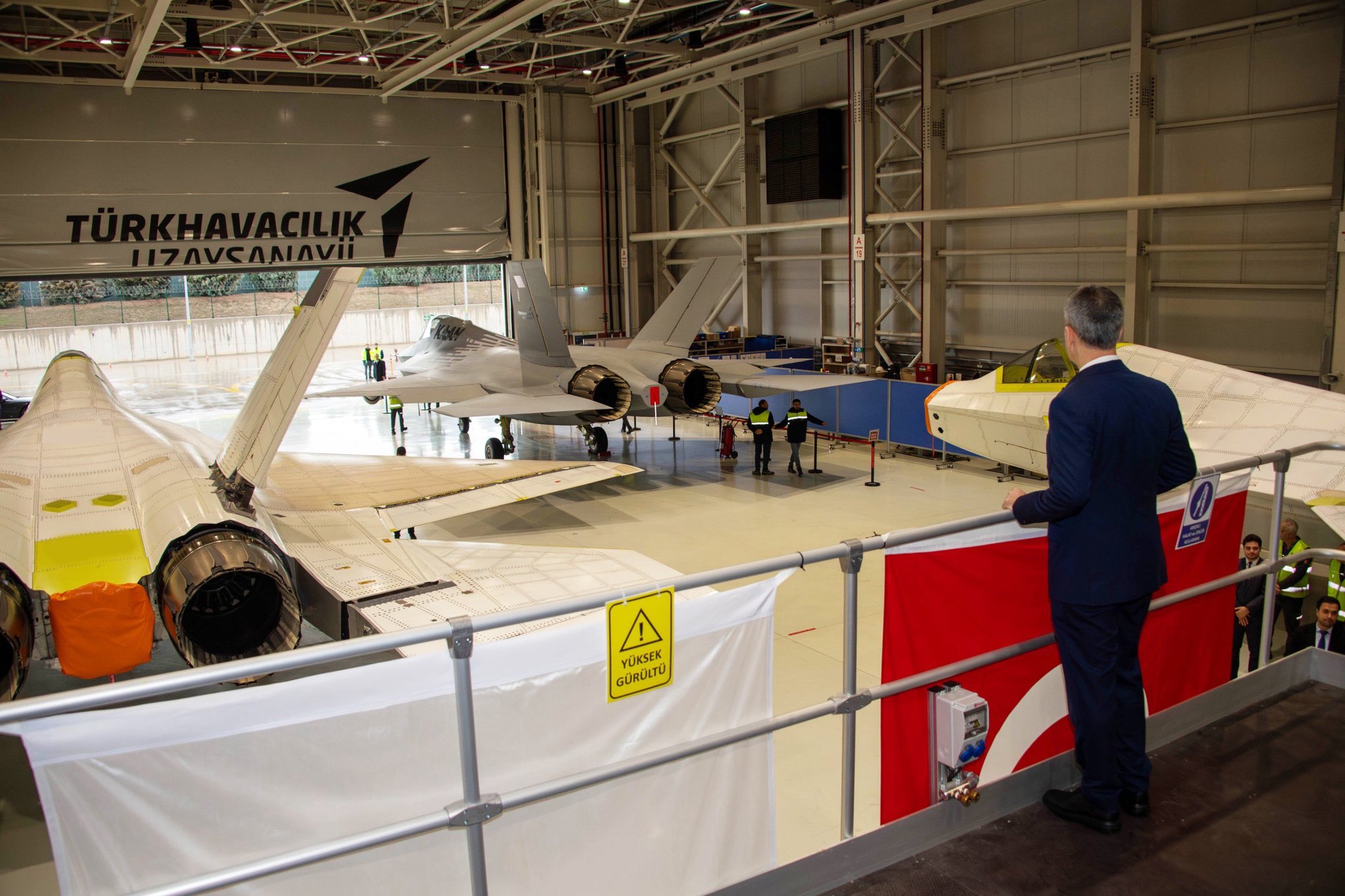
ISLAMABAD: What began as a single demonstrator has now evolved into a structured, multi-prototype fifth-generation fighter program, as Türkiye’s KAAN project moves decisively beyond its maiden flight milestone. With its first flight successfully completed in 2024, the aircraft is no longer a proof-of-concept platform but part of a broader industrial roadmap targeting 20 initial block deliveries by 2030. The program remains in the advanced prototype phase, yet its pace signals a deliberate transition toward serial production capability.
The KAAN program, led by under the strategic direction of , represents Türkiye’s most ambitious aerospace initiative to date. Following its inaugural flight, additional test activities have intensified, including ground-based validation and systems integration trials. A static test airframe has also been rolled out, enabling structural stress assessments and fatigue testing critical to airworthiness certification and long-term fleet sustainability.
Officials confirm that multiple flying prototypes are advancing in parallel, marking a significant shift from experimental validation to fleet-oriented development. Such concurrency — where development, testing and production preparation occur simultaneously — reflects a maturing industrial ecosystem. Rather than waiting for a single prototype to complete the full test cycle, the program has adopted a parallel architecture that accelerates data collection, subsystem refinement and risk mitigation ahead of eventual low-rate initial production.
Technologically, KAAN is being developed as a full-spectrum fifth-generation platform incorporating low observability, internal weapons bays and advanced sensor fusion. Radar cross-section reduction measures are integrated into the airframe geometry, composite materials and embedded antenna designs. The aircraft’s mission systems are expected to fuse data from multiple onboard and offboard sensors into a unified tactical picture, enhancing situational awareness in contested airspace and enabling beyond-visual-range engagement superiority.
Electronic warfare capabilities are also central to the aircraft’s design philosophy. Integrated electronic support measures, radar warning receivers and active jamming systems are being embedded from the outset rather than retrofitted in later blocks. The roadmap outlines phased capability upgrades, meaning the first operational configuration will gradually evolve through software-driven enhancements. This spiral development model mirrors global best practices in fifth-generation programs, where hardware stability supports continuous digital evolution.
A critical pillar of long-term autonomy lies in domestic propulsion development. While early prototypes rely on existing powerplants, Türkiye continues work on an indigenous engine to reduce external dependencies and secure full export flexibility. Engine testing programs, materials research and high-temperature turbine development remain ongoing. Achieving a domestically produced engine would significantly elevate strategic independence and strengthen the aircraft’s lifecycle cost management.
Parallel to the core fighter development, integration with manned-unmanned teaming concepts is progressing. The KAAN platform is envisioned to operate alongside advanced unmanned combat aerial vehicles, expanding its operational envelope while reducing pilot exposure to high-threat environments. Data links, cooperative targeting and distributed sensor networks are under refinement, aligning with emerging doctrines in network-centric warfare and autonomous support systems.
The program’s industrial footprint extends beyond aerospace manufacturing. Supply chain localisation, advanced composite production, avionics software engineering and electronic warfare system integration have stimulated a broader defence-industrial ecosystem within Türkiye. Such structural scaling is indicative of a long-term commitment rather than a short-term procurement objective. The concurrency model — development, testing and production preparation running together — signals confidence in foundational design maturity.
For Pakistan, which has entered the program as a development partner, the implications are strategically significant. Islamabad has long sought a pathway toward fifth-generation capability amid evolving regional dynamics. Participation in the KAAN project offers industrial access, technological collaboration and potential early acquisition alignment. As three prototypes inch closer to serial production readiness, Pakistan’s prospects of receiving aircraft around 2030 appear increasingly plausible, particularly under an initial block configuration.
Analysts suggest that coordinated production planning between Ankara and Islamabad could facilitate near-simultaneous induction once the aircraft transitions from advanced prototypes to low-rate initial production. Such timing would mark Pakistan’s closest step yet toward operational fifth-generation capability. While serial production has not commenced, the structured scaling model — validated flight tests, static airframe validation and parallel prototype advancement — provides measurable indicators of program momentum.
In global aerospace terms, the KAAN program exemplifies how a fifth-generation fighter initiative scales deliberately. It avoids premature declarations of mass production while methodically expanding testing infrastructure and industrial readiness. The target of delivering 20 aircraft by 2030 under the initial block configuration underscores ambition tempered by phased realism. As development continues, the program’s trajectory suggests that KAAN is no longer defined by a single prototype, but by an evolving architecture designed for sustained operational integration.