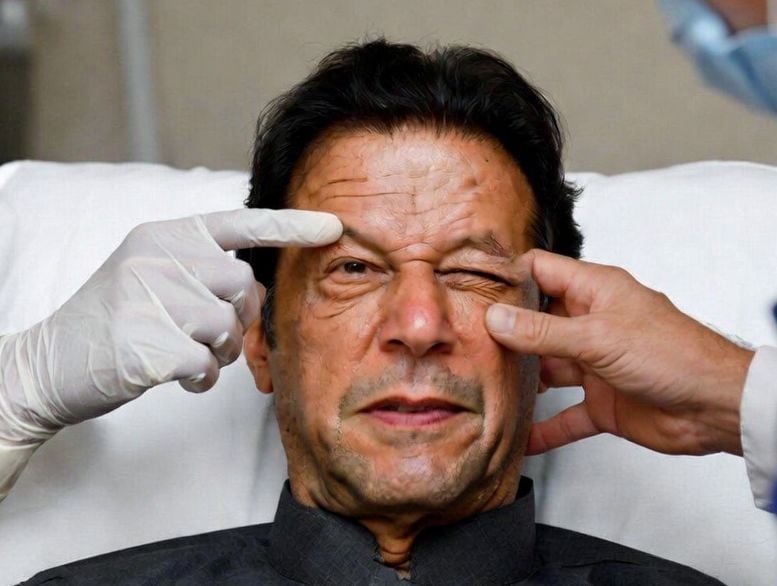
ISLAMABAD: Concerns over the health of incarcerated former prime minister Imran Khan have intensified following a detailed report highlighting severe impairment in his right eye vision, prompting legal moves for bail on medical grounds and drawing fresh scrutiny from the Supreme Court of Pakistan. The development has sparked widespread debate on prison medical care standards and the former leader’s ongoing detention amid multiple pending cases.
A report submitted to the Supreme Court by Barrister Salman Safdar, appointed as amicus curiae, detailed that Imran Khan retains only 15 percent vision in his right eye after being diagnosed with right central retinal vein occlusion, a condition involving a blood clot causing significant retinal damage. The lawyer, who visited Khan in Adiala Jail on February 10, 2026, noted that the 73-year-old former premier experienced blurred vision starting in October 2025, which progressed rapidly despite initial treatments limited to eye drops.
Khan described to Safdar a sudden and complete loss of vision in the right eye at one stage, followed by examination at the Pakistan Institute of Medical Sciences where specialist Dr Muhammad Arif confirmed the blood clot and administered an injection. Despite this intervention, the vision remained severely compromised at 15 percent, with allegations that complaints were ignored for nearly three months, exacerbating the condition and raising questions about timely medical access in custody.
Responding to the report during a hearing on February 12, 2026, a Supreme Court bench comprising Chief Justice Yahya Afridi and Justice Shahid Bilal Hasan directed authorities to constitute a medical board for an urgent specialist ophthalmological examination before February 16, 2026. The court emphasized the need for independent verification of the condition and ordered facilitation of access to Khan’s personal physicians while allowing telephone contact with his sons abroad.
The Supreme Court also stressed that intervention was necessary to address the gravity of the reported health issue, rejecting certain pleas such as family presence during the medical exam but underscoring equal treatment standards for prisoners. This order came amid broader concerns about Khan’s detention conditions, including prolonged isolation and restricted legal consultations, as highlighted in Safdar’s seven-page submission.
Separately, Imran Khan and his wife Bushra Bibi filed a petition in the Islamabad High Court seeking suspension of their sentences and release on bail in the Toshakhana-II case involving alleged under-priced purchase of state gifts. The application, submitted through counsel including Salman Safdar and Salman Akram Raja, cited both legal infirmities in the trial verdict and the emerging medical emergency as grounds for relief, arguing that adequate treatment for the eye ailment cannot be ensured inside prison.
The petition referenced the Supreme Court proceedings and the PIMS diagnosis, asserting that the former premier’s age and deteriorating health warrant humanitarian consideration. It maintained that Khan had complied with bail conditions during the trial and that the medical grounds provide additional basis for suspension pending appeal adjudication in related matters.
Meanwhile, the Supreme Court has scheduled a three-member bench, headed by Justice Muhammad Hashim Kakar and including Justices Salahuddin Panhwar and Ishtiaq Ibrahim, to hear six cases linked to Imran Khan on February 18, 2026. These include government appeals against acquittals in the cypher case involving classified documents, challenges to bails in May 9-related incidents, and other matters such as defamation and Toshakhana appeals, though no direct consolidation for medical bail has been indicated.
The cases also encompass proceedings involving Bushra Bibi and Shah Mahmood Qureshi in select instances, reflecting the apex court’s approach to handling interconnected legal challenges efficiently. While the February 18 hearing focuses on substantive appeals and bail cancellations, it occurs against the backdrop of the ongoing medical review ordered earlier.
Government officials, including Information Minister Attaullah Tarar, have assured that further treatment for Khan will occur at a specialized medical facility with eye specialists, and a detailed report on his care will be submitted to the Supreme Court. This response aims to counter claims of neglect while the situation continues to unfold under judicial oversight.
The combination of health concerns and legal proceedings has kept Imran Khan’s case at the forefront of national discourse, with implications for prison reform, judicial intervention in detainee welfare, and the broader political landscape in Pakistan as multiple high-profile matters remain pending resolution.