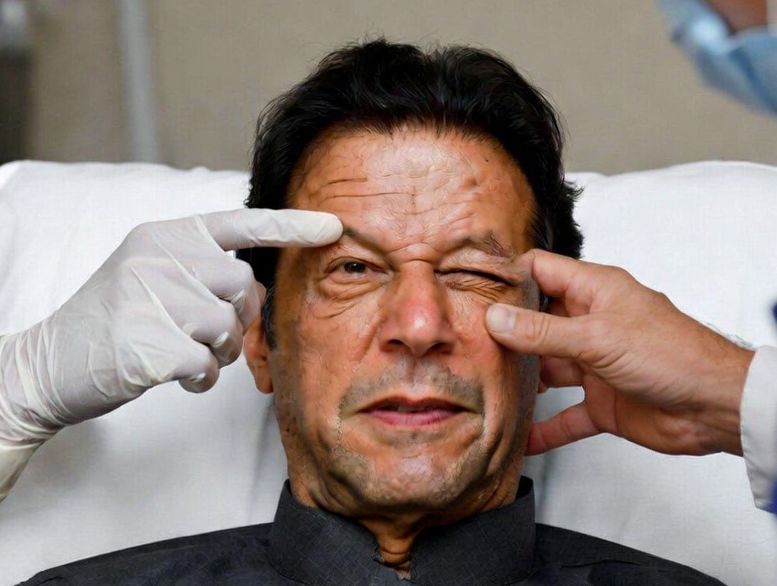
ISLAMABAD: Minister of State for Law and Justice Barrister Aqeel Malik has confirmed that the government is prepared to facilitate former prime minister Imran Khan’s travel abroad for specialized medical treatment, provided he submits a formal written application. The minister emphasized that such a request would be forwarded to the Supreme Court for consideration, and if the apex court approves on medical grounds, authorities would raise no objection. This position addresses persistent claims by Pakistan Tehreek-e-Insaf regarding inadequate jail-based care for Mr Khan’s eye ailment, which reportedly began deteriorating in late 2025.
However, the reports circulating in the media further ckaim that there has been a softness in government and the authorities about Imran Khan case after his medical reports have Surfaced shoring serious damage to the eye and protests from the PTI Parliamentarains.
Additionally, PTI founder sister has been allowed to meet his brother and earlier his lawyer has also met him which showed some flexibility in the government stance. Furthermore his bail matters have also been placed in High Court and Supreme Court and Supreme Court had taken some changed stance on his appeals which were earlier even not scheduled for hearing. However, PTI circles and analysts close to Imran Khan has revealed that it all depends upon Imran Khan written request, which Khan may never apply before the government or even the court, a position which he has been constantly denying over bowing before the authorities for his release, giving an impression that he is asking for some sort of soft deal.
Barrister Aqeel Malik clarified that the proposal aligns with constitutional provisions guaranteeing prisoners access to necessary medical facilities. He stated that Mr Khan, classified as a superior-class inmate, receives daily examinations by jail medical staff, with referrals to institutions such as the Pakistan Institute of Medical Sciences when required. Recent procedures at PIMS, including a brief intervention in January 2026, were described as routine, countering allegations of deliberate neglect or obstruction by prison authorities.
The minister rejected assertions that the government politicizes Mr Khan’s health, instead accusing PTI of exaggerating routine matters for political gain. He noted contradictions in timelines presented by PTI regarding the onset and progression of the eye condition, underscoring that only public hospital doctors can form medical boards absent explicit Supreme Court directives. This framework ensures impartial assessment while preventing external interference in judicial processes.
Parliamentary Affairs Minister Dr Tariq Fazal Chaudhry reinforced the government’s stance, assuring that Mr Khan could be transported “wherever he prefers” for check-ups or advanced care, including domestic facilities like Al-Shifa Eye Trust or international options if medically justified. Such assurances follow Supreme Court interventions, including orders for specialist access, family contact, and detailed health reviews by amicus curiae reports highlighting solitary confinement and vision loss concerns.
Medical evaluations indicate Mr Khan experienced normal vision until October 2025, after which blurred vision and partial loss emerged due to a central retinal vein occlusion or similar complication. Reports submitted to the Supreme Court detail requests for examination by personal physicians, including Dr Faisal Sultan or Dr Asim Yousaf, alongside demands for regular blood tests given his age. While jail authorities maintain that adequate treatment is provided under prison rules, opposition figures argue for immediate transfer to private or specialized facilities to avert permanent impairment.
The government’s conditional approval reflects a balance between legal obligations and judicial oversight. Barrister Aqeel Malik reiterated that any abroad travel would depend on a court-endorsed medical necessity, preventing misuse of health claims for political or exile purposes. This approach echoes precedents where high-profile detainees receive external care only upon verified requirements and apex court sanction.
Public discourse on Mr Khan’s incarceration has intensified, with PTI staging protests and writing to international human rights bodies over alleged mistreatment. Government spokespersons have downplayed these as non-issues inflated for narrative advantage, while affirming commitment to prisoner welfare in accordance with law. The situation underscores broader tensions in Pakistan’s political landscape, where health and legal rights intersect with partisan strategies.
Observers note that this development could influence ongoing court proceedings related to Mr Khan’s multiple cases. Should the Supreme Court greenlight abroad treatment following a formal application, it may set a precedent for handling medical needs of prominent undertrial prisoners. Until then, authorities insist on domestic protocols, including continued monitoring and referrals as needed.
The episode highlights the complexities of ensuring equitable medical access within custodial settings amid heightened political polarization. Barrister Aqeel Malik’s statements aim to project transparency and adherence to due process, while addressing international scrutiny over prison conditions in high-profile detentions.