



ISLAMABAD: The Pakistan Stock Exchange’s benchmark KSE-100 index shed a massive 6,600 points in a turbulent trading session on Monday.
The sharp plunge came after weekend peace talks between the United States and Iran failed and the US president ordered a blockade of Iranian ports.
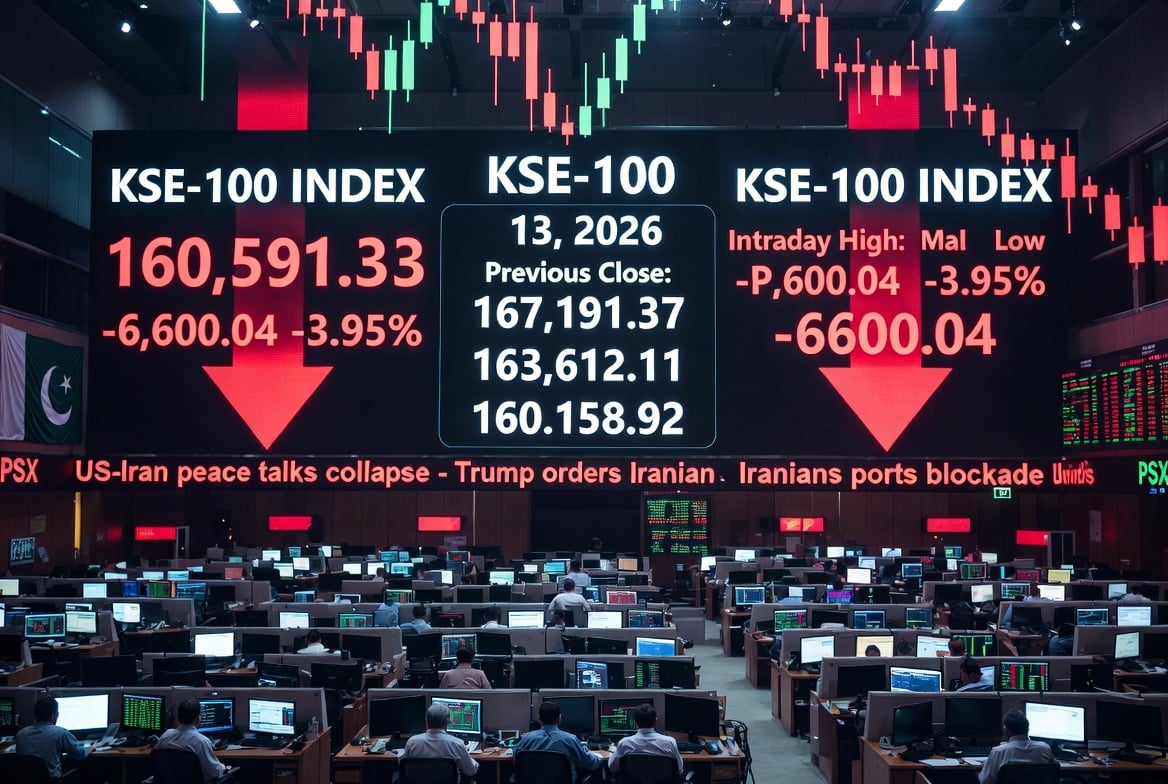
The KSE-100 opened on a weak note near 161,000 points against the previous close of 167,191.37.
It fluctuated wildly throughout the day reaching an intraday high of 163,612.11 points at 12:13pm.
The index then hit an intraday low of 160,158.92 points at 2:56pm before closing at 160,591.33 points.
The final drop of 6,600.04 points represented a steep 3.95 percent decline in a single session.
Analysts described the sell-off as one of the sharpest point losses in recent months driven purely by external geopolitical shocks.
Fears of disrupted global oil supplies through the Strait of Hormuz triggered panic selling across blue-chip stocks.
Energy and banking sectors bore the brunt as investors rushed to offload positions amid rising uncertainty.
Regional media reports from Dawn and The Express Tribune confirmed the session’s extreme volatility and linked it directly to the collapsed talks held in Islamabad.
International outlets including Reuters and NPR also covered the US blockade announcement adding to global market jitters.
The reversal erased much of the massive 12,000-plus point gains recorded just days earlier when the initial US-Iran ceasefire was announced.
That earlier rally had pushed the index above 165,000 points in record intraday surges.
Monday’s drop highlights how fragile investor sentiment remains in the face of renewed Middle East tensions.
Despite the heavy losses market depth remained robust with trading volume exceeding 324 million shares.
Analysts noted that the PSX had shown remarkable resilience in the preceding weeks supported by strong macroeconomic indicators.
Foreign exchange reserves rebuilt to nearly 20 billion dollars continued to act as a buffer against external volatility.
The latest Fitch Ratings affirmation of Pakistan’s B- stable outlook just weeks ago had boosted confidence before this external shock.
Tax revenues up nearly three percent of GDP and inflation down to 4.5 percent had underpinned recent market optimism.
Remittances hitting a record 39 billion dollars in the last fiscal year also provided underlying economic strength.
Yet the blockade threat has raised concerns over potential oil price spikes that could indirectly pressure Pakistan’s import bill.
Experts believe the market reaction remains temporary as long as diplomatic efforts resume quickly.
Pakistan’s role as the venue for the high-stakes US-Iran talks has once again placed Islamabad at the centre of global diplomacy.
Observers expect renewed negotiations could stabilise sentiment and trigger a rebound in coming sessions.
The KSE-100 still trades well above levels seen earlier in the year reflecting overall yearly gains of nearly 38 percent.
Long-term investors view the current dip as a buying opportunity amid Pakistan’s ongoing IMF-backed reforms.
The government remains committed to fiscal consolidation that has already narrowed the deficit significantly.
Monday’s session serves as a reminder of the interconnected nature of Pakistan’s capital markets with international events.
Market watchers will closely monitor developments in the Strait of Hormuz over the next 48 hours.
Any de-escalation could swiftly reverse today’s losses and restore the bullish momentum seen last week.
Pakistan’s stock market has demonstrated strong fundamentals even during periods of regional instability.
The PSX continues to attract foreign portfolio interest on the back of improved credit ratings and diplomatic leverage.