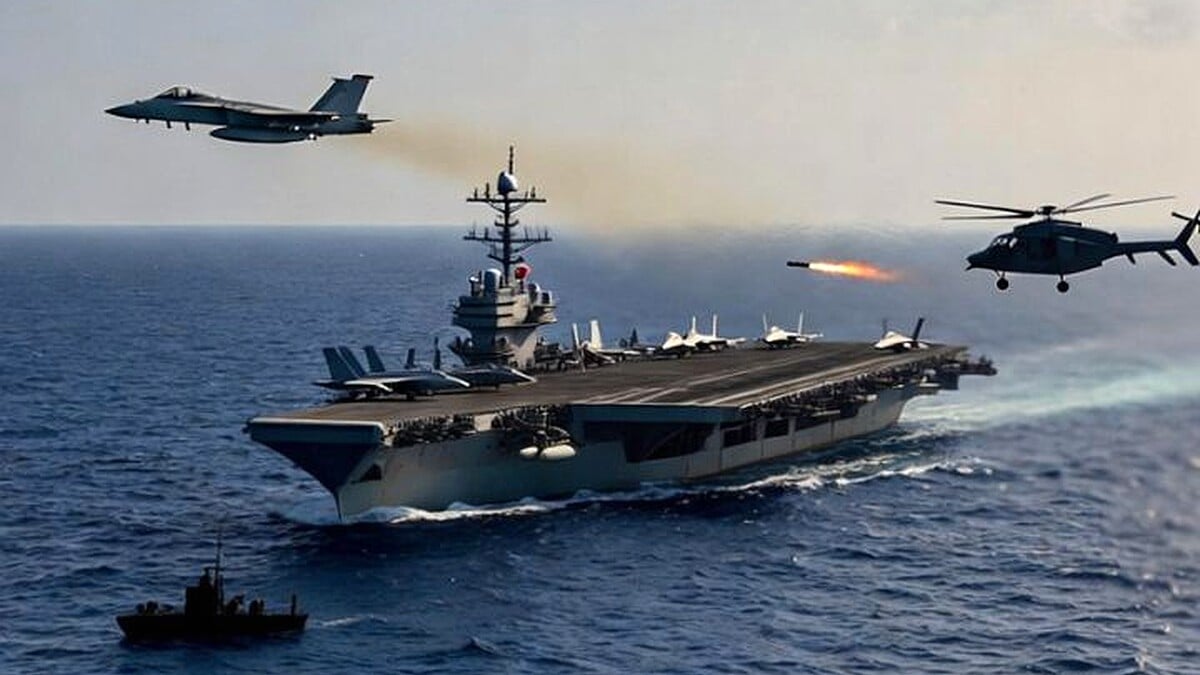
ISLAMABAD: US naval forces have admitted that Iranian unmanned vessel approached too close to the aircraft carrier USS Abraham Lincoln in the Arabian Sea, according to officials cited by CBS News.
The incident unfolded amid rising tensions between the United States and Iran.
Two US officials, speaking anonymously as they were not authorised to comment publicly, detailed the sequence of events to CBS News.
An Iranian vessel sailed unusually close to the USS Abraham Lincoln, a Nimitz-class nuclear-powered aircraft carrier.
The carrier forms the core of a strike group operating in the region.
A US Navy destroyer, part of the carrier’s escort, first attempted to engage the approaching vessel.
It used its Mark-45 5-inch naval gun, a standard deck weapon on Arleigh Burke-class destroyers.
The gun fired multiple rounds, but the shots missed several times.
It remains unclear if these were deliberate warning shots or attempts to disable the vessel.
Following the unsuccessful gunfire, an MH-60 Seahawk helicopter launched from the carrier group.
The helicopter, armed with precision-guided munitions, targeted the Iranian ship.
It struck the vessel with two AGM-114 Hellfire missiles.
Hellfire missiles, originally designed for anti-armour roles, have proven effective against small boats and vessels in naval operations.
The status of the Iranian vessel and its crew remains unknown.
No further details on damage extent or casualties have emerged.
The Pentagon and US Central Command have not issued public statements on the matter.
When contacted by CBS News, a CENTCOM representative responded that they had nothing to add.
The USS Abraham Lincoln has been active in the Arabian Sea for months.
It supports broader US military operations in the Middle East.
These include responses to regional threats and freedom of navigation assertions.
The carrier departed its homeport in San Diego late last year.
It carries a mix of F/A-18 Super Hornets and F-35C stealth fighters.
Escorting destroyers provide layered defence against air, surface and subsurface threats.
Recent weeks have seen multiple maritime encounters in the area.
Iranian forces have harassed commercial shipping and conducted provocative manoeuvres.
US officials have repeatedly warned against actions endangering naval assets.
This incident follows a pattern of close approaches by Iranian boats to US warships.
Such encounters often involve Islamic Revolutionary Guard Corps Navy vessels.
The IRGC Navy operates fast attack craft and small boats suited for swarm tactics.
These tactics aim to overwhelm larger ships through coordinated approaches.
US carrier strike groups maintain strict rules of engagement.
They prioritise de-escalation but authorise force when threats become imminent.
The Mark-45 gun, firing 5-inch projectiles at high rates, serves as a first-line response.
When ineffective against agile small craft, helicopters provide rapid precision strikes.
Hellfire missiles offer standoff capability and high accuracy.
The Arabian Sea location places the incident outside the Strait of Hormuz.
Yet it falls within waters where Iran claims influence.
Broader context includes ongoing US-Iran friction.
This stems from sanctions, nuclear concerns and proxy conflicts.
The Abraham Lincoln group has participated in strikes against Iranian-linked targets.
It operates under Operation Epic Fury designations in some reporting.
No Iranian official confirmation of the incident has surfaced yet.
Tehran has previously denied or reframed similar events.
Propaganda claims often circulate on both sides during escalations.
US sources emphasise defensive actions to protect forces.
The lack of CENTCOM comment suggests operational security priorities.
Such incidents risk further escalation in an already volatile region.
Naval experts note the challenge of engaging small, fast vessels with large-calibre guns.
Misses highlight the need for alternative platforms like helicopters.
The use of Hellfires demonstrates integrated air-surface operations.
This event underscores the delicate balance in international waters.
Freedom of navigation remains a core US principle.
Iran views US presence as provocative.
Dialogue channels exist but see limited use amid tensions.
Observers watch for Iranian retaliation or further approaches.
The carrier group’s continued operations signal resolve.
No injuries to US personnel have been reported.
The incident adds to a series of naval interactions this year.
Previous events included drone shootdowns near the carrier.
An Iranian Shahed-139 drone was downed by an F-35 in February.
Such actions reflect heightened alert levels.
The Arabian Sea serves as a critical theatre for power projection.
Oil routes and strategic chokepoints amplify stakes.
Both navies maintain presence to deter aggression.
This latest encounter illustrates risks of miscalculation.
Clear communication and rules could prevent worse outcomes.
For now, details remain limited to anonymous sourcing.
Further developments may clarify the full picture.