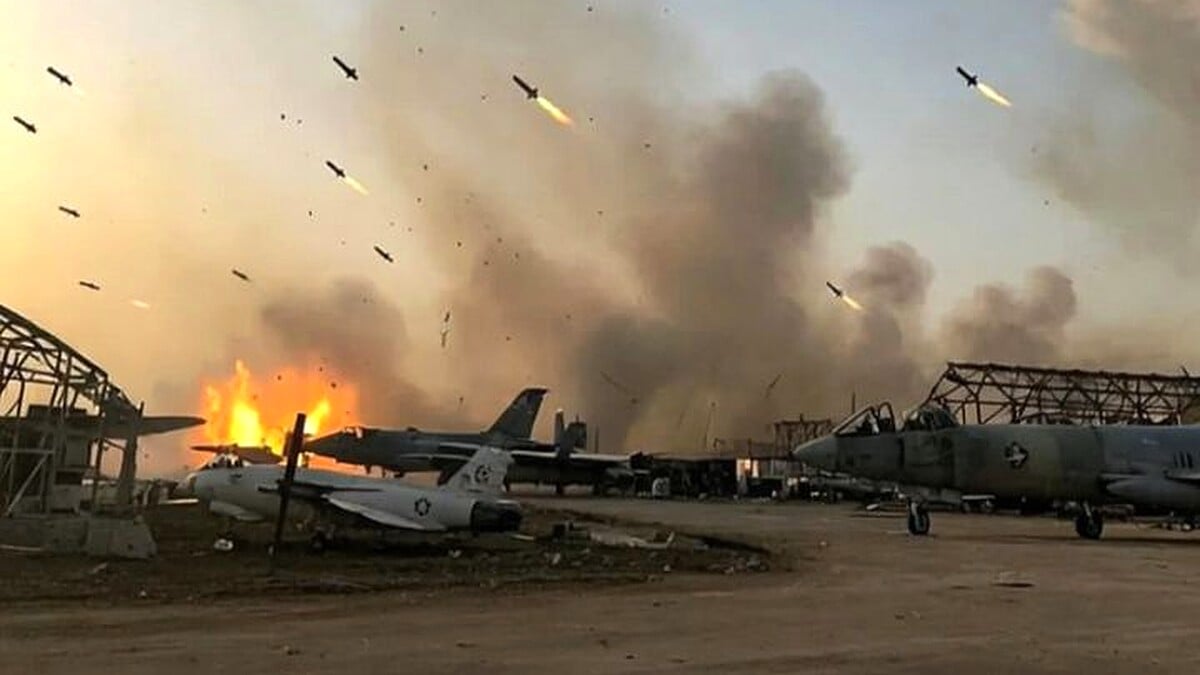
ISLAMABAD: The Islamic Revolutionary Guard Corps of Iran has directly hit two strategic Israeli Air Force bases and the headquarters of the Shin Bet internal security agency.
Iranian military officials announced the attacks targeted Palmahim and Ovda airbases along with Shin Bet facilities in a coordinated retaliatory operation.
The strikes occurred amid the third week of escalating conflict between Iran and the US-Israeli alliance that began on February 28 2026.
Palmahim Airbase sits on the Mediterranean coast west of Yavne roughly 12 kilometres south of Tel Aviv. It operates as a joint Israeli Air Force and space agency facility.
The base hosts unmanned aerial vehicle squadrons including Hermes and Heron platforms as well as transport helicopter units. It also maintains an Arrow missile defence battery southeast of the main airfield.
No permanent fighter jet squadrons are stationed at Palmahim yet its UAV operations provide up to 80 percent of certain Israeli intelligence surveillance and reconnaissance data in regional conflicts.
Palmahim functions as Israel’s primary spaceport launching Shavit rockets carrying Ofek reconnaissance satellites. These launches occur westward over the Mediterranean to avoid neighbouring airspace.
The base additionally serves as a test site for Jericho ballistic missiles and advanced Arrow defence systems enhancing protection for central Israel.
Ovda Airbase lies in the southern Negev Desert approximately 40 kilometres north of Eilat. It features two runways measuring 3000 metres and 2600 metres capable of supporting heavy transport and tanker aircraft.
The facility has no permanently stationed operational fighter jets or helicopters focusing instead on advanced training and logistical support. Until May 2025 it housed an aggressor squadron simulating enemy aircraft for pilot exercises.
Ovda hosts Israel’s Air Force Officers School and has been used for major international drills such as Blue Flag. In February 2026 it received the first deployment of United States F-22 Raptor stealth fighters for potential operations against Iran.
The base provides rapid deployment capabilities and backup tanker support in southern Israel making it a key asset for extended range missions.
Shin Bet also known as the Israel Security Agency maintains its headquarters in northwest Tel Aviv north of Yarkon Park. As Israel’s domestic counterintelligence service it handles internal security threats espionage and political subversion.
The agency has played a central role in thwarting attacks and gathering intelligence on groups such as Hamas particularly after the October 2023 events.
Iranian statements specified that drones struck observation towers runways and hangars at both airbases plus the Shin Bet headquarters.
The Iranian army described the operation as precise and successful using destructive drones launched from within Iran.
Israeli officials have confirmed ongoing wide-scale counter-strikes on Iranian targets including IRGC infrastructure but have not yet detailed damage from the incoming attacks.
The broader conflict has claimed at least 13 lives and injured nearly 2000 people in Israel according to local authorities since late February.
Iran accuses Israel of striking hospitals and civilian sites prompting the latest military response across the region.
Analysts highlight that damaging Palmahim could temporarily disrupt UAV-driven intelligence gathering and central missile defence coverage.
Disruption at Ovda may affect training programmes and joint US-Israeli operational readiness given the recent American fighter presence.
The Shin Bet headquarters strike represents a rare direct challenge to Israel’s internal security apparatus potentially complicating counter-terrorism coordination.
This exchange forms part of a wider pattern where Iranian forces have faced severe degradation of missile and drone capabilities from prior US-Israeli air campaigns.
Despite setbacks Iran continues limited drone operations targeting high-value Israeli military and intelligence sites.
The Palmahim base near the Gush Dan metropolitan area protects densely populated central regions while Ovda supports southern defence and rapid response.
Both locations have historical significance Palmahim dating to the 1970s as a missile test range and Ovda built in 1981 under US assistance after the Camp David Accords.
Shin Bet’s Tel Aviv location underscores the symbolic nature of the strike against one of Israel’s core intelligence pillars.
Regional observers note that such targeted claims aim to demonstrate Iran’s reach despite defensive interceptions by Israeli systems.
The ongoing war has drawn in multiple actors with Hezbollah increasing rocket activity to divert Israeli focus from Iran.
Casualty figures and infrastructure damage reports remain preliminary as both sides maintain operational secrecy.
International attention grows over the risk of further escalation involving oil routes and global energy markets.
Pakistan has called for de-escalation and diplomatic resolution to prevent wider Middle East instability.
The IRGC and regular Iranian army coordinated the strikes marking a unified military statement against perceived aggression.
Future developments depend on Israeli responses and any verified impact assessments from the targeted sites.
Iranian media released statements emphasising precision while Israeli sources focus on continued offensive operations inside Iran.
The conflict trajectory suggests sustained aerial exchanges with both nations protecting core strategic assets.
These latest strikes underline the vulnerability of even well-defended Israeli installations to long-range drone technology in prolonged confrontations.