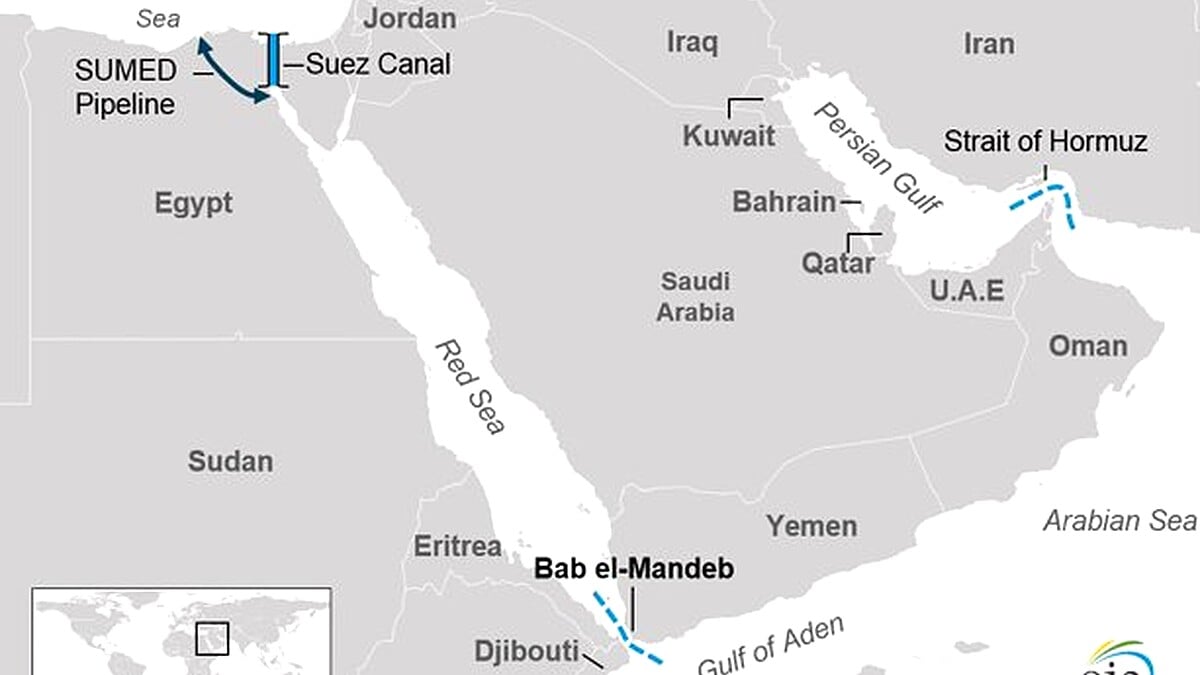
ISLAMABAD: A senior Iranian military official has issued a direct warning that any strategic misstep by Washington could see the Bab el-Mandeb Strait face the same fate as the already disrupted Strait of Hormuz.
The unnamed official told Qatar-based Al Jazeera that the region stands on the brink of full-scale regional war. Iran, he said, still holds many cards and maintains phased, gradual military plans ready for execution.
The remarks come as the US-Israel conflict with Iran enters its second week following strikes launched on February 28 that targeted Iranian leadership and military sites. Shipping data shows the Strait of Hormuz, which normally carries 20.9 million barrels of oil per day, has seen traffic drop by more than 90 percent. Tanker movements have ground nearly to a halt.
According to the US Energy Information Administration, that volume represented about 20 percent of global oil consumption and roughly one quarter of all seaborne oil trade before the current escalation. Gulf producers including Saudi Arabia, Iraq and Kuwait have cut output and filled storage tanks to capacity after failing to load tankers.
Now Tehran signals it could extend the blockade southward to the Bab el-Mandeb Strait. This narrow passage between Yemen and Djibouti controls entry to the Red Sea and, by extension, the Suez Canal route. Recent figures for the first half of 2025 show 4.2 million barrels of oil moving daily through Bab el-Mandeb, with an additional 4.9 million barrels per day via the Suez Canal itself.
Together these routes handle around 12 percent of global seaborne trade and a significant share of energy shipments to Europe and Asia. Analysts note that simultaneous closure of both Hormuz and Bab el-Mandeb would leave few alternatives besides the long and costly detour around the Cape of Good Hope.
Shipping costs have already surged. Supertanker rates in the Middle East reached record highs this week. European natural gas prices jumped alongside Brent crude, which rose nearly 10 percent in early March trading. Container vessels and oil tankers are diverting en masse, adding 10 to 14 days to voyage times and increasing fuel consumption by up to 40 percent.
The threat carries extra weight because of Iran’s regional proxies. Yemen’s Houthis, aligned with Tehran, previously conducted over 190 attacks on Red Sea shipping between late 2023 and late 2025. Those earlier operations halved oil and container traffic through Bab el-Mandeb and Suez. Renewed Houthi statements this week suggest missile and drone campaigns could resume immediately if ordered.
Iranian officials describe their strategy as multi-layered. They point to naval mines, anti-ship missiles, unmanned aerial vehicles and electronic jamming capabilities already demonstrated in the Persian Gulf. The senior Al Jazeera interviewee stressed that plans remain gradual, allowing escalation in controlled stages rather than immediate all-out closure.
Global inventories currently stand at historic highs of 8.2 billion barrels, enough to cover a full Hormuz shutdown for over 400 days according to market analysts. Yet the International Energy Agency is already preparing recommendations for the largest-ever strategic reserve release, potentially 400 million barrels, to cushion the shock.
Pakistan, which imports nearly 80 percent of its crude oil, faces direct exposure. Industry sources in Islamabad warn that prolonged disruption could push domestic fuel prices higher and strain foreign exchange reserves already under pressure. Similar concerns echo across importing nations in South Asia and Europe.
Maritime security firms have issued fresh advisories raising the threat level for the entire Red Sea corridor. The European Union’s naval mission EUNAVFOR ASPIDES remains on high alert, while the US Navy has expanded warning zones across both chokepoints.
Experts tracking the conflict note that Bab el-Mandeb’s geography makes it particularly vulnerable. At its narrowest point the channel measures just 26 kilometres wide, easily monitored and targeted from Yemeni shores. Unlike Hormuz, where Gulf states have limited pipeline bypass options of around 4.7 million barrels per day, no comparable land route exists to replace Red Sea transit.
The official’s reference to “another strait” leaves little ambiguity. Secondary reporting from Turkish and Russian outlets quoting the same Al Jazeera interview explicitly links the warning to Bab el-Mandeb. They describe the move as Tehran’s response to what it calls American miscalculation in backing Israeli strikes.
Regional observers say the statement forms part of a broader deterrence message. Iran has already jammed commercial navigation signals in the Gulf and launched retaliatory missiles toward Israeli and US targets. Extending pressure to the Red Sea would compound economic pain on Western allies while testing the limits of international naval coalitions.
Shipping analysts at Clarksons Research report more than 3,200 vessels currently idle or waiting outside the Persian Gulf, representing about four percent of global tonnage. Red Sea recovery plans, which had begun slowly after the 2024-25 Houthi lull, have now been shelved indefinitely.
The stakes extend beyond oil. Around 30 percent of global container traffic once used the Suez route before earlier disruptions. Grain shipments to East Africa and Europe, liquefied natural gas cargoes and consumer goods all face delays and higher insurance premiums.
As the conflict enters its critical phase, the Iranian warning underscores the fragility of maritime chokepoints. With both Hormuz and Bab el-Mandeb under threat, the global economy confronts a scenario few planners had fully modelled. Markets, governments and shipping lines now watch Tehran’s next move with heightened urgency.