Pakistan reaffirms solidarity with Saudi Arabia while urging de-escalation in Middle East tensions.
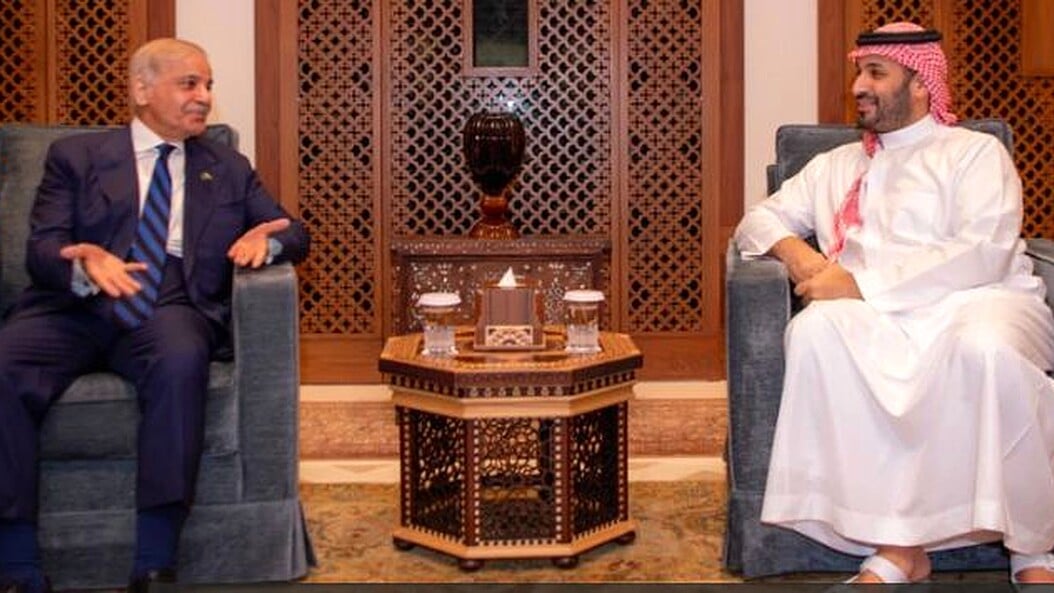
ISLAMABAD: Prime Minister Shehbaz Sharif, accompanied by Chief of Defence Forces Field Marshal Syed Asim Munir, held a high-level meeting with Saudi Arabia’s Crown Prince and Prime Minister Mohammed bin Salman in Jeddah on Thursday, a development viewed with significant interest amid the ongoing regional conflict involving Iran, the United States, and Israel.
The meeting followed a telephone conversation between Prime Minister Sharif and Iranian President Masoud Pezeshkian earlier in the week, highlighting Pakistan’s active diplomatic engagement on both sides of the divide.
In an official statement issued by the Pakistani government, Prime Minister Sharif expressed gratitude for Saudi Arabia’s longstanding support and assured the Kingdom of Pakistan’s complete solidarity during these challenging times.
The premier emphasized that Pakistan would always stand firmly with Saudi Arabia and contribute to efforts aimed at promoting peace and stability in the region.
Discussions between the two leaders focused on the security and stability implications of the recent military escalations in the Middle East.
The restricted meeting included key figures from both sides, with Pakistan represented by Deputy Prime Minister and Foreign Minister Mohammad Ishaq Dar alongside Field Marshal Asim Munir, while Saudi Arabia’s General Intelligence Directorate President Khalid al-Hamdan was also present.
As per the sources, Pakistan has assured full support to Saudi Arabia in the defence of the country from any external threat. However, Pakistan may not be involved in any offence against any other Muslim country and the militray assistance would be confined to the defence of Kingdom when asked for.
This engagement occurs against the backdrop of intensified hostilities, where US and Israeli strikes have targeted Iranian sites, resulting in significant casualties including the death of Iran’s former Supreme Leader Ali Khamenei, prompting Iranian retaliatory missile and drone attacks on US military bases and energy infrastructure in the Gulf.
Iran has further escalated by threatening and partially disrupting maritime traffic through the Strait of Hormuz, a critical chokepoint for global oil supplies, leading to sharp increases in energy prices and widespread concerns over supply chain disruptions.
Pakistan’s position is particularly delicate due to its strategic partnerships.
Pakistan maintains a formal Strategic Mutual Defence Agreement with Saudi Arabia, signed in 2025, which commits both nations to mutual support in the event of aggression.
At the same time, Islamabad shares a long border with Iran and has historically pursued balanced relations with Tehran.
Pakistan is employing backchannel diplomacy to discourage both sides from further escalation.
Abdullah Khan, Director of the Pakistan Institute for Conflict and Security Studies, indicated that Islamabad is conveying to Saudi Arabia and its Arab allies the risks of being drawn into broader confrontations, while advising Iran that prolonging the conflict would be detrimental to its own interests.
Foreign Minister Ishaq Dar has previously reminded Tehran of Pakistan’s defence commitments to Saudi Arabia, underscoring the need for restraint.
Senator Mushahid Hussain Syed observed on social media that Pakistan must exercise skillful and nuanced diplomacy to avoid entanglement in any strategic trap.
Pakistan faces multiple strategic concerns if the conflict widens.
Disruptions in the Strait of Hormuz could severely impact global oil flows, with potential knock-on effects on Pakistan’s energy imports and economy.
Policy circles in Islamabad express apprehension over larger strategic shifts, including Iran’s policies in Sistan and Balochistan province, adjacent to Pakistan’s southwestern border.
Pakistan’s defence ties with Saudi Arabia and Turkey could come under pressure, while US-Israeli military strategies and Iranian responses might indirectly affect sensitive border areas and projects like Gwadar port.
The presence of high-ranking military leadership in the Jeddah meeting signals the integrated civil-military approach Pakistan is adopting in response to the crisis.
Observers interpret the visit as part of broader efforts to mediate or at least contain the fallout, preventing a full-scale regional war that could draw in multiple actors.
Pakistan’s messaging remains consistent: support for allies like Saudi Arabia is unwavering, yet priority is given to de-escalation through dialogue.
As the Middle East situation remains fluid, with threats to energy routes persisting and military operations continuing, Pakistan’s diplomatic maneuvers are likely to remain under close scrutiny from regional and international stakeholders.
The outcome of these engagements could influence the trajectory of the conflict and Pakistan’s standing in an increasingly polarized region.