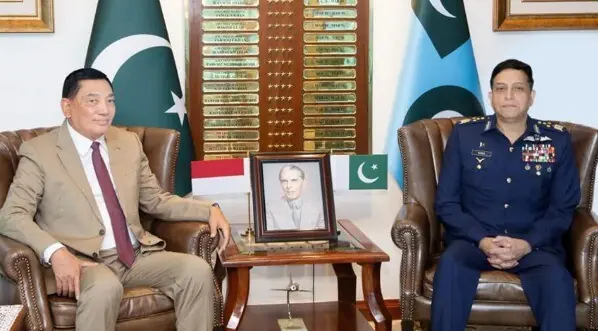
ISLAMABAD: Air Chief Marshal Zaheer Ahmed Baber Sidhu, Chief of Air Staff of the Pakistan Air Force (PAF), called on Indonesian President Prabowo Subianto during his official visit to Indonesia, signalling a significant push to institutionalise long-term defence cooperation between the two Muslim-majority nations. The high-level engagement, confirmed by the Inter-Services Public Relations (ISPR), centred on expanding aerospace collaboration, advanced pilot training, and potential acquisition of Pakistan’s JF-17 Thunder fighter aircraft by Indonesia.
During the meeting, the Air Chief underscored the historic bonds and shared strategic outlook that have shaped relations between Pakistan and Indonesia since the mid-20th century. He highlighted PAF’s transition into a technologically integrated force equipped with indigenous capabilities, modern training ecosystems and advanced aerospace manufacturing infrastructure. President Prabowo expressed strong interest in leveraging Pakistan’s operational experience and defence production ecosystem to enhance Indonesia’s evolving airpower posture.
Indonesia, Southeast Asia’s largest economy and an archipelagic state spanning over 17,000 islands, faces unique security challenges, including maritime domain awareness, airspace protection and rapid response capability. Defence analysts note that Jakarta’s modernisation roadmap prioritises cost-effective multi-role fighter platforms capable of operating in diverse terrains. In this context, Pakistan’s JF-17 Thunder — jointly developed by Pakistan Aeronautical Complex (PAC) and China’s Chengdu Aircraft Corporation — is increasingly viewed as a competitive option.
The JF-17 Thunder has undergone successive upgrades since its induction into the PAF in 2007. The latest Block-III variant features advanced avionics, an active electronically scanned array (AESA) radar, enhanced beyond-visual-range missile capability and improved electronic warfare systems. Aviation experts argue that the aircraft offers a balanced combination of affordability, operational reliability and technological adaptability, attributes particularly relevant for middle-income nations seeking fleet modernisation without the high lifecycle costs associated with Western platforms.
PAF’s credibility in promoting the JF-17 platform stems partly from its extensive operational experience. Over the past decade, the force has invested heavily in integrated air defence systems, network-centric warfare capabilities and advanced training methodologies. Its performance during periods of heightened regional tensions demonstrated coordinated response mechanisms and effective employment of airpower assets against a numerically larger adversary, reinforcing perceptions of professionalism and doctrinal maturity within the force.
Beyond hardware acquisition, discussions reportedly focused on training collaboration and aerospace industrial partnerships. PAF operates a comprehensive training ecosystem encompassing basic flight instruction, advanced tactical training and operational conversion programmes supported by simulation technologies. Indonesia has shown interest in structured pilot training, maintenance capacity-building and technical exchange initiatives, which could enable Jakarta to develop indigenous expertise while reducing long-term dependence on external contractors.
Defence economists observe that Indonesia’s military modernisation plan aligns with a broader regional trend toward diversified procurement. Rather than relying solely on a single supplier bloc, Jakarta has pursued a mixed portfolio approach involving European, American and Asian manufacturers. In this strategic calculus, Pakistan offers not only aircraft but also access to an evolving aerospace ecosystem, including maintenance, repair and overhaul (MRO) services and potential joint production frameworks.
The visit also holds geopolitical implications. Strengthened Pakistan-Indonesia defence cooperation would reinforce South-South partnerships and expand Islamabad’s footprint in Southeast Asia’s security architecture. Both nations are members of multilateral forums such as the Organisation of Islamic Cooperation, and enhanced defence collaboration could complement broader economic and diplomatic engagement. Analysts suggest that defence-industrial linkages often serve as catalysts for wider trade, technology transfer and strategic trust.
For Pakistan, potential export of JF-17 aircraft to Indonesia would represent a significant milestone in expanding its defence export base. Previous exports to countries including Nigeria and Myanmar have demonstrated the platform’s viability in diverse operational environments. A deal with Indonesia, however, would carry greater symbolic and economic weight, given Jakarta’s regional influence and scale of defence requirements. Such an agreement could further validate Pakistan’s indigenous aerospace ambitions.
While no formal procurement agreement was announced, the high-level meeting underscores growing momentum toward deeper bilateral defence alignment. As Indonesia evaluates its future air combat requirements, Pakistan’s combination of operational experience, competitive technology and integrated training infrastructure positions it as a credible partner. The evolving dialogue reflects not merely a transactional arms discussion, but a broader vision of collaborative aerospace development grounded in shared strategic interests and mutual confidence.