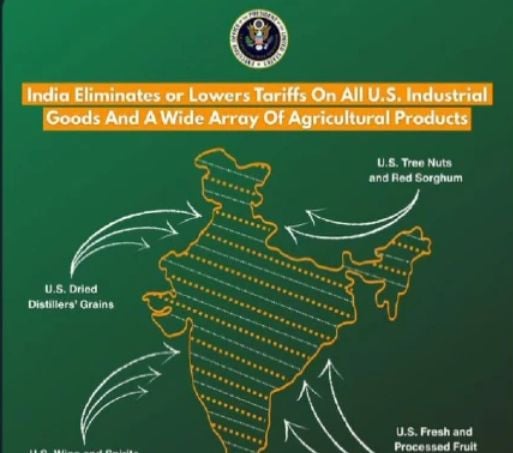
ISLAMABAD: Pakistan’s Ministry of Foreign Affairs has announced that the United States deleted a social media post from the Office of the United States Trade Representative (USTR) after Islamabad raised objections over a map showing Pakistan-administered Kashmir and Aksai Chin as integral parts of India. The development, confirmed by Foreign Office spokesperson Tahir Andrabi, highlights ongoing sensitivities surrounding the Kashmir dispute and the United States’ traditional neutral stance on territorial depictions in the region.
The controversy originated last week when the USTR shared a post on X announcing a framework for an interim trade agreement between the United States and India. Accompanying the announcement was a graphic featuring a map of India that included the entire Jammu and Kashmir region, encompassing Azad Jammu and Kashmir and Gilgit-Baltistan under Pakistan’s administration, along with Aksai Chin claimed by China, within undisputed Indian boundaries. This representation deviated from previous US official maps that typically marked these areas as disputed or separately delineated.
Pakistan’s Foreign Ministry swiftly contacted US officials through diplomatic channels, both at the US Embassy in Islamabad and relevant departments in Washington. Spokesperson Andrabi described the map as “illegal” and inconsistent with United Nations Security Council resolutions that recognize Jammu and Kashmir as a disputed territory pending a final resolution. He expressed satisfaction that US authorities acknowledged the error and promptly removed the post from the USTR’s official X account within days of its publication.
The Kashmir conflict remains one of South Asia’s most enduring and volatile disputes, stemming from the 1947 partition of British India. Both Pakistan and India claim the former princely state in full, leading to three major wars in 1947-48, 1965, and 1999, alongside numerous skirmishes along the Line of Control. The region is divided, with India administering Jammu, Kashmir Valley, and Ladakh, while Pakistan controls Azad Jammu and Kashmir and Gilgit-Baltistan, and China holds Aksai Chin following the 1962 Sino-Indian war.
The United Nations has played a central role since the early years of the dispute. On January 1, 1948, India approached the UN Security Council, leading to Resolution 47 adopted on April 21, 1948. This resolution called for a ceasefire, withdrawal of forces, and a plebiscite to determine the region’s future under impartial conditions. Subsequent resolutions reinforced the need for demilitarization and self-determination, though neither side fully implemented the proposed steps, resulting in stalled progress and the establishment of the United Nations Military Observer Group in India and Pakistan (UNMOGIP) to monitor the ceasefire.
Despite the UN framework, bilateral agreements such as the 1972 Simla Accord shifted focus toward bilateral resolution without third-party intervention, a position India emphasizes. Pakistan, however, continues to advocate for UN resolutions and international involvement. The US has historically maintained a neutral posture, avoiding explicit endorsement of either claim in official maps and statements to preserve diplomatic balance in the region.
Indian reactions to the USTR post were initially positive among some users and media outlets, who interpreted the map as tacit US support for India’s position on Kashmir. Several Indian accounts shared the graphic, reinforcing narratives of territorial integrity. The subsequent deletion sparked criticism from opposition figures in India, including Congress leader Pawan Khera, who questioned the government’s diplomatic efforts and highlighted perceived losses in the “battle of narratives” against Pakistan.
The incident underscores the diplomatic weight attached to cartographic representations in international communications, particularly concerning disputed territories. While the trade agreement framework press release remains available without the map, the removal reaffirms Washington’s adherence to its longstanding policy of depicting Jammu and Kashmir with notations of disputed status, avoiding actions that could be construed as altering the legal or political landscape.
Experts note that such episodes rarely indicate substantive policy shifts but rather administrative oversights corrected through quiet diplomacy. The swift Pakistani response and US compliance demonstrate the continued relevance of the Kashmir issue in bilateral relations with major powers. As US-India trade ties deepen under evolving frameworks, territorial sensitivities are likely to persist as flashpoints in South Asian geopolitics.
Pakistan’s Ministry of Foreign Affairs reiterated its commitment to highlighting what it terms the “legal UN-sanctioned” status of the region, urging accurate depictions in global discourse. The episode serves as a reminder of the enduring complexities surrounding Kashmir, where maps, narratives, and diplomacy intersect amid unresolved claims dating back nearly eight decades.
(Word count: 782)
AI-created image: A digital illustration depicting a world map focused on South Asia, with the Kashmir region highlighted in disputed shading between India and Pakistan, overlaid by a faded screenshot of a deleted X post from the US Trade Representative account showing an undivided India map, and subtle UN Security Council resolution icons in the background symbolizing international mediation efforts.