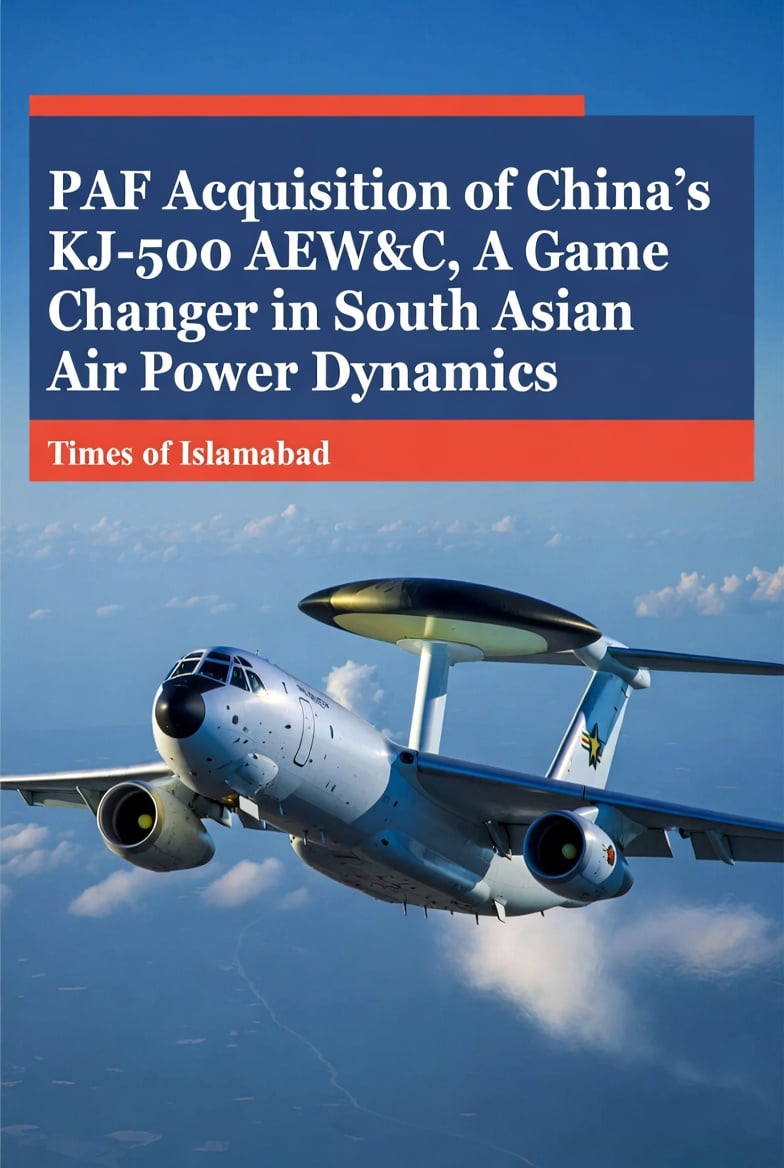




ISLAMABAD: Pakistan has formally moved to acquire the Shaanxi KJ-500 airborne early warning and control aircraft from China marking a pivotal enhancement in its air defence capabilities as of early 2026.
The platform distinguished by its fixed dorsal radome housing three active electronically scanned array antennas delivers continuous 360-degree coverage without any mechanical rotation.
It can track 60 to 100 targets including stealth aircraft and cruise missiles at ranges reaching up to 470 kilometres.
With a flight endurance of 12 hours the KJ-500 functions as a central C4ISR hub for the Pakistan Air Force.
This acquisition will integrate seamlessly with the J-10C and JF-17 fighter fleets creating a unified networked air defence system.
Formal negotiations between Chinese and Pakistani officials were confirmed in June 2025 according to regional defence reports.
The KJ-500 packs the radar performance of heavy strategic platforms into a medium-sized Y-9 turboprop airframe delivering exceptional operational efficiency.
Defence analysts describe it as a true force multiplier that will reshape South Asia’s aerial battlefield dynamics.
Advanced data-linking capabilities enable real-time intelligence sharing with fighters and ground-based systems.
The aircraft’s maximum range of 5,700 kilometres and cruise speed of 550 kilometres per hour support prolonged command missions.
Its max takeoff weight of 77 tonnes underscores the robust design optimised for high-demand environments.
Pakistan Air Force crews will gain unprecedented situational awareness through the fixed AESA radar configuration.
This eliminates blind spots common in older rotating radar systems providing uninterrupted surveillance.
Regional media outlets report the deal forms part of a broader defence package enhancing overall interoperability.
The KJ-500’s ability to detect low-observable threats addresses emerging challenges from stealth and hypersonic technologies.
Integration with J-10C multirole fighters will amplify beyond-visual-range engagement precision and speed.
JF-17 Thunder variants will similarly benefit from extended sensor fusion and targeting data.
Such synergy creates a networked kill chain linking sensors shooters and command nodes effectively.
The platform has proven its reliability in People’s Liberation Army Air Force operations across complex domains.
For Pakistan the KJ-500 represents a generational leap over legacy AEW&C systems currently in service.
Its cost-effective turboprop design promises sustained availability with lower maintenance demands than jet alternatives.
Continuous 360-degree coverage combined with electronic support measures enhances threat identification accuracy.
Crewed by around ten operators the aircraft manages sophisticated electronic warfare and intelligence tasks onboard.
This development signals deepening military-technical cooperation between Pakistan and China.
Experts project the acquisition will significantly strengthen deterrence and operational readiness in contested airspace.
The radar’s high data processing capacity handles multiple tracks without any performance loss.
As delivery timelines advance the Pakistan Air Force prepares extensive training and doctrinal updates.
The move underscores confidence in Chinese aerospace engineering for modern network-centric warfare.
Regional reports emphasise the platform’s role in countering advanced aerial threats effectively.
Pakistan’s commitment to the KJ-500 positions its air force at the forefront of regional surveillance capabilities.
This acquisition is set to redefine aerial command doctrines across the South Asian theatre.
With its advanced features the KJ-500 emerges as an indispensable asset for integrated defence networks.