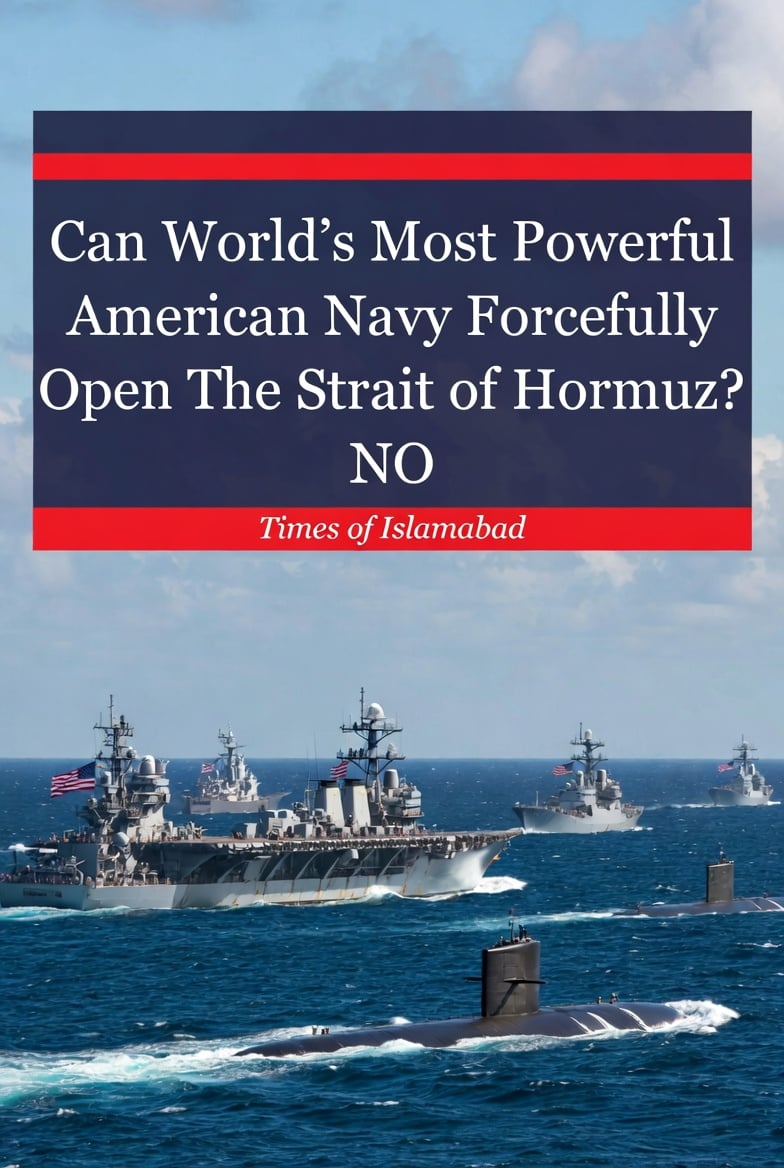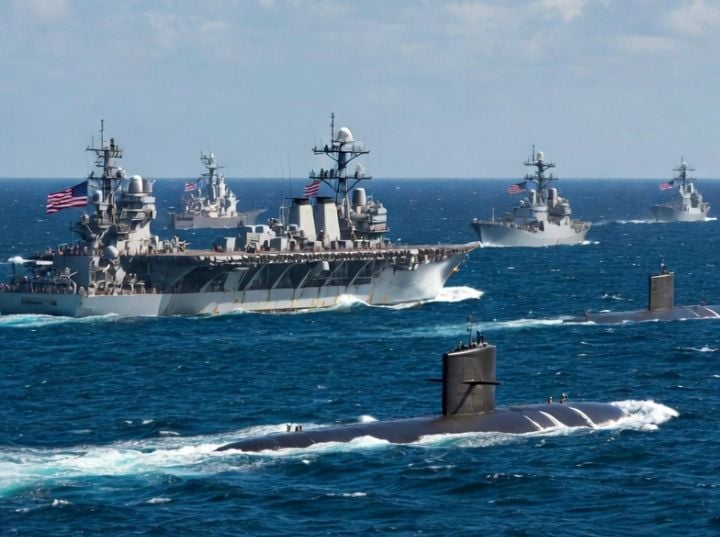




ISLAMABAD: A growing debate within strategic circles has reignited questions over whether the United States Navy could forcefully open the Strait of Hormuz during a conflict, but military assessments, regional realities, and evolving Iranian capabilities suggest that such an operation would be far more complex and potentially unachievable than often assumed, especially under sustained resistance from Iran.
The Strait of Hormuz, a narrow maritime chokepoint between Iran and Oman, handles nearly 20 percent of the world’s total oil consumption, with approximately 17 to 21 million barrels of crude oil passing through daily according to estimates by the US Energy Information Administration, making it one of the most strategically sensitive waterways globally.
At its narrowest point, the strait is only about 33 kilometers wide, with shipping lanes restricted to roughly 3 kilometers in each direction, a geographical limitation that inherently favors defensive operations and significantly constrains large naval fleets like that of the United States.
Iran has spent decades developing a layered anti-access/area denial strategy specifically designed to exploit these geographic constraints, focusing on asymmetric warfare rather than conventional naval parity with the US Navy, which remains the most powerful maritime force globally with 11 aircraft carriers and over 290 deployable ships.
One of Iran’s most critical advantages lies in its extensive inventory of naval mines, which military analysts estimate could number in the thousands, including sophisticated influence mines capable of targeting vessels based on magnetic, acoustic, or pressure signatures, making mine-clearing operations extremely time-consuming and dangerous under combat conditions.
Historical precedent further underscores the threat posed by mines, as during the in the 1980s, relatively simple mining operations caused significant disruption to maritime traffic, and even damaged US vessels such as the USS Samuel B. Roberts, demonstrating how low-cost systems can impose high strategic costs.
In addition to mines, Iran’s fleet of small, fast attack craft—often referred to as swarm boats—represents a major tactical challenge, as these vessels are designed for hit-and-run attacks, equipped with anti-ship missiles, rockets, and torpedoes, and capable of overwhelming larger ships through coordinated swarm tactics.
The Islamic Revolutionary Guard Corps Navy has emphasized the use of these fast boats in confined waters, where their speed, maneuverability, and familiarity with local terrain provide a decisive edge, particularly against large, less agile warships.
Iran has also invested in small and stealthy submarines, including Ghadir-class midget submarines, which are specifically designed for shallow waters like the Strait of Hormuz, allowing them to lay mines, launch torpedoes, and remain difficult to detect using conventional anti-submarine warfare systems.
Another critical component of Iran’s strategy is its expanding arsenal of anti-ship missiles, including systems like Noor, Qader, and Khalij Fars, with ranges extending up to 300 kilometers or more, capable of being launched from coastal batteries hidden within mountainous terrain along Iran’s southern coastline.
These coastal defenses benefit from natural cover provided by rugged mountains, enabling mobile launch platforms to relocate quickly and evade detection, thereby complicating targeting efforts by US forces and enhancing Iran’s survivability in a prolonged engagement.
Moreover, Iran’s use of unmanned aerial vehicles has added a new dimension to its maritime strategy, with drones capable of surveillance, targeting, and even direct attack roles, increasing situational awareness and enabling more precise strikes against naval assets.
The integration of drones with missile systems creates a networked warfare environment in which Iranian forces can detect, track, and engage targets with greater efficiency, further raising the operational risks for any force attempting to enter the strait.
Regional media reports and military analyses from outlets in the Middle East have increasingly highlighted Iran’s ability to conduct hybrid warfare in the strait, combining conventional and unconventional tactics to create a multi-layered defense that is difficult to penetrate.
A key factor often overlooked is the logistical and operational challenge of mine-clearing under hostile conditions, as US Navy minesweeping capabilities, though advanced, require time, specialized vessels, and relatively secure environments to operate effectively.
In a high-threat scenario, minesweepers themselves would become prime targets for Iranian missiles, drones, and fast boats, potentially delaying clearance operations for weeks or even months, during which global oil markets could experience severe disruption.
Furthermore, the political and economic implications of a prolonged closure or contested reopening of the strait would be immense, with oil prices likely to surge beyond $150 per barrel in extreme scenarios, according to some energy market forecasts, placing significant strain on global economies.
Iran’s strategic doctrine does not necessarily require total denial of access to the strait but rather aims to make any attempt to forcefully open it prohibitively costly, both militarily and economically, thereby deterring adversaries from initiating such operations.
Even limited disruptions could achieve Iran’s objectives by creating uncertainty in global energy markets and exerting pressure on countries dependent on Gulf oil exports, including major economies in Asia and Europe.
The United States, while possessing overwhelming naval power, would face the challenge of projecting that power effectively within a constrained and heavily defended environment where traditional advantages such as carrier strike groups may be less decisive.
Analysts argue that aircraft carriers, which serve as the backbone of US naval operations, could be particularly vulnerable to concentrated missile attacks in such a confined space, forcing them to operate at greater distances and reducing their effectiveness.
Additionally, the rules of engagement and risk of escalation would further complicate any military action, as direct confrontation with Iran in the strait could quickly expand into a broader regional conflict involving multiple actors.
The presence of civilian shipping and the potential for collateral damage would also impose constraints on military operations, making precision and restraint critical yet difficult to maintain in a high-intensity environment.
In this context, the notion of forcefully opening the Strait of Hormuz appears less a question of capability and more one of cost, risk, and strategic feasibility, with evidence suggesting that Iran’s asymmetric advantages and geographic positioning create formidable barriers to such an endeavor.
While the US Navy retains unmatched global reach, the unique conditions of the Strait of Hormuz tilt the balance toward a defender that has spent decades preparing for precisely this scenario, raising serious doubts about the practicality of a forced reopening under hostile conditions.