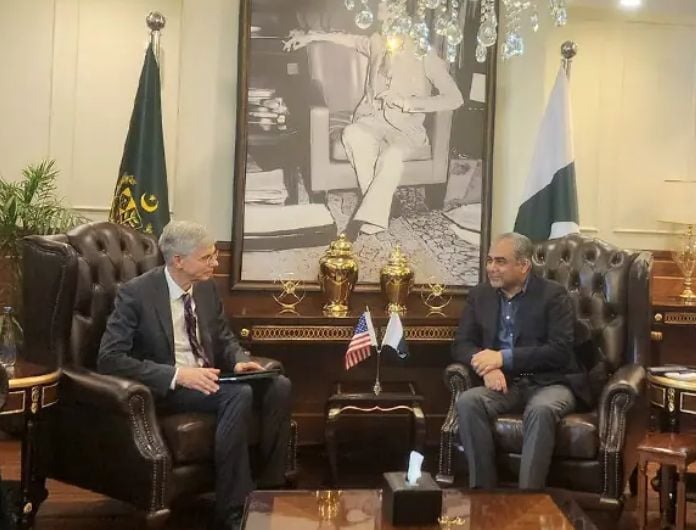
ISLAMABAD: Pakistan and the United States have agreed to deepen counterterrorism cooperation while promoting substantial investments in the mining minerals and energy sectors a move aimed at bolstering bilateral ties amid rising security challenges and economic opportunities the Ministry of Interior announced in a press release on Thursday. The understanding was reached during a high-level meeting in Islamabad where Interior Minister Mohsin Naqvi and Minister of State for Interior Talal Chaudhry hosted US Assistant Secretary of State for South and Central Asian Affairs John Mark Pomeroy accompanied by US Ambassador Natalie Baker. The discussions highlighted the mutual commitment to combat terrorism and expand economic collaboration in key resource-rich areas underscoring the strategic importance both nations attach to their partnership.
The recent agreement emerges against a backdrop of heightened terrorist threats in Pakistan particularly in urban centers and Balochistan province. The US official strongly condemned the latest attacks in Islamabad and Quetta offering condolences to the victims and their families. These incidents part of a broader wave of violence in 2025 and early 2026 have included suicide bombings court attacks and assaults on security forces claiming numerous lives and injuring many others. Such events have intensified calls for enhanced international cooperation to address both domestic militancy and transnational threats emphasizing the need for intelligence sharing and joint operational strategies.
During the meeting bilateral relations regional developments and avenues for closer collaboration in internal security were thoroughly discussed. Both sides reaffirmed their resolve to strengthen counterterrorism efforts particularly through improved coordination on intelligence and capacity building. Interior Minister Mohsin Naqvi stressed that global partnerships remain essential in eradicating terrorism highlighting the pivotal role of US-Pakistan relations in this endeavor. The US delegation expressed appreciation for Pakistan’s ongoing contributions to countering terrorism and advancing shared security priorities a sentiment that reflects Washington’s recognition of Islamabad’s efforts despite regional complexities.
Beyond security the talks focused on economic dimensions with both parties agreeing to promote investment and partnerships in Pakistan’s mining minerals and energy sectors. These areas hold immense potential given Pakistan’s vast untapped reserves of critical minerals including copper gold and rare earth elements vital for global supply chains in energy defense and advanced manufacturing. The agreement aligns with broader US interests in diversifying mineral sources and supports Pakistan’s ambitions to attract foreign direct investment to fuel economic growth and job creation in underdeveloped regions.
Pakistan’s mineral wealth particularly in Balochistan has drawn increasing attention from international players including the United States. Previous initiatives such as memorandums of understanding with US firms for critical minerals development illustrate a growing trajectory of cooperation. The latest commitment seeks to build on these foundations by encouraging American investors to explore opportunities while the Pakistani government assures a secure and conducive environment for such ventures. This economic pillar is seen as complementary to security ties fostering long-term stability through mutual prosperity.
US Assistant Secretary John Mark Pomeroy underscored that Washington places great importance on its relationship with Pakistan extending beyond traditional security domains into sustained economic engagement. He highlighted the shared priorities in countering threats while expanding trade investment and partnerships in strategic sectors. The presence of Ambassador Natalie Baker reinforced the diplomatic weight of the discussions signaling a comprehensive approach to bilateral relations amid evolving geopolitical dynamics in South and Central Asia.
The agreement also reflects broader US policy emphasizing partnerships in the region to counter instability and promote resilience. Ongoing counterterrorism coordination has supported Pakistan’s efforts against internal militant groups while addressing transnational risks. Economic collaboration particularly in energy and minerals is viewed as a means to strengthen bilateral bonds and contribute to regional stability by unlocking resources that benefit both economies and global markets.
Observers note that this development comes at a time when Pakistan faces persistent challenges from separatist and militant activities in Balochistan where mineral-rich areas often overlap with conflict zones. Enhanced US support in security could help mitigate risks enabling safer investment flows. Meanwhile Pakistan’s commitment to providing protection for investors aims to attract the capital needed to develop these sectors efficiently and sustainably.
In conclusion the enhanced cooperation outlined in the meeting represents a multifaceted advancement in Pakistan-US relations integrating security imperatives with economic opportunities. By addressing immediate threats through joint counterterrorism measures and laying groundwork for long-term investments the two countries aim to foster a more stable and prosperous partnership that benefits both nations and contributes to regional peace.