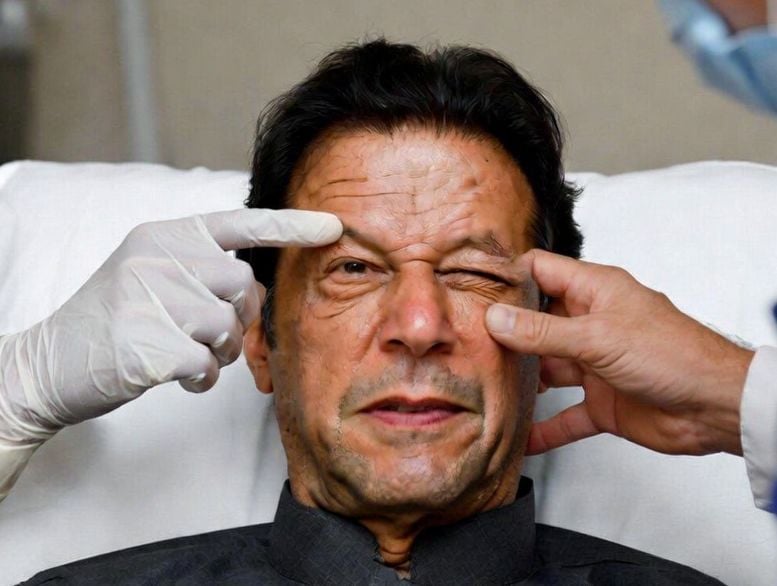
ISLAMABAD: The Supreme Court of Pakistan on Thursday directed the formation of a specialized medical team to examine former prime minister and Pakistan Tehreek-e-Insaf (PTI) founder Imran Khan’s right eye, following claims that only 15 per cent vision remains after a recent blood clot-related issue. The bench, headed by Chief Justice Yahya Afridi and comprising Justice Shahid Bilal Hassan, emphasized that prisoner health constitutes a paramount concern requiring immediate state intervention. The order mandates the examination, along with permission for phone conversations with his children, to be completed before February 16. This development arises from ongoing scrutiny of Imran Khan’s confinement conditions in Rawalpindi’s Adiala Jail, where he has been incarcerated since August 2023 on multiple convictions.
The directive stems from a report submitted by senior lawyer Salman Safdar, appointed as amicus curiae by the court to assess Imran Khan’s living environment. In the seven-page document, Safdar quoted the PTI founder stating that despite medical intervention—including an injection at the Pakistan Institute of Medical Sciences (PIMS) in Islamabad on January 24—he retained merely 15 per cent vision in his right eye due to severe damage from a diagnosed retinal blood clot. The procedure, initially unconfirmed to family members, prompted renewed allegations from PTI circles about inadequate and delayed care, heightening public and judicial attention toward prison medical protocols for high-profile inmates.
Chief Justice Afridi underscored the gravity of the situation during the hearing, observing that Imran Khan’s health represents the most critical aspect of the case. He sought clarification on the government’s position regarding medical provisions for prisoners, to which Attorney General for Pakistan Mansoor Usman Awan responded affirmatively. The AGP assured the bench that the state bears full responsibility for delivering appropriate healthcare, adding that if any dissatisfaction persists on the prisoner’s part, corrective measures would be promptly implemented to uphold constitutional safeguards.
The court further addressed the matter of family communication, noting that Imran Khan’s requests for telephone contact with his sons, Qasim and Sulaiman, hold significant importance. CJP Afridi expressed confidence in the government’s willingness to facilitate such interactions, framing them as essential for maintaining humane treatment standards. While the bench rejected certain ancillary pleas—such as family presence during the medical examination—it prioritized verifiable medical assessment and limited familial access as immediate remedies within the jail framework.
Background context reveals that Imran Khan underwent treatment for central retinal vein occlusion at PIMS, confirmed through official reports shared with authorities and partially with family. Earlier examinations at Adiala Jail included detailed procedures like slit-lamp evaluation, fundoscopy, intraocular pressure checks, laboratory tests, and optical coherence tomography. Despite these steps, the PTI founder expressed dissatisfaction with the overall facilities and outcomes, fueling debates on equitable medical access for incarcerated individuals regardless of status.
The hearing also touched upon broader living conditions in Adiala Jail, including amenities provided to Imran Khan. Reports indicate access to basic necessities, reading materials, and routine medical monitoring, yet concerns persist about isolation and psychological pressures amid prolonged detention. The Supreme Court’s intervention reflects a commitment to judicial oversight in ensuring that fundamental rights—particularly health and family ties—are not compromised during imprisonment.
Legal observers note that this order aligns with precedents emphasizing state accountability in prisoner welfare cases. By setting a strict deadline of February 16 for compliance, the bench aims to prevent potential irreversible harm, especially concerning vision loss risks highlighted in medical narratives. The decision reserves judgment on related matters, including aspects of the Toshakhana case, signaling that health considerations may influence future proceedings.
PTI representatives welcomed the ruling as validation of longstanding grievances about Imran Khan’s treatment, calling for independent physician involvement. Government sources, meanwhile, reiterated commitments to transparent healthcare delivery, positioning the directives as routine enforcement of jail rules rather than exceptional concessions.
This case continues to draw national attention, intersecting judicial authority, political dynamics, and human rights discourse in Pakistan’s evolving legal landscape.