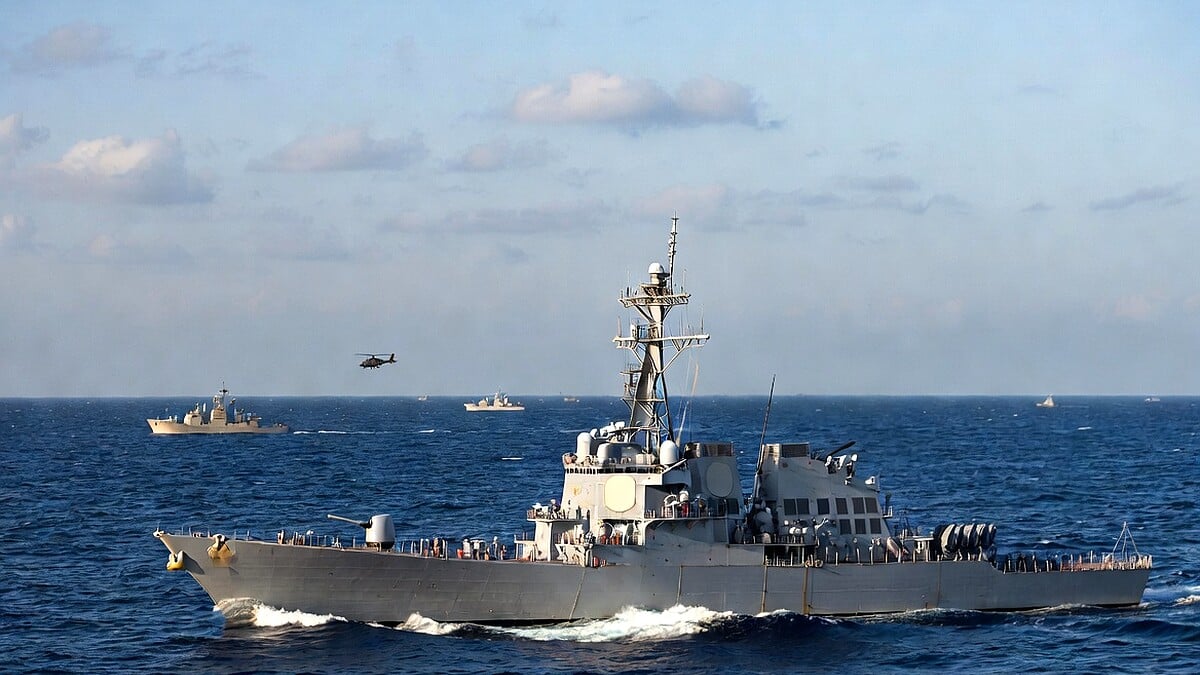




ISLAMABAD: A United States Navy destroyer sailing toward the Strait of Hormuz was forced to change course after receiving a direct warning from Iranian forces that it would be targeted within 30 minutes if it continued its approach.
Iranian state media reported the incident as a clear demonstration of Tehran’s control over the critical chokepoint. PressTV cited sources claiming the warship altered direction immediately following the ultimatum.
The development highlights persistent friction between US and Iranian naval forces even as broader ceasefire discussions unfold in the region. The Strait of Hormuz carries approximately 20 percent of global oil trade, making any disruption a matter of international economic concern.
A separate security official briefed Tasnim news agency dismissed an Axios report suggesting US Navy ships had successfully passed through the strait. The Iranian official described the American claim as inaccurate and inconsistent with on-ground realities.
Axios had reported, citing an anonymous US official, that several warships traveled westward toward the Gulf but later returned through the strait to the Arabian Sea. The story emphasized the transit was not coordinated with Iran and served to assert freedom of navigation.
This indirect acknowledgment appeared to align with elements of the PressTV account, underscoring a tense back-and-forth between the two sides. The episode comes shortly after a US official admitted that American vessels had avoided the area due to perceived intimidation by Iranian capabilities.
President Donald Trump declared on Saturday that the United States was initiating steps to clear sea mines from the strait for the benefit of international shipping. His statement reflected ongoing American determination to restore unrestricted passage despite reported Iranian mine-laying activities earlier in the conflict.
The Strait of Hormuz measures roughly 21 nautical miles at its narrowest point, creating a natural vulnerability for large vessels. Data from maritime tracking indicates that daily oil flows through the waterway normally exceed 20 million barrels, equivalent to significant portions of global energy supply.
During recent escalations in the 2026 Iran conflict, Iran closed or severely restricted the strait in response to strikes, causing sharp spikes in global oil prices and supply chain disruptions. US Central Command previously reported destroying multiple Iranian mine-laying vessels and degrading anti-ship missile sites to mitigate threats.
Regional reports from Iranian outlets portrayed the destroyer incident as evidence of effective deterrence without direct engagement. International coverage remained limited on this specific turning-back event, with Western outlets focusing more broadly on ceasefire negotiations tied to reopening the strait.
White House officials have linked any potential ceasefire to Iran allowing free navigation, while Iranian authorities have maintained that passage remains subject to their oversight in territorial waters. The back-channel talks, including messages relayed through mediators, reportedly involve conditions on mine clearance and cessation of attacks on commercial shipping.
Earlier this week, shipping industry sources noted continued reluctance among insurers to cover vessels transiting the area, citing residual risks from mines and fast-attack craft. Traffic data showed only limited smaller cargo movements, with major tankers largely avoiding the route pending clearer security assurances.
The US Navy maintains a substantial presence in the broader Arabian Sea and Gulf of Oman but has faced challenges in escort operations due to the density of threats in the confined strait. Analysts estimate that full mine clearance could require weeks or months, depending on the accuracy of deployment records.
Trump’s recent remarks on clearing the waterway underscored American willingness to act unilaterally if necessary, even as allies showed limited enthusiasm for joint naval coalitions. Several European and Asian partners declined direct warship commitments, citing high operational risks.
The incident involving the US destroyer adds to a pattern of close encounters that test the boundaries of freedom of navigation principles. Iranian forces have historically used speedboats, helicopters, and coastal radars to monitor and challenge foreign military vessels approaching sensitive zones.
Global energy markets remain sensitive to any flare-up near Hormuz. A single sustained closure could add billions to daily energy costs worldwide and exacerbate inflationary pressures in import-dependent economies.
Diplomatic efforts continue in parallel with military posturing. Reports indicate ongoing indirect communications aimed at de-escalating naval tensions while addressing core demands from both sides regarding the strait’s status.
Pakistan, as a close regional observer with stakes in Gulf stability, monitors these developments closely given their potential impact on energy imports and maritime security in the Indian Ocean.
The latest faceoff serves as a reminder of the fragile balance in one of the world’s most vital maritime arteries. Further incidents risk complicating ceasefire prospects and prolonging economic uncertainties tied to energy flows.